Google Doodle celebrates physicist Max Born

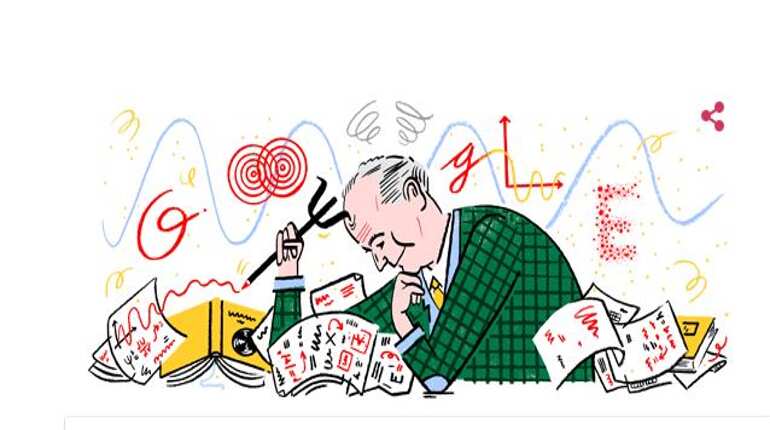
Google Doodle
Max Born was a German physicist and mathematician who was instrumental in the development of quantum mechanics.
Google is celebrating the German physicist and mathematician Max Born on his 135th birth anniversary with a doodle created by guest artist Kati Szilagyi. In the doodle, Born is seen writing using a pen that resembles the symbol psi, which is also the symbol for wave function in physics.
Max Born was a German physicist and mathematician who was instrumental in the development of quantum mechanics. Born won the 1954 Nobel Prize in Physics for his "fundamental research in Quantum Mechanics, especially in the statistical interpretation of the wave function".
Born entered the University of Göttingen in 1904, where he found the three renowned mathematicians, Felix Klein, David Hilbert and Hermann Minkowski. He wrote his Ph.D. thesis on the subject of "Stability of Elastica in a Plane and Space", winning the University's Philosophy Faculty Prize. In 1905, he began researching special relativity with Minkowski, and subsequently wrote his habilitation thesis on the Thomson model of the atom. A chance meeting with Fritz Haber in Berlin in 1918 led to the discussion of the manner in which an ionic compound is formed when a metal reacts with a halogen, which is today known as the Born–Haber cycle.
In the First World War, after originally being placed as a radio operator, he was moved to research duties regarding sound ranging due to his specialist knowledge. In 1921, Born returned to Göttingen, arranging another chair for his long-time friend and colleague James Franck. Under Born, Göttingen became one of the world's foremost centres for physics.
In January 1933, the Nazi Party came to power in Germany, and Born, who was Jewish, was suspended. He emigrated to the United Kingdom, where he took a job at St John's College, Cambridge, and wrote a popular science book, The Restless Universe, as well as Atomic Physics, which soon became a standard textbook. In October 1936, he became the Tait Professor of Natural Philosophy at the University of Edinburgh, where, working with German-born assistants E. Walter Kellermann and Klaus Fuchs, he continued his research into physics. Born became a naturalised British subject on 31 August 1939, one day before World War II broke out in Europe. He remained at Edinburgh until 1952. He retired to Bad Pyrmont, in West Germany, and died in hospital in Göttingen on 5 January 1970.