Asia shares sink to four-month low, yen a safe harbour

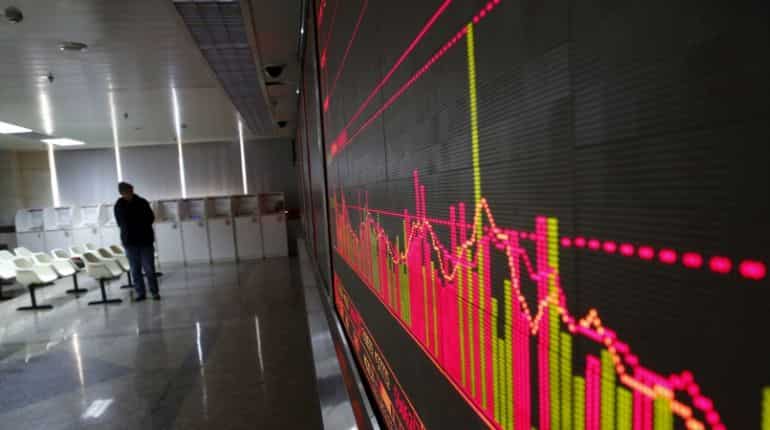
Beijing stocks
Asiansharescarved out afour-monthtrough on Thursday amid worries the Sino-US trade conflict was fast morphing into a technology cold war between the world's two largest economies.
Late Wednesday, Reuters reported the USadministration was considering Huawei-like sanctions on Chinese video surveillance firm Hikvision over the country's treatment of its Uighur Muslim minority, according to a person briefed on the matter.
After the United States placed Huawei Technologies on a trade blacklist last week, British chip designer ARM has halted relations with Huawei in order to comply with the blockade.

"For China, the key risk is that the combined effects of investment restrictions, export controls, and tariffs will rewire supply chains and weaken manufacturing investment, particularly in the technology sectors driving growth," ratings agency S&P warned in a special report.
Shanghai blue chips shed 1.5% in response to be near theirlowest since February. MSCI's broadest index ofAsia-Pacific shares outside Japan slid 0.9% to reach itslowest infourmonths.
Japan's Nikkei lost 1%, while South Korea shed 0.7%. Also feeling the pain, E-Mini futures for the S&P 500 dropped 0.5%.
Minutes of the US Federal Reserve's last meeting out on Wednesday underlined its readiness to be patient on policy "for some time" given the uncertainglobaloutlook.
The chance of a rate cut seemed to diminish as many Fed policymakers saw recent weakness in inflation as "transitory", though the latest escalation in the trade war meansmarketsare still wagering on an eventual easing.
Yields on two-year Treasuries of 2.237% are also well belowthe current effective fund's rate at 2.39%.
There remains no end in sight to the trade dispute. Treasury Secretary Steven Mnuchin on Wednesday said it would be at least a month before the USwould enact proposed tariffs on $300 billion in Chinese imports as it studies the impact on American consumers.
The mood on Wall Street was cautious with the Dow ending Wednesday down 0.39%, while the S&P 500 lost 0.28% and the Nasdaq 0.45%.
Sharesin chipmaker Qualcomm Inc dived 10.9% after a federal judge ruled the company illegally suppressed competition in the market for smartphone chips by threatening to cut off supplies and extracting excessive licensing fees.
MORE BREXIT CHAOS
In currencies, constant trade friction saw thesafehavenyenin demand again as the dollar dipped to 110.20yenand away from the week's top of 110.67.
The dollar fared better on the euro at $1.1151 and was steady on a basket of currencies at 98.111.
Sterling was the main mover, sliding to afour-monthlowat $1.2625 before steadying at $1.2651 inAsia.
British Prime Minister Theresa May came under intense pressure after her latest Brexit gambit backfired and fuelled calls for her to quit.
Prominent Brexit supporter Andrea Leadsom resigned from the government on Wednesday and British media reported May could announce her departure date as early as Friday.
"Uncertainty is the only clear certainty in the near term," said Westpac macro strategist Tim Riddell.
"The risk of a hard-Brexit replacement for May has increased the risks of a hard Brexit result or even a forced no-deal exit," he added. "Such an event would likely force GBPlower, increase risks of assets sliding and BOE (Bank of England) taking counteraction to support assets."
In commoditymarkets, spot gold edged up a touch to $1,274.10 per ounce.
Oil prices added to losses suffered overnight after an unexpected build in the UScrude inventories compounded investor worries about demand.
The UScrude was last down 44 cents at $60.98 a barrel, while Brent crude futures lost 45 cents to $70.54.