Fueled by cash, health care and Trump’s woes, Democrats aim for Senate control

Democratic Party Senate
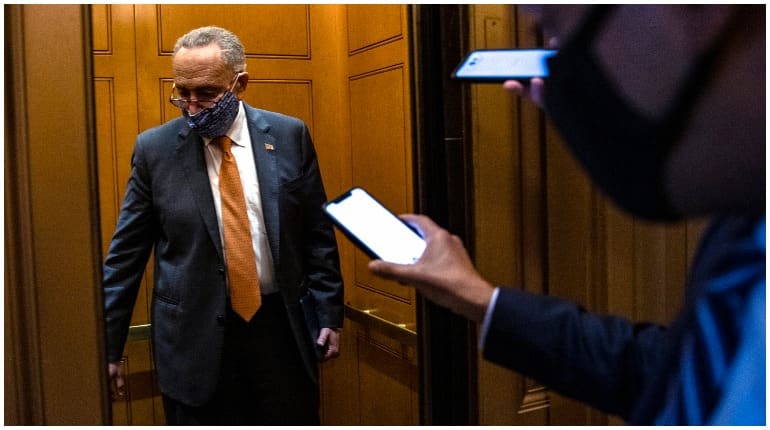
Voters caught up in this state’s exceedingly close Senate race could be forgiven for believing Gov. Steve Bullock, the Democratic candidate, was sharing the ballot with Sen. Chuck Schumer of New York, the minority leader.
An incessant stream of Republican-funded advertisements depicts Bullock, a popular two-term governor, alongside Schumer and other leading Democrats such as Speaker Nancy Pelosi. Sen. Steve Daines, the Republican incumbent battling for political survival in the conservative-leaning state, regularly tries to tie his opponent to the national party, asserting that Bullock is Schumer’s “lap dog.”
“Steve Bullock in the Senate puts Chuck Schumer in charge,” the latest ad from the National Republican Senatorial Committee said. “Think about that.”
Bullock doesn’t think much about it.
“I say it is all B.S.,” he said in an interview as snow descended upon Montana and shut down campaign appearances already curtailed by the coronavirus, which has hung over the election season and was surging anew in the Mountain West. “Montanans see through some of the stuff where they are trying to turn me into something they don’t recognize.”
But while the governor resented the ad’s implication, in one respect it was absolutely true: If Bullock is elected to the Senate, Schumer will almost certainly be in charge as the majority leader.
Here in Montana and in crucial battleground states across the country, Republicans are playing defense in a struggle for control of the Senate. Dragged by President Donald Trump’s struggles even in conservative states and confronting a phalanx of Democratic opponents who have raked in extraordinary sums of cash to challenge them, Republicans privately acknowledge that their majority is hanging by a thread.
The Montana race, described by strategists for both parties as a coin flip, is one of a handful of contests that will determine control of the Senate and the ability of the next president to pursue his agenda, fill a cabinet and win the judicial confirmations suddenly at the forefront of the nation’s political dialogue. Democrats have other narrow paths to Senate power, but a Bullock victory would essentially assure it and signal Democratic gains elsewhere.
As the race entered its final days, Republicans led by Mitch McConnell, the majority leader, were being forced to shore up candidates in traditionally safe locations such as Alaska, Kansas and South Carolina. Democrats believe they are already on track to win Arizona and Colorado and are on the hunt for a half-dozen others starting with Iowa, Maine and North Carolina. Georgia is suddenly looming as a real opportunity for Democrats, with both of the state’s Republican senators at risk.
Democrats conceded they were likely to lose in Alabama, where Sen. Doug Jones is running for reelection after an upset victory in a special election in 2017, and are keeping a close watch on Michigan, where Sen. Gary Peters is facing John James, a Republican who was receiving a last-minute surge of outside money. But they were eyeing significant pickups elsewhere.
With Republicans holding the Senate majority by a margin of 53-47, a net gain of three seats would put Democrats in control should former Vice President Joe Biden win the presidency; four would be required if Trump is reelected.
Schumer called the battle for the Senate a “nail-biter,” but said the outlook for Democrats was far brighter than it was only a few months ago.
“If you would have told me in early January that we would have a good chance of winning the Senate, I would have said that is a real long shot,” he said in an interview. “Now we are in the ballpark because of the strategic decision to expand the seats that are in play.”
Republicans quietly agree that their prospects have dimmed considerably. One Senate Republican leader said privately that the party could end up with anywhere from 47 to 52 seats.
“It is a 50-50 proposition,” said McConnell, R-Ky., who appears to be safely headed toward reelection himself, about his chances for remaining majority leader. “We have a lot of exposure. It is a dogfight out there.”
Republicans are battling the brawl from a weakened position, given Trump’s woes and the record-crushing levels of money Democrats have raised for Senate races. Democratic challengers have flipped the usual formula on its head and outperformed Republican incumbents when it comes to contributions, providing ample resources for TV advertising even as the traditional campaign model has been upended by the pandemic.
Here in Montana, at least an estimated $120 million will be spent, while in Maine, more than $100 million is being poured into the showdown between Sen. Susan Collins, a Republican seeking a fifth term, and Sara Gideon, the Democratic speaker of the state House. The race in North Carolina, where Sen. Thom Tillis, a Republican, is trying to hold on against Cal Cunningham, a Democrat, is set to be the most expensive Senate contest ever, with well over $200 million expended.
While Democratic candidates are still outspending Republicans in most of the marquee races during the final weeks, the Senate Leadership Fund, a super PAC affiliated with McConnell, has dumped more than $82 million into the effort since early October, helping close a money gap Republicans attribute to the success of online small-donor Democratic fundraising.
“We are being outspent dramatically, like so many other races around the country,” said Sen. John Cornyn, a three-term Texas Republican who finds himself in an unexpectedly tough match against M.J. Hegar, a Democrat and veteran. “We have been a little late to the dance and I think we are going to have to learn from the way Democrats raise money. It is no longer like going to a dinner and a cocktail party.”
The fact that Cornyn finds himself sweating is testament to how Democrats have opened multiple potential routes to a Senate majority while Republicans have failed to put their usual strongholds out of reach. Democrats have been unable to put away Collins, whom they saw as exceptionally vulnerable after her vote in 2018 to confirm Judge Brett Kavanaugh to the Supreme Court. But Republicans now worry the voting system in Maine — in which voters’ second-choice candidate is counted if no candidate earns 50% — could cost her on Tuesday.
Democrats have focused relentlessly on health care in their campaigns, scorching Republicans for their yearslong drive to overturn the Affordable Care Act and its protections for preexisting conditions. The power of the message has been amplified by the pandemic and public anxiety about health costs. Republicans have pushed back with pledges to guarantee coverage but have not produced specifics on how they would do so.
The challenge for Democrats is that to win the Senate, they must prevail in states Trump carried in 2016 and is likely to carry again this year such as Iowa and Montana, though Biden victories in places like Arizona and North Carolina would make their task easier.