Friend-turned-foe: How 2023 saw the emergence of Xi’s biggest nemesis - Bongbong Marcos

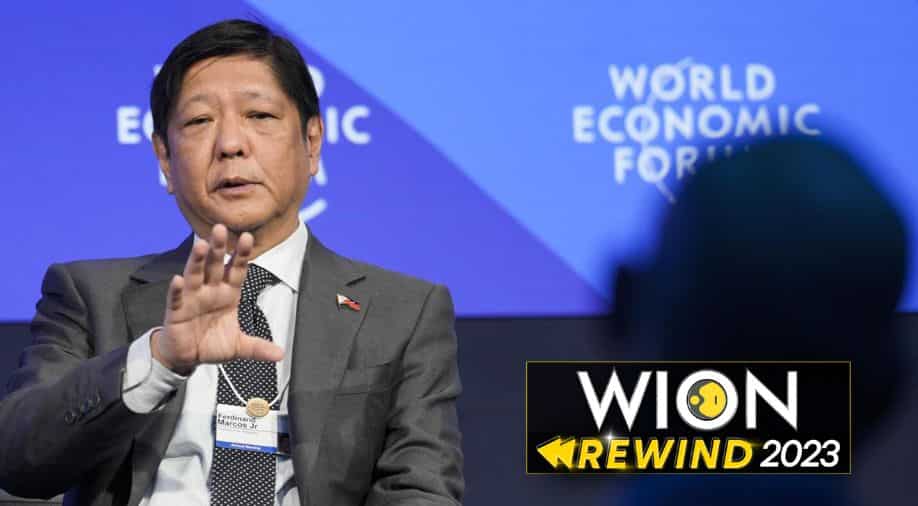
Ferdinand "Bongbong" Marcos Jr, Philippine president
The victory of Ferdinand "Bongbong" Marcos Jr in the May 2022 Philippine presidential elections came as a rude shock for the West and a bonanza for China.
The son and namesake of the late Philippine dictator had long been projected as pro-China and anti-US by the Western media.
“Why the Philippines election could be a win for China,” opined CNN in a lengthy editorial.
But the year 2023 turned the tables upside down.
Marcos turned out to be Chinese leader Xi Jinping’s biggest and boldest nemesis, especially about his nation’s righteous claim over parts of the South China Sea that China has increasingly and aggressively disputed over the past 10 months.
Let’s have a look at key events of 2023 that largely shaped the ties between China and the Philippines.
January 2023: Marcos visits Beijing
The year started on a positive note for the bilateral ties.
In his first foreign visit outside Southeast Asia, Macros arrived in Beijing in January to reaffirm Manila’s commitment towards continuing his predecessor Rodrigo Duterte’s pro-China policy.
The visit was hailed as successful by the Bongbong administration, with Manila having struck three major following deals with Beijing:
1) Investment pledges worth $22 billion
2) Compromise over “South China Sea disputes”
3) A new emergency hotline between maritime officers of the two countries
February 2023: Xi’s stab in the back
In an awful surprise within weeks of his trip to Beijing, Marcos on February 6 received the news of China shining a “military grade” laser at a Filipino coast guard boat.
The vessel was on a resupply mission to a marooned navy vessel that Manila has used for years to claim the Second Thomas Shoal in the South China Sea.
The laser was so powerful that not only it temporarily blinded the crew of the boat but it also led Marcos to open his eyes to China’s dangerous designs in the Philippines waters.
The incident infuriated the Philippine president like never before.
For the first time in over a decade, a Chinese ambassador was summoned by Manila and given a strongly worded public complaint.
“I thought … the Philippines was the friend of China,” was all Chinese envoy Huang Xilian could say to the Philippine president.
August 2023: When China ‘snapped’ the hotline
After months of tense encounters, a major Chinese incursion took place in one morning of August. A Chinese coast guard ship bore down on a Philippine coast guard vessel and fired at it with water cannons.
When the Philippine officials tried to contact their Chinese counterparts through the newly established emergency hotline, they found themselves completely ghosted.
Their calls were answered only after a long wait of six hours.
September 2023: Manila fires back
After months of Chinese harassment, Manila chose to return the favour in September.
China had installed a floating, 300-metre-long barrier in the West Philippine Sea, much to Marcos’s chagrin.
He ordered the coast guard to cut the barrier, bring its anchor back to Manila and then went on to publicly humiliate China by displaying it at a news conference, calling it a “souvenir”.
The move left Beijing red-faced and observers stunned.
November 2022: BRI bulldozed
In November, the Philippines became the latest country to bid adieu to China’s ambitious Belt and Road Initiative.
And Marcos’s move couldn’t be more well-timed.
It came just days after Xi Jinping hosted leaders of 23 countries for the Belt and Road Forum in Beijing to breathe fresh life into the ambitious infrastructure plan, which has begun to fall apart already.
December 2022: When China crossed the red line
Marcos declared in December that the ties with China were heading in a ‘poor direction’ after its coast guard blasted a boat carrying the Philippine military chief with a water cannon.
The standoff continued for two consecutive days.
Watch:Philippines installs Japan-made air radars amid tensions with China
Manila even considered expelling the Chinese ambassador after the military chief was harassed.
Foreign ministry spokesperson Teresita Daza said in a press conference on Dec 11 that declaring China’s ambassador Huang Xilian as “persona non grata” in the Philippines was also “something that has to be seriously considered.”
The Philippines turns to democratic allies
The country is now stepping up efforts to bolster its ties with democratic partners like the US, the EU, Japan, India and South Korea.
“We have to come up with a paradigm shift,” Marcos declared in Tokyo during a Japan-ASEAN summit earlier this month.
There is also an indication that the Marcos Jr. administration might look to sign the reciprocal access agreement (RAA) with Japan as soon as next year.
Filipino National Security Council (NSC) Director General Jonathan Malaya said both Manila and Tokyo wish to sign the agreement as soon as possible since it will significantly increase their marine cooperation.
The US and UK have also condemned recent Chinese aggression, with Washington DC categorically asserting its ironclad commitment to the Southeast Asian country and pledging to defend it against potential Chinese invasion.
The year 2023 will go down in history as a major turning point for the China-Philippines ties.
Xi’s handling of China’s ties with its neighbours is increasingly laying bare the desperation of his regime to score geopolitical points overseas, amidst a gloomy outlook at home.
(With inputs from agencies)