Explained | Where is Sahel region exactly and what's the trouble there

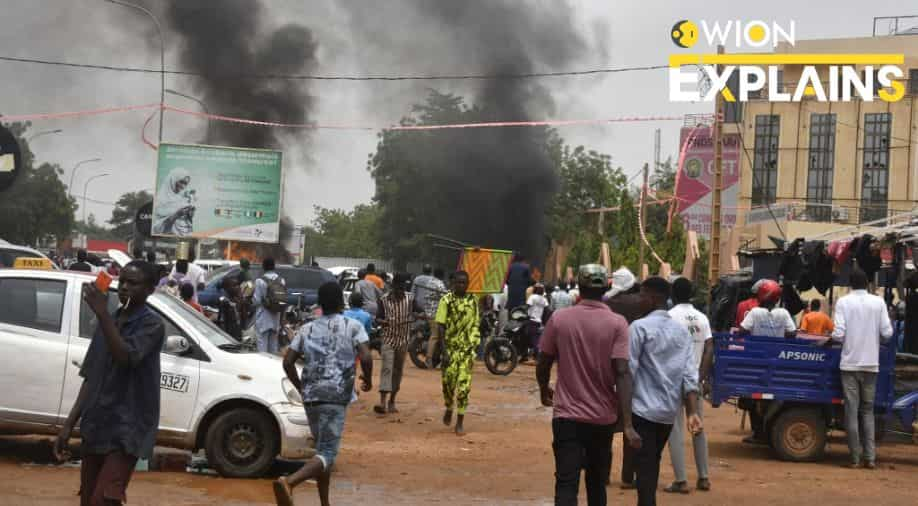
Sahel explainer
Africa is often dubbed the crucible of life. Scientists say that first humans evolved here and then spread to different parts of the world. Given its central importance in the birth and development of humankind, the continent should have been one of the most important regions in the world. But colonialism, fighting between African nations, big power politics and exploitation of its natural resources have made it one of the poorest regions in the world. The conflicts and geopolitical realities in Africa still assume a certain secondary position when it comes to global news.
But recent military coups, jihadist insurgency and more have compelled everyone to focus their gaze on the African continent, particularly on the Sahel region.
Where exactly is Sahel?

(Source: Wikimedia Commons)
The word Sahel, or Sahil in Arabic means coast or shore. Sahel is the vast region that stretches from the Atlantic Ocean to the Red Sea along Sahara desert's southern rim. Thus, Sahel region is wedged between Sahara desert in the north and tropical forests and the savannah to the south. This makes climate in the Sahel tropical semi-arid.
Speaking politics
There are several political definitions of the Sahel according towhich the areacomprises12 countries and houses 400 million people.However, countries like Mali, Niger, Burkina Faso, Chad and Mauritania form the core of the Sahel region. This group is also called the G5 Sahel.
Other political definitions include countries like Senegal, Nigeria, Sudan, South Sudan and Eritrea.
So what's the trouble exactly?
The Sahel region has vast stretches of inhospitable terrain. Geographical conditions make it especially difficult to control. Think of Sahel as the African equivalent of Afghanistan in the geographical sense where gaining total control is quite a task. The central Sahel is notoriously difficult to control. A certain power vacuum thus created has made the region a hunting ground for armed groups. The rebels and jihadists who hold sway in a particular swathe of land can roam freely, even ignoring international borders between the countries.
Jihadist violence erupted after a rebellion in northern Mali in 2012. The conflict has since spread to the centre of the country, as well as to neighbouring Burkina Faso and Niger, claiming thousands of lives and displacing more than 3.5 million people.
Several anti-jihadist military operations were launched in Sahel, particularly by France which is a former colonial power in this region. The result of these operations has been mixed.
France's Operation Barkhane was launched in 2014. The aim was to combat and prevent the spread of jihadist groups. The headquarters of the French forces were atN'Djamena, the capital of Chad.
French forces tasted success in earlier Operation Serval during which they gained control of half of Mali from the insurgents. Operation Barkhane was launched to build upon the initial success. The scope of the operation was expanded to the Sahel region rather than just Mali.
A coup in Mali in 2021 proved to be disruptive to French operations. The military junta ruling Mali was against French presence. French President Emmanuel Macron announced in June 2021 that France will pull out its troops in a phased manner. In November 2022, Macron announced that Operation Barkhane had formally ended.
Opposition to the French presence in the Sahel is often said to be one of the main reasons for the failure of French operations. France is often described as a 'waning power' in Africa. It has also been seen that Russia has opposed French forces in Africa through its proxies.
Effects of Climate Change
Countries in the Sahel region have a large percentage of the population under the poverty line. To add to the people's hardships, global warming is around 50 per cent greater in the Sahel. The region has suffered the worst drought anywhere on the planet.
All of these factors have resulted in devastating consequences. There has been a staggering 90 per cent decline in the surface of Lake Chad in the past 40 years. Efforts are being taken to stop the loss of the main source of fresh water to 40 million people across four countries.
Why is Sahel in news now?
In 2020, United Nations Secretary-General Antonio Guterres described the Sahel as a "microcosm of cascading global risks converging in one region."
The region, which has been a stage for conflict between big global powers, has seen three coups in three countries in a span of three years.
In 2021, the Malian coup took place just months after a previous military takeover. In 2021, the Malian Army, led by Vice President Assimi Goita, captured President Bah N'daw along with Prime Minister Moctar Ouane. Goita announced that both, N'daw and Ouane were stripped of power.
A coup in another Sahel country, Burkina Faso followed in 2022. In the month of January, the Burkina Faso military deposed President Roch Marc Christian Kabore. The coup was led by military officer Paul-Henri Sandaogo Damiba.
Now, the president of another Sahel country was detained by the military. Deposing Niger President Mohamed Bazoum, presidential guard commander General Abdourahamane Tchiani declared himself the leader of a new military junta.
In a sign that the situation in the region was deteriorating, on August 1military juntas in Mali and Burkina Faso declared that any plan to intervene militarily in Niger would be construed as a 'declaration of war' against both countries. Mali and Burkina Faso said this in a joint statement.
You can now write for wionews.com and be a part of the community. Share your stories and opinions with us here.
WATCH WION LIVE HERE