Explained: How the row over Katchatheevu island between India and Sri Lanka was diffused and revived

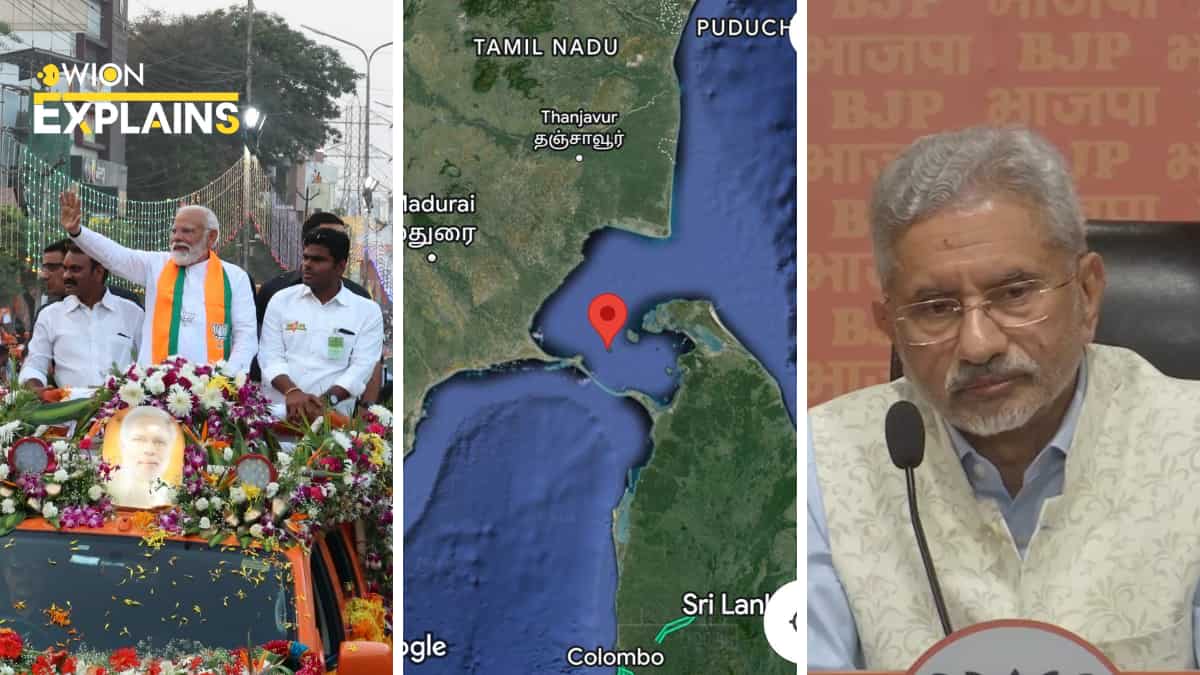
Katchatheevu island row: Ramnad zamindari of Ramanathapuram controlled the island
Prime Minister Narendra Modi's attack on Congress party over former prime minister Indira Gandhi's decision to "callously give away" the island of Katchatheevu has revived the discourse over the way the 285-acre uninhabited island's ownership changed hands.
The development came after Tamil Nadu chief of the ruling Bharatiya Janata Party, K Annamalai, filed aRight To Information application and obtained crucial information related to how the 285-acre island came to be administered by Sri Lanka.
Prime Minister Narendra Modi later reacted on a report related to the row, and it immediately turned into a political issue in the ongoing election summer.
Katchatheevu island: Where is it located?
Katchatheevu is a 285-acre uninhabited island in the Palk Strait, between India and Sri Lanka. It is no more than 1.6 km in length and slightly over 300 m wide at its broadest point, according to the Indian Express.
Katchatheevu is about 33 km from the Indian coast and is some 62 km southwest of Jaffna, at the northern tip of Sri Lanka, and 24 km away from Sri Lanka's inhabited Delft Island.
The island is relatively new on the geological timescale. It appeared on Earth as one of the results of a 14-century volcanic eruption.
Who controlled Katchatheevu?
The island was controlled by the Jaffna kingdom of Sri Lanka in the early medieval period. In the 17th century, Ramnad zamindari based out of Tamil Nadu's Ramanathapuram came to control the island.
The island became part of the Madras Presidency during British Raj.
But its control remained a matter of contention due to fishing rights that came with the ownership of this island.
A colonial survey marked Katchatheevu in Sri Lanka. But the British challenged this citing the ownership of the island by the Ramnad kingdom.
This dispute was not settled until 1974.
In 1974, India and Sri Lanka signed the ‘Indo-Sri Lankan Maritime agreement’.
An annual report of Ministry of External Affairs for 1974-75 says: "The long outstanding problem of Kachchativu was amicably settled on 28 June 1974, with the conclusion of the agreement between India and Sri Lanka on the boundary in the historic waters between the two countries and related matters. The Agreement sets out the geographical co-ordinates of the points constituting the boundary in the historic waters between the two countries and sets at rest a longstanding controversy with the neighbouring country regarding the island of Kachchativu."
"Although the island of Kachchativu falls on the side of the boundary of Sri Lanka and will belong to Sri Lanka, the Agreement safeguards the rights of Indian pilgrims and fishermen who would be entitled to visit the island in the same manner as they were doing before this Agreement came into force. No travel documents or visas will be required by them to visit this island. The Agreement also provides that the vessels of both countries will enjoy in each other's waters such rights as they have traditionally enjoyed therein."
The pilgrims herein refer to the Indian Catholics who annual visit an early 20th century Catholic shrine, the only inhabited structure on the island, the St Anthony church. In 2023, 2500 Indians made the journey to Katchatheevu from Rameswaram for an annual service at the Church.
Another agreement was signed in 1976, during the period of Emergency in the country. This agreement barred either country from fishing in each other's Exclusive Economic Zone (EEZ).
Katchatheevu is located at the edge of the EEZs of either country. This continues to keep the nature of waters around it uncertain in relation to the fishing rights.
Fishing rights of Indian fishermen and Katchatheevu
It is in relation to the fishing rights of Indian fishermen that Katchatheevu features repeatedly in Tamil Nadu politics with regular correspondence between state government in Chennai and central government in New Delhi.
Addressing a press conference in New Delhi, External Affairs Minister Dr S. Jaishankar said, "In the last 20 years, 6,184 Indian fishermen have been detained by Sri Lanka and 1,175 Indian fishing vessels have been seized, detained, or apprehended by Sri Lanka. This is the background of the issue."
Jaishankar called it a "live issue" and not something that surfaced "suddenly".
"The then CM of Tamil Nadu has written to me numerous times. And my record shows that to the current CM, I have replied 21 times on this issue. This is not an issue that has suddenly surfaced. This is a live issue."
"It is an issue that has been very much debated in parliament and in Tamil Nadu circles. It has been the subject of correspondence between the union government and the state government."
The row has become very much political, with Tamil Nadu's Dravida Munnetra Kazhagam (DMK) party chief MK Stalin saying it's the BJP's 'diversionary' tactic.
Congress leader P Chidambaram questioned why Prime Minister Modi is raising an issue which was settled in 1974.
"Why is the PM raking up an issue that was settled in 1974? In 1974, the Indira Gandhi government, in order to help lakhs of Tamils, negotiated with Sri Lanka. Katchatheevu island was acknowledged as belonging to Sri Lanka. In return, 6 lakhs Tamils were allowed to come to India. The issue was closed 50 years ago," P Chidambaram claimed.
Referring to India's standoff in 2020 in Ladakh, he claimed Chinese troops are occupying Indian territory.
"2,000 sq km of Indian territory has been occupied by Chinese troops. The PM says no Chinese troops are present in Indian territory and no part of Indian territory is in occupation of Chinese troops. You gave a clean chit to China. He should talk about what has happened in the last 3 years instead of what happened 50 years ago. Chinese occupation is aggression. I would request the PM to speak about that," he said.
(With inputs from agencies)