Explained | Hamas' mysterious tunnels in Gaza that pose challenge for Israel

Israel-Hamas war
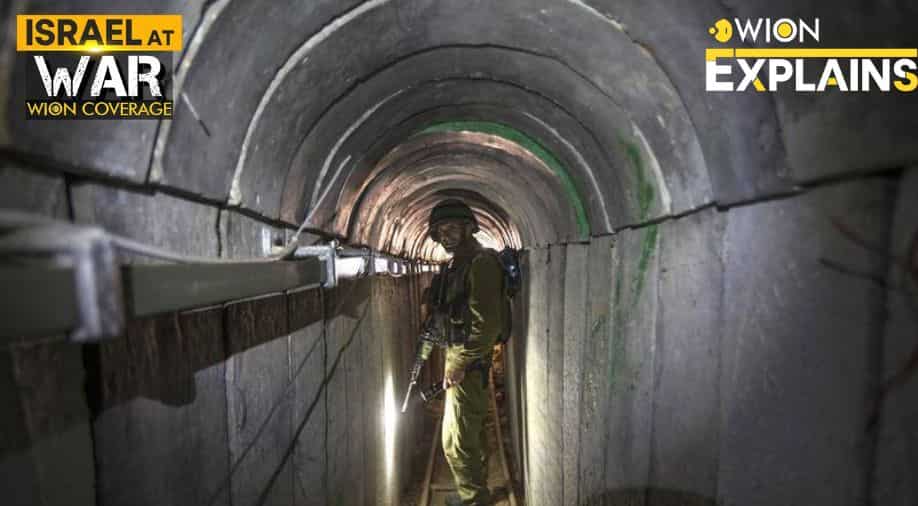
On the sixth day of the ever-escalating Israel-Hamas war, Israel Defense Forces (IDF) said that, apart from bombarding the Gaza Strip, they have been striking parts of secret tunnels that have been built by Hamas in the embattled zone.
These passageways have been a mystery forever with nothing to very little known about it in the outside world. Israel has raised the issue of Hamas operating these labyrinth of tunnels under Gaza repeatedly using it either to smuggle weapons, fighters or other contraband.
"Think of the Gaza Strip as one layer for civilians and then another layer for Hamas. We are trying to get to that second layer that Hamas has built," said an Israel Defense Forces (IDF) spokesperson in a video, released on Thursday (Oct 12).
"These aren't bunkers for Gazan civilians. It's only for Hamas and other terrorists so that they can continue to fire rockets at Israel, to plan operations, to launch terrorists into Israel," they added.
As Israel plans a ground offensive in Gaza, the experts hint that an extensive network of tunnels under Gaza may pose as one of the biggest challenges to the Israeli army in the densely populated region.
History of the 'Gaza Metro' tunnel system
Since the 1980s, the tunnels have been a part of the life of Gazans, however, its importance increased after Hamas removed Fatah from the seat of power and subsequently severe restrictions were placed on the movement of goods and people by Israel and Egypt on the territory.
Before the Gaza Strip came under the control of the Hamas, the tunnel labyrinth was being used for smuggling. A few tunnels, which were located across their border with Gaza, were destroyed by Egypt.
However, the tunnels towards Israel were slowly expanded and started being used by Hamas for more sinister goals. Israel dubbed these tunnels as the "Gaza Metro" because they believed it stretched under a territory which was only 41km (25 miles) long and 10km wide.
After a conflict in 2021, the IDF claimed to have launched air strikes on more than 100km of tunnels and destroyed them. However, Hamas in its counterclaims stated that the tunnels stretched only 500km, which meant only 5 per cent of it was hit.
At one time, nearly 2,500 tunnels which were underneath the Egyptian border were being used for smuggling fuels, weapons and commercial goods by other militant groups.
Through time, smuggling did not remain the primary purpose of the tunnel, especially after 2010, when Israel started allowing the import of more goods through its crossings. Later, smuggling was stopped by Egypt by flooding or destroying the tunnels.
Role played by tunnels in terror attacks of Hamas
In 2006, Hamas captured Israeli soldier Gilad Shalid and killed his two colleagues in a cross-border raid, through tunnels. The soldier remained captured by Hamas for two years before he was released under a prisoner exchange deal.
In some years, the Israelis started calling these tunnels as "terror tunnels" and further restricted the entry of construction materials into the Gaza Strip.
A 1.6km-long, 18m-deep tunnel, which had a concrete roof and walls, was discovered by the IDF in 2013. The tunnel, which was found after strange sounds were heard by the residents, ran from the Gaza Strip to land near an Israeli kibbutz.
The year after, Israel emphasised the need to curb the threat of attacks which were being carried out by Hamas militants using such "terror tunnels".
WATCH |A humanitarian crisis unfolds in Gaza | The West Asia Post
Key role of ‘terror tunnels’ in October 7 attacks
The shocking attacks of Hamas which shook Israel last weekend were a combination of simultaneous attacks via water and land and a barrage of rocket strikes.
The border of Israel with Gaza remains fenced and has sensors installed which can detect movement. However, no early warning was issued before a surprise attack was launched by Hamas on civilians.
The experts believe that tunnels may have played an important role in the undetected crossing of Hamas operatives into Israel.
The fence built by Israel on the Gaza border is 30 feet high and has an underground concrete barrier. So, the only way Hamas operatives were able to enter Israel undetected would have been by digging tunnels under the barrier and the fence.
Speaking to the BBC, Reichman University faculty member Dr Daphne Richemond-Barak said that the Gaza Strip has sophisticated tunnels, unlike the rudimentary tunnels over the borders.
"The cross-border tunnels tend to be rudimentary, meaning they have barely any fortification. They are dug for a one-time purpose - invading Israeli territory," she said.
The tunnels inside, Richemond-Barak said are, "equipped for a longer, sustained presence". "The leaders are hiding there, they have command-and-control centres, they use them for transport and lines of communication," she added.
(With inputs from agencies)
You cannow write for wionews.comand be a part of the community. Share your stories and opinions with ushere.
WATCH WION LIVE HERE