Explained | Germany: Five convicted for $123 million Dresden Green Vault jewel heist. Here's what happened

Germany
Five men have been sentenced to several years in prison for their role in what has been dubbed the biggest art heist in modern history by German media, on Tuesday (May 16). The audacious heist made headlines across the world back in 2019 when pieces with an estimated value of over 113 million euros ($123 million) were stolen after a break-in at the Gruenes Gewoelbe (Green Vault) museum in the German city of Dresden.
About the heist
The gang belonging to the notorious criminal network, Berlin’s Remmo family, broke into the historic Green Vault in Dresden in the early hours of November 25, 2019. In what is being described as a meticulously planned heist, the theft was conducted by a gang living in the city of Berlin who have reportedly visited the site multiple times before and had prepared their entry point in advance.
According to the prosecutors, during these visits they had taken apart a section of cast-iron guttering in advance using a hydraulic cutting machine to saw through the bars of a protective window covering before taping them back into place, to get into the building as quickly as possible during the heist.
Furthermore, they have also set fire to a circuit breaker panel near the museum which effectively created a blackout on the surrounding streets of the site when two men slipped inside, the footage released by Saxony Police showed. They quickly move through the gallery using flashlights. Subsequently, one of them uses an axe to break the glass which took at least nine hits.
They went on to steal millions of dollars worth of jewels and then sprayed a foam fire extinguisher over the room to cover their tracks and left the site in an Audi. The car was then dumped in a car park before it was set on fire and took a different vehicle to get to Berlin, reported BBC.
Notably, Berlin’s Remmo family is a notorious organised crime gang of Arab roots known as a “clan” by the German media. Last year, a German court also found them guilty of stealing a giant gold coin which weighed at least 100 kilograms from the German capital city’s Bode Museum in 2017. The coin was never recovered and is said to be either broken up or melted down.
What did they steal?
Among some of the most valuable artefacts stolen from the Green Vault, the gang stole some 4,300 diamonds and other precious stones from 21 diamond-studded items, while the estimated cost was around 113 million euros, some have called these priceless as the vault was home to an astounding collection of historical jewellery and precious ornaments.
Notably, one of the most famous pieces of the collection, a 41-carat green diamond known as the Dresden Green, was not present in the museum at the time as it was loaned to the Metropolitan Museum of Art in New York City.
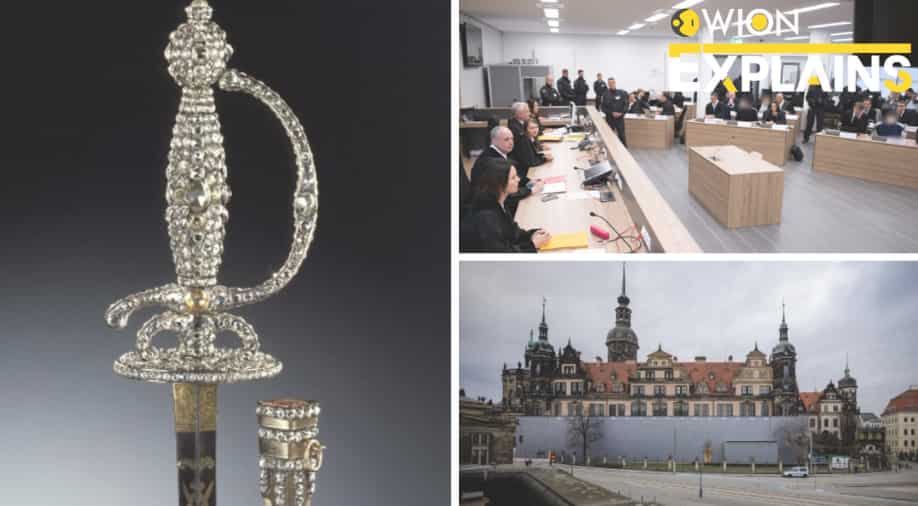
The items stolen also included a 1780s hat clasp decorated with 15 large and more than 100 small diamonds as well as a 96-centimetre sword and a sheath which were decorated with more than 800 diamonds.
What happened in the court?
Out of the six members of the criminal gang, which were suspected to be involved in the heist, five men got convicted. The perpetrators are said to be in their 20s from Germany and were charged with crimes including aggravated arson and dangerous bodily injury, theft with weapons, damage to property, and intentional arson.
Their sentences ranged from four to six years with the highest being against Wissam R, 26, and Rabieh R, 29, who were handed six years and three months and six years and two months prison sentences respectively. While the sixth suspect who had an alibi and pleaded not guilty, was acquitted.
The verdict closes the year-long investigation which had led to their arrests. While a large part of the loot was returned to the museum following a confession from three of the men who agreed to give up the location of the stolen items for a lighter sentence in a deal with the prosecutors, several items remain missing.
Among which was a very rare diamond called the White Stone of Saxony. While the artefacts that were returned were also partly damaged. According to estimators, the damage caused by the break-in alone was more than one million euros ($1,088,660).
The Green Vault
The Gruenes Gewoelbe or Green Vault which is a part of the Royal Palace of Dresden gets its name from the green-coloured columns and green velvet wall coverings present in multiple rooms of the museum and consists of priceless artefacts from shimmering bowls carved out of crystal to jewelled figurines and gilded ostrich eggs.
The treasures were said to have survived bombing raids of World War II only to be carted off to the Soviet Union as spoils of war. During the war, three of the vault’s eight richly decorated exhibition rooms were destroyed in an air raid on the German city in February 1945.
Fortunately, some of the portable exhibits had already been removed and stored at a fortress in the nearby Elbsandstein mountains. The artefacts were then taken by the Red Army Trophy Commission and shipped to the Soviet Union and were returned to Dresden, the historic capital of the state of Saxony, in 1958 after Moscow passed a resolution.
However, due to the damage to the palace parts of the collection returned were on public display in the city’s Albertinum museum. It was not until 50 years or so later that the treasure reclaimed its place in the Royal Palace in 2004.
Chancellor Angela Merkel, in 2006, officially reopened the vault following a multi-million-euro renovation. The director of Dresden’s State Art Collection, Marion Ackermann, as per CNN, said their material value doesn’t even begin to reflect their “incalculable” historical and cultural importance.
The items were amassed by Augustus the Strong, the Elector of Saxony, back in the 18th century, who not only collected the diamond-studded pieces but also designed the Green Vault to display them. As per reports, nearly all the stolen items were forged during the rule of Frederick Augustus III, the last Elector of Saxony who later came to be known as Frederick Augustus I, the first King of Saxony.
(With inputs from agencies)
WATCH WION LIVE HERE
You can now write for wionews.com and be a part of the community. Share your stories and opinions with us here.