Explained: Why catastrophe has rained from the skies in the 11 days of September

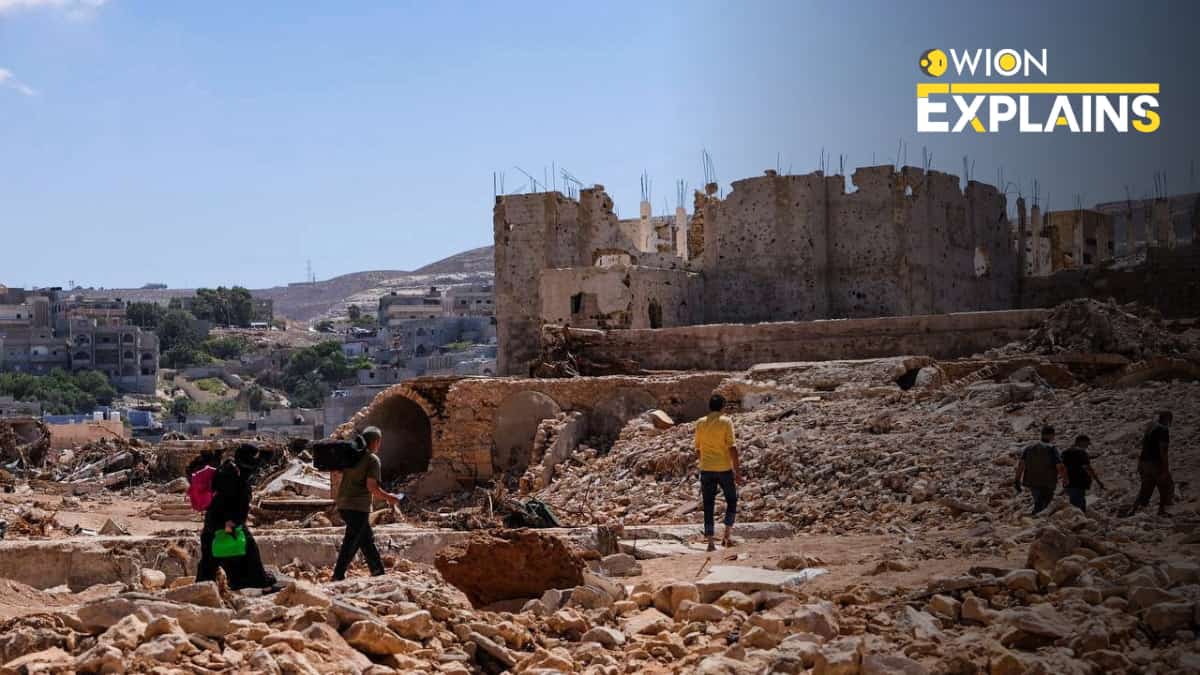
Libya floods
From China to Libya, catastrophic floods have wreaked havoc, killing thousands of people globally. The situation in the Libyan coastal city of Derna is particularly distressing due to the flash flooding caused by Storm Daniel, leaving around 4,000 and more than 10,000 missing. The Libyan floods are one of the eight devastating flooding events that have created chaos on four continents in the first 11 days of September.
Amid the worsening situation in Libya, relief missions have gathered pace with Turkey, Egypt and the United Arab Emirates among the first nations to rush aid to the conflict-scarred country. The United Nations has pledged $10 million in support for survivors, with more than 30,000 people left homeless. According to the European Union, assistance from Germany, Romania and Finland had been dispatched. The United States, Algeria, Qatar, Italy, France and Tunisia have all also offered assistance.

Image:A view shows a damaged car following a powerful storm and heavy rainfall in Derna, Libya, September 13, 2023. REUTERS/Esam Omran Al-Fetori. Credit: Reuters.
Flash floods across continents
Apart from Libya, parts of central Greece, northwestern Turkey, southern Brazil, central and coastal Spain, southern China, Hong Kong, and the southwestern United States were inundated by heavy rain.
A report by NBC News cited Andrew Hoell, who is a research meteorologist at the National Oceanic and Atmospheric Administration's Physical Sciences Laboratory, as saying that many unrelated extreme weather events around the world in such a short time are unusual.
He said, "Sometimes we have a clustering of these events, whether it's in a given country, given hemisphere or globally. And it seems like right now, globally, this is prime time for a number of flooding events."

Image: An aerial view of cars stuck on a bridge surrounded by flood waters, as storm Daniel hits central Greece, in the village of Flamouli, near Trikala, Greece, September 7, 2023. Credit: Reuters.
What is flooding and why such incidents have increased in recent times?
Flooding happens when a river or stream overflows into the surrounding area due to prolonged rain over several days or incessant rain over a short period of time. It is also caused as a result of a water control structure, such as a levee or damfailing. It leads to loss of life and property, and also outbreaks of deadly disease.
Weather analysts and studies have said that such incidents have risen in recent decades and climate change is one of the reasons behind it. The planet's water cycle is being increased by global warming and warmer temperatures cause more evaporation, hence a warmer atmosphere may contain more moisture. The phenomenon means that storms can provide more intense precipitation, resulting in serious flooding.
A report by the Environmental Protection Agency published last year mentioned that researchers have observed those changes over time as the world warms. The US-based agency said that global precipitation has increased at an average rate of 0.04 inches per decade since 1901.
Hoell said, "From a 1,000-foot view, it's definitely true that if you have higher temperatures, you have more water vapour, and therefore you can have more precipitation fall from the sky. But when you look at a specific event and the specific set of physical processes relevant to that event, it then becomes difficult to attribute every single process in that causal chain."
Climate-related extreme weather events are typically the worst in conflict-torn and impoverished nations with limited infrastructure, early warning systems, and strong emergency response services.

Image:A view of a flooded area after heavy rain inHongKong, China, Sept. 8, 2023. Credit: Reuters.
But what's caused deadly flooding on different continents within a gap of 10 days?
Mediterranean Storm Daniel poured heavy rain over central Greece and Libya. Typhoon Haikui and its remnants dumped unprecedented amounts of rain on Hong Kong and southern China, inundating cities, and causing the heaviest precipitation since records began 140 years ago. Fast-moving thunderstorms over southern Nevada this month caused flash flooding. A cyclone dumped more than 300 millimetres of rain in the southern Brazilian state of Rio Grande do Sul in less than 24 hours in the first week of September.
All these incidents are fuelled by climate, but they are not linked to one another. Hoell said, "We really don't have a long enough sample or record to be able to detect a change because they're not really that common of an occurrence."
Meanwhile, Dr Karsten Haustein, a climate scientist at Leipzig University told UK newspaper the Guardian: "While no formal attribution of the role of climate change in making Storm Daniel more intense has been conducted yet, it is safe to say that the Mediterranean sea surface temperatures have been considerably above average throughout summer."
Watch this report:
What is 'Medicane'?
Mediterranean storms like Daniel which bear the features of tropical cyclones and hurricanes, known as "medicanes", only occur one to three times a year.
While scientists generally avoid direct links between individual weather events and long-term global warming, Storm Daniel "is illustrative of the type of devastating flooding event we may expect increasingly in the future", AFP quoted Lizzie Kendon as saying.Kendon is a climate science professor at the University of Bristol.
The EU's climate monitoring service Copernicus said rising global sea surface temperatures were driving record levels of heat across the globe, with 2023 likely to be the warmest in human history.
(With inputs from agencies)
WATCH WION LIVE HERE
You can now write for wionews.com and be a part of the community. Share your stories and opinions with us here.