China coaxing wayward elephants home with drones and bananas

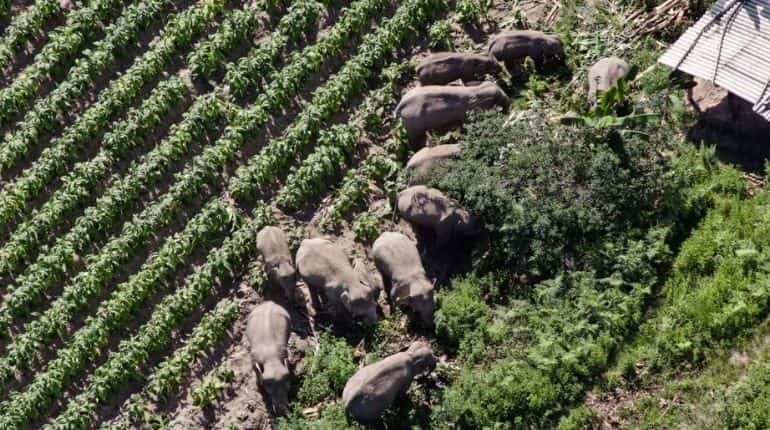
This handout aerial picture released by the Yunnan Forest Brigade shows a migrating herd of wild Asian elephants in southwest China's Yunnan province
China is coaxing its wildelephantswith bananas and drones toreturn to their protected habitat in southwest Yunnan province following a 1,300 km trek.
Wildlife protection officials told a press briefing theelephantssafely crossed a bridge over the Yuan River, headed south towards a nature reserve administered by the city of Puer.
An emergency committee set up to handle the wildelephantsused electric fences, laid corn trees as bait, and built artificial roads to ensure theelephantstook the correct route.
Yunnan deployed more than 25,000 police and staff and 1,500 emergency vehicles to track and feed theelephantsand guarantee public safety, said Wan Yong, head of the provincial forestry commission.
More than 150,000 people were evacuated along the migration route and more than 5 million yuan ($771,000) in insurance funds disbursed to cover property damage, he said.
The group left its home range far south near the Laos border 16 months ago for a grand food tour across rich farmland bursting with corn, sugarcane, bananas and dragon-fruit in southeasternYunnanprovince.
The Chinese public has delighted in the elephants' antics, including parading down city streets, guzzling grain alcohol and dozing en masse in a field.
China's state-controlled media has cast them as the lovable protagonists in a national lesson on conservation.
But the elephants, which can weigh up to four tons and sprint as fast as Usain Bolt, are also extremely dangerous, particularly if they sense a threat to their young.
Two of them who earlier broke for home trampled a villager to death in March, said Chen Mingyong, aYunnanUniversity elephant-behaviour expert attached to the task force. The fatality appears not to have been reported.
Mystery migration
Why the elephants began their trek remains a puzzle.
Possible explanations include tighter competition for resources due to an increase in wild elephants in their home range.
Climate change may also be subtly affecting their habitat, Chen said, or fluctuations in the earth's electromagnetic field could have thrown off their finely-tuned navigational sense, or they may have simply taken a wrong turn.
Researchers are particularly stumped over why the skilled navigators made a nearly straight beeline for Kunming before angling back south a couple months ago.
State protection efforts have enabled the wild elephant population of Xishuangbanna to double since 1978. Wan said a ban on hunting activities had also madeelephantsmore willing to enter human communities.
Experts say natural habitats have shrunk and become fragmented due to rapid urbanisation, new transportation infrastructure and the extension of commercial farming.
(With inputs from agencies)