Australia determined to curb Chinese students making anti-India comments. Should US follow the same?

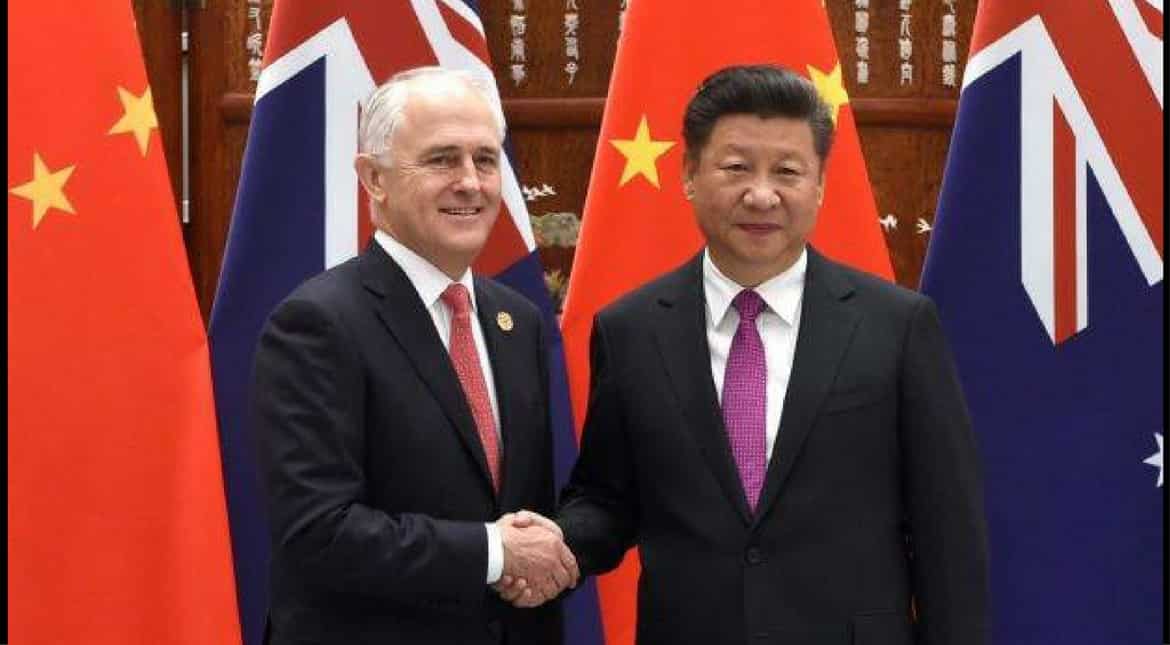
Australia's PM Malcolm Turnbull with China's President Xi Jinping
John Garnaut, a former adviser to Australian PM Malcolm Turnbull, had stated, "Beijing is stirring up 'red hot patriotism' among Chinese students on Australian campuses".
By:Tridivesh Singh Maini & Sandeep Sachdeva
Ties between Australia and China have been strained recently. Only a few days ago, Australian PM, Malcolm Turnbull urged China to take a tougher stand against North Korea.
On August 31, 2017, Turnbullsaid, "China has by far the greatest leverage".“China really has to step up now and bring this regime to its senses. “They are committed to stop buying coal, iron ore, seafood and other products from North Korea. They can go further – they can cut off their oil supply for example”, he added.
At the Shangri-La Dialogue in June 2017, Turnbull had minced no words and urged China to play by a rule based structure (alluding it to its assertiveness on the South China Sea Issue).
A lecturer of the University of Sydney was forced to apologise for a map which depicted Arunachal Pradesh, Aksai Chin, and Ladakh as part of India, while China considers these as disputed territory.
It is not just differences in the strategic sphere, which have been clearly evident in recent months. Australia has also been uncomfortable with Chinese students being excessively assertive on University campuses. There have been at least four instances, wherein Chinese international students in Australia have pressurised lecturers to apologise under the pretext of making offensive comments. A lecturer of the University of Sydney was forced to apologise for a map which depicted Arunachal Pradesh, Aksai Chin, and Ladakh as part of India, while China considers these as disputed territory. This incident had happened 18 months ago, but the Doklam dispute provoked Chinese students to not just use harsh words for the Professor, Khimji Vaghjiani, who happened to be of Indian origin, on a University WeChat account.
Students also protested outside the Indian Consulate in Sydney on this issue, this was during the Doklam standoff. One of the placards read: "Anyone who offends China will be killed no matter how far the target is."
Commenting on this assertiveness by Chinese students, John Garnaut, a former adviser to Prime Minister Malcolm Turnbull, had stated, "Beijing is stirring up 'red hot patriotism' among Chinese students on Australian campuses". He went on to describe it as national security risks for Australia.
Australia needs to be commended for taking a principled stand against aggressive Chinese students in spite of having close economic ties with China. The bilateral trade between both countries is well over 100 Billion USD. Apart from it, in last ten years Australia has also received the second highest volume of Chinese direct investment.
Australia needs to be commended for taking a principled stand against aggressive Chinese students in spite of having close economic ties with China.
On the other hand, Trump has spoken tough against China on not just the issue of North Korea but also dubbed China as a currency manipulator. As soon as North Korea formally announced that it has conducted hydrogen bomb test on this weekend, President Trump not only lambasted the North Korea but also took aim at China for the current political crisis as he tweeted "North Korea is a rogue nation which has become a great threat and embarrassment to China, which is trying to help but with little success.”
Trump further tweeted that the U.S. is considering "Stopping all trade with any country doing business with North Korea.”
According to media reports, Treasury Secretary Steve Mnuchin is drafting a harsher sanctions package against North Korea and its trading partner. It is especially aimed China because it is North Korea's largest trading partner, accounting for 85 per cent of its total trade.
Yet, due to economic interests of the US, as well as some voices in the state department, which urge restraint US while making belligerent noises is compelled to rightly act in a nuanced manner, which Beijing perceives as the weakness of Washington DC.
Even on the second issue, Chinese students have been asserting themselves on US campuses. There are over 300,000 Chinese students in the US. Confucius institutes on US Campuses follow a Chinese agenda, and controversial issues like the Cultural Revolution, The Tiananmen Square are not discussed. A close watch is kept on the activities of Chinese students, and those criticising China. Associations always vehemently opposed Universities for their decisions on related issues. This year in June 2017, Chinese Students and Scholars Association (CSSA) opposed the Dalai Lama’s commencement address at the University of California, San Diego.
Initially, the CCSA admitted that: "It had been in contact with the People’s Republic of China Consulate General in Los Angeles at the earliest opportunity since the matter arose,” and “was waiting for the advice of the Consulate General.” Later on, it issued a denial.
While the US has begun to take note of assertiveness by Chinese students, it is still excessively tolerant, towards incidents while Australia is seeking to nip the evil in the bud. While a number of countries, posing to be the beacons of democracy, do make noise about democracy and liberal values, but their economic constraints have prevented them from doing so. In this sense, Australia deserves full marks.
Australia, Japan, and India can show the way, not just through strategic cooperation, but also by raising greater awareness against Chinese assertiveness in countries in South Asia and South East Asia.
Australia’s ties with Japan and India are more robust in the context of the Asia Pacific and are likely to get only closer with Trump's unpredictability, and American cautiousness vis-a-vis China, in spite of all the bluster. Even in the context of defending liberal values and democratic ideals, countries in the Asia-Pacific region need to work together. Australia, Japan, and India can show the way, not just through strategic cooperation, but also by raising greater awareness against Chinese assertiveness in countries in South Asia and South East Asia. While it may seem ambitious at this time, there is also scope for the three countries to work closely to send a clear message, that none of these countries is willing to make any compromise with democratic ideals like freedom of speech and diversity of opinion.
The battle in the Asia-Pacific region is not just about economics and security, but also about values. And the Australia-India-Japan tri-lateral can certainly lead the way.