Ambitions of Chinese graduates die a slow death in moribund jobs market

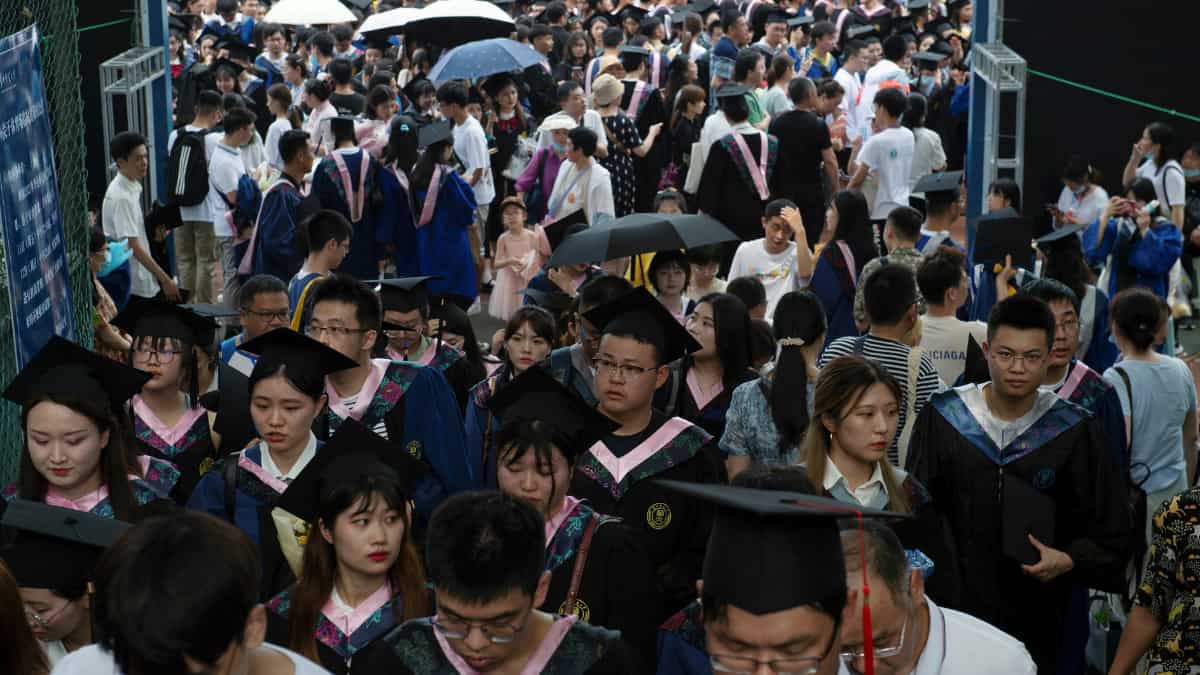
Graduates attend a graduation ceremony at Central China Normal University in Wuhan.
With a lack of jobs for thousands of students graduating every year and a shortage of factory labour because of an ageing workforce, the job market imbalance is deepening in China, withgraduateswho are failing to land a job opting for manual labour.
Applied maths graduate Liang Huaxiao, explaining her failure at landing a job in one of the tech giants of China, said, "Finding a job has been really difficult. I told my family that I'm willing to take up manual labour and my mum straight-up cried. She felt so sorry for me."
In April, the country's youth unemployment hit a record 20.4 per cent, and this summer another batch of 11.58 million university students is ready to graduate.
The graduates will be competing for jobs in what is one of the fastest-growing major economies of the world, but also a country whose manufacturing-heavy structure is out of step with the younger generation's aspirations.
In recent years, the industries which are popular among fresh graduates, like tech, education, real estate and finance, have faced regulatory crackdowns.
Even though some measures were rolled back, business sentiment is showing a slow recovery. Private investment increased only by 0.4 per cent in January-April, while state investment rose by 9.4 per cent.
"China's education raced ahead of the economy, which means that more diplomas were handed out than were needed by a manufacturing-based economy," stated Keyu Jin, author of The New China Playbook, which tells of the economic ascent of the country. "There's a big mismatch between expectations and the reality of the economic circumstances,” he added.
'Roll up your sleeves'
It still remains unclear how many graduates are opting for jobs which are below their skill level, however, the trend has been acknowledged by the state media. Young graduates have been encouraged by the state media editorials to "roll up their sleeves".
Youngsters have been repeatedly exhorted by President Xi Jinping to "seek hardships" in a state media article, which talked about his suffering during the Cultural Revolution.
WATCH |India and China hold in-person diplomatic talks in New Delhi | 'Frank and open' discussions
State-owned enterprises have been appealed by the government to recruit more university graduates and expand vocational training schools which can fill shortages in advanced manufacturing.
Some local governments, like that of Shanghai, have been offering employment subsidies to firms which are hiring 2023 graduates.
Few high-skilled roles are being offered by the service industries which are at the forefront of the post-pandemic recovery of China.
"Many white-collar service positions have vanished,” stated Chim Lee, an analyst at the Economist Intelligence Unit. "Jobs being created are predominantly in areas not requiring higher education, such as catering and tourism,” he added.
(With inputs from agencies)
You cannow write for wionews.comand be a part of the community. Share your stories and opinions with ushere.
WATCH WION LIVE HERE