After war and violence, Syria's pistachio farmers return to their orchards

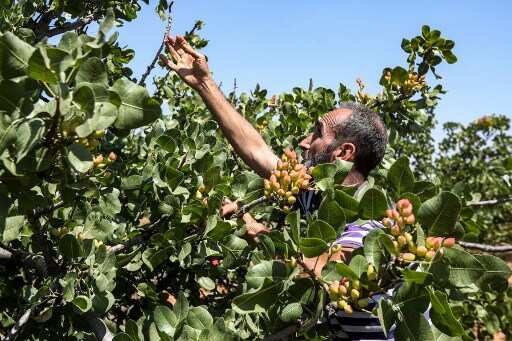
Pistachio orchard in Syria
Fadi al-Mahmoud painstakingly parts the green leaves and examines the fruit of his toil - the famed pistachio nut.
He is almost oblivious to the army nearby sweeping the same ground for buried explosives. War-torn Syria also happens to be home to rich pistachio farming.
After years of war and violence, Syria's pistachio farmers have returned to the orchards.
"Our fields have been neglected for eight years, from 2012 to today they've suffered a lot. The trees need continuous pruning, three or four times a year, and insecticides two or three times. When we returned, half of the trees had dried out, some tree branches had withered, and there were trenches and landmines scattered all around," Fadi al-Mahmoud says.
Al-Mahmoud is awaiting his first harvest after years of war with some pistachio fields in Syria completely destroyed farmers are now doing damage-control in the hope of getting a good yield. Before violence wreaked havoc on pistachio fields, Syria produced up to 80,000 tonnes of pistachios a year.
In rich fields across Aleppo's Hama and idlib provinces, it was exported to Saudi Arabia, Lebanon, Jordan and Europe but the conflict which ensued in 2011 crippled production as many pistachio growing regions were controlled by jihadists and rebels and have now fallen to Syrian President Bashar al-Assad's forces.
"The production of pistachios before the crisis ranged between sixty thousand and seventy five thousand tons each year. During the crisis, production decreased a lot, due to the inability of farmers to reach their land and take care of their crops," Hassan Ibrahim, director, Pistachio department of ministry of agriculture, said.
Though the violence has subsided even to this day the locals across battle-scarred Hama live with the deafening sounds of blasts as the army routinely detonates landmines in nearby fields.
Pistachio farmers are now hoping to recover years of losses and look forward to a revival of their famed produce but they are aware of the danger that lurks in Syria's soil.