5th BIMSTEC NSA Meet: NSA Ajit Doval calls for decisive action amid global conflict and economic turmoil

&imwidth=600&imheight=450&format=webp&quality=medium "5th BIMSTEC NSA Meet: NSA Ajit Doval calls for decisive action amid global conflict and economic turmoil")
5th BIMSTEC NSA Meet: NSA Ajit Doval calls for decisive action amid global conflict and economic turmoil
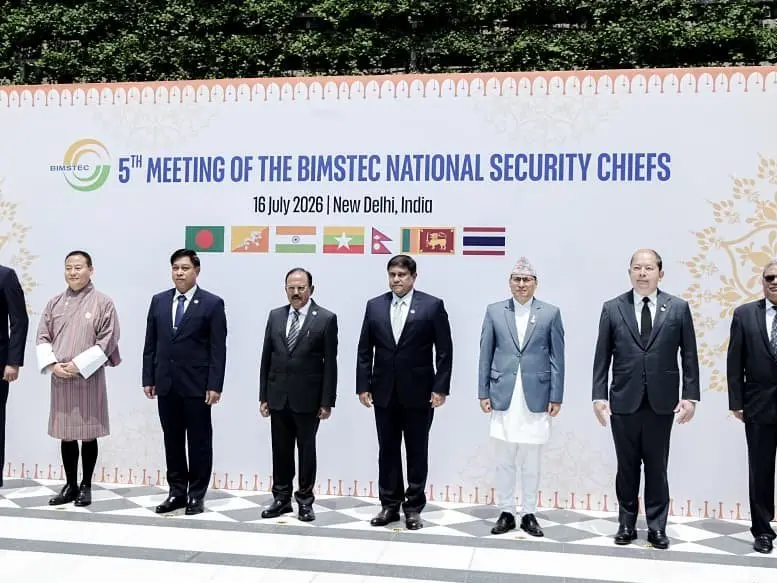
At the 5th BIMSTEC National Security Advisers' Meeting in New Delhi, Indian NSA Ajit Doval urged member states to unite against multi-domain threats and economic supply chain disruptions.
At the fifth BIMSTEC National Security Advisers' Meeting hosted in New Delhi, Indian National Security Adviser (NSA) Ajit Doval underscored the urgent need for closer regional cooperation. He emphasised that the current global landscape—marked by conflicts, geopolitical uncertainties, multi-domain security threats, technological disruptions, and economic hardships from supply chain disruptions—requires member states to collaborate and take decisive actions for mutual benefit.
Doval highlighted the Bay of Bengal grouping's immense significance, noting that BIMSTEC unites two dynamic regions, representing 1.7 billion people (roughly 22% of the global population) with a combined GDP of nearly USD 5 trillion. He stated that these nations are connected not just geographically by the Bay of Bengal, but also through deep civilizational and cultural legacies spanning a millennium of shared history.
According to the NSA, BIMSTEC has built robust cooperation and made significant progress in countering common threats, including terrorism, transnational organized crime, cyber threats, and maritime challenges. He noted that the grouping is poised to combat new and emerging threats together. Doval stressed that BIMSTEC's long-standing pillars—regional security, connectivity, capacity building, and economic security—must continue driving their collective efforts.
Furthermore, Doval described BIMSTEC as central to India's regional vision, embodying its "Neighbourhood First" approach, commitment to the "Act East Policy," and the "MAHASAGAR" vision (Mutual and Holistic Advancement for Security and Growth Across Regions). As BIMSTEC prepares to mark its 30th anniversary next year, he called on member countries to expand their collaborative potential, infuse new energy and resources, and strengthen institutional capacities. He expressed confidence that their shared vision, common aspirations, and mutual trust will continue to deliver tangible outcomes for regional security and resilience.
Established on June 6, 1997, via the Bangkok Declaration, the regional organisation was initially known as BIST-EC (Bangladesh, India, Sri Lanka, and Thailand). It evolved into BIMSTEC and grew to its current seven-member states following the admission of Myanmar in December 1997, and Bhutan and Nepal in February 2004.

