4,600-year-old Egyptian art reveals an extinct goose

4,600-year-old Egyptian art reveals an extinct goose
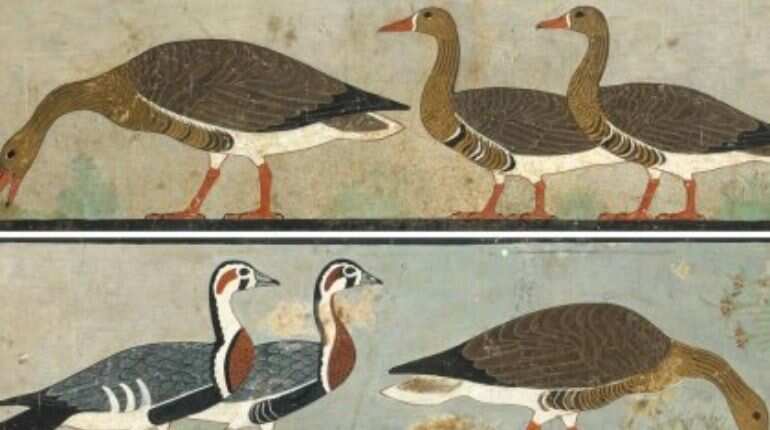
Archaeologists have discovered anextinct goose from a4,600-year-old Egyptian paintingfamously known as the ‘Meidum Geese’ from the Chapel of Itet.
Meidum Geesehas been admired since its discovery in the 1800s and described as ‘Egypt’s Mona Lisa’.
Animals depicted by ancient artisans have the potential to provide insightsinto past cultures. While qualitative approaches are commonly used to identify animals to species level, the use of more objective approaches has the potential to reduce bias and uncertainty.
Anthony Romilio, an evolutionary biologist fromthe University of Queensland in Australia usedtaxonomic sleuthing to have a closer look at the painting when he suspected that it had more than what caught the eye.
Hesaid the strange but beautiful bird was quite unlike modern red-breasted geese, withdistinct, bold colours and patterns on its body, face, breast, wings and legs.
Romilio said extinct animals had been identified previously in ancient art, but not all the species had been scientifically confirmed.
Hefound of the three different graphically represented geese types, one form resembles greylag geese (but did not exclude bean geese), a second form is like greater white-fronted geese, but the third goose type did not plausibly match with red-breasted geese.
To assure that it was extinct geese, Romilio used a highly effective method in identifying species,using quantitative measurements of key bird features,and greatly strengthens the value of the information to zoological and ecological science.