

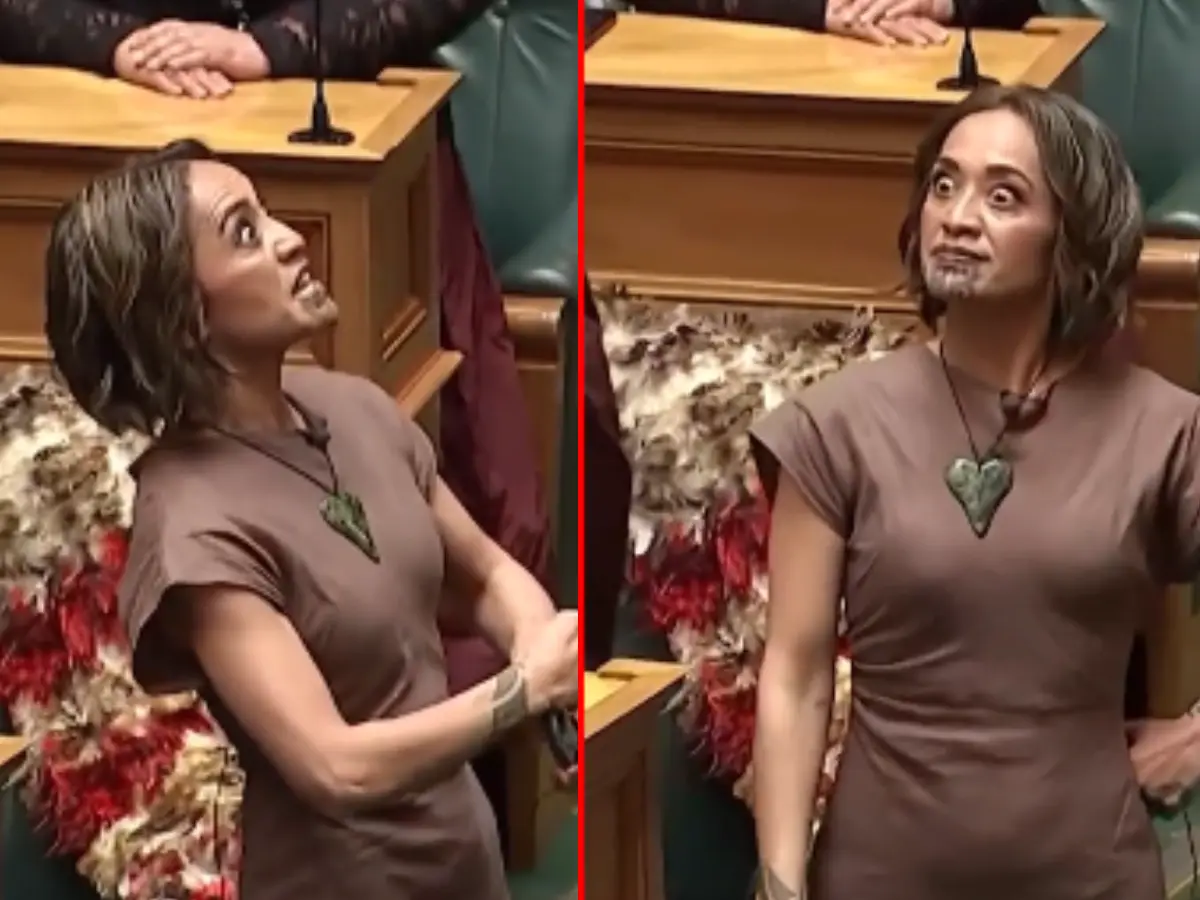
&imwidth=800&imheight=600&format=webp&quality=medium "'No, not that...' - Public breaks into Maori Haka dance in New Zealand Parliament, MPs join in")
New Zealand’s Parliament witnessed yet another haka, a traditional Maori dance. It happened after the newest Maori Party MP, Oriini Kaipara, delivered her maiden speech. Spectators in the public gallery broke out into an unsanctioned haka, as the speaker of the House, Gerry Brownlee, got visibly agitated and said, “No, not that." Kaipara joined the Parliament in September to fill a vacant seat. She gave her first official address to the parliament on Thursday. Several MPs sang a Maori song which had been pre-approved to welcome her. However, there was a sudden twist in things when people in the gallery broke into a Haka dance, which was not agreed upon. A few other MPs also joined in the spontaneous haka.
This made speaker Gerry Brownlee visibly livid, who immediately tried to stop it. “No, not that. The guarantee was that it would not be taking place,” Brownlee said. However, no one paid heed to him, forcing him to suspend the session. Brownlee said that he will have the incident investigated to see whether any of the MPs knew about the "spontaneous" Haka dance in the gallery. He termed the unapproved actions as contemptuous. Notably, any kind of song or dance performance in the New Zealand parliament needs approval under parliamentary rules. While the song was given the green light, there was no mention of a Haka dance.
Maori Haka dance in New Zealand Parliament
The Maori Party, known as Te Pati Maori, has often used symbolic performances to assert Indigenous pride and challenge colonial-era norms in governance. The Haka has evolved into an expression of New Zealand’s Indigenous heritage. It is commonly performed at sporting events and some cultural events. The national rugby team, the All Blacks, often kicks off games with the Haka. In earlier times, the Haka symbolised a war cry, and was also a gesture to welcome other tribes.
In November last year, three Maori Party members broke into a Maori Haka dance during a heated vote on a controversial bill seeking to reinterpret the 184-year-old Treaty of Waitangi, also referred to as Te Tiriti. It was an agreement between the British Crown and the Maori people, signed in 1840 that offered them protection. All three of them were handed historically lengthy suspensions.

