
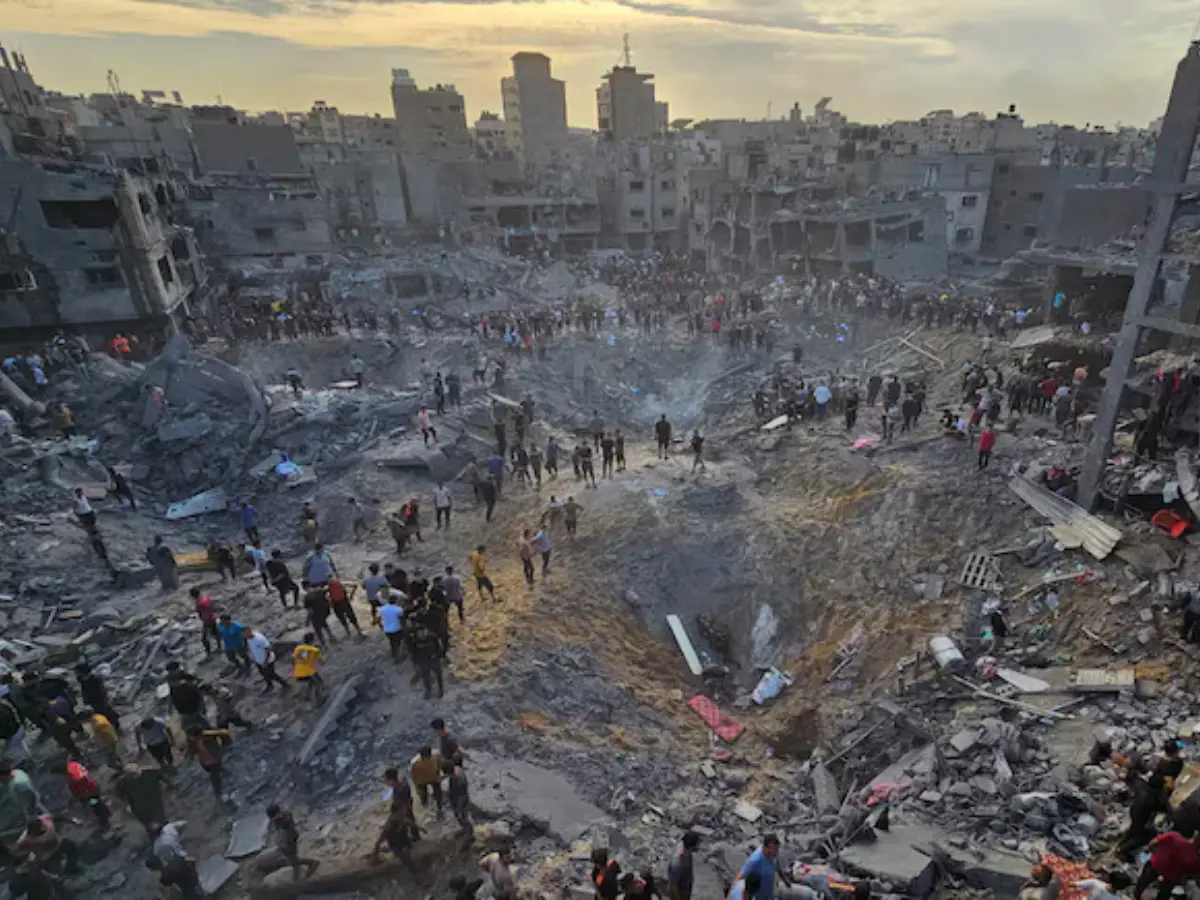
&imwidth=800&imheight=600&format=webp&quality=medium "'Gazans crying blood, it's suffocating': War-torn Gaza paying high price as inflation hits 230% amid Israel-Hamas war")
As the situation in Gaza worsens amid the Israel-Hamas war, be it cash, food, fuel, or medicine, everything is in short supply. People in Gaza have been selling their possessions to buy essential goods to feed their families and for basic survival needs.
At least 798 people have been killed while trying to receive food aid in Gaza since the end of May, according to the United Nations Human Rights Office, Reuters reported.
Almost every bank branch as well as ATMs are inoperable in Gaza, hence, people have become dependent on an unrestrained network of powerful cash brokers to get money for daily expenses. While, to add on to their expenses, the commissions on those transactions have soared to about 40 per cent.

Ayman al-Dahdouh, a school director living in Gaza, said, "The people are crying blood because of this." "It's suffocating us, starving us."
The people in Gaza have been using the Israeli currency, the shekel, for most of their transactions. However, as Israel is no longer supplying the territory with newly printed bank notes, merchants have been accepting frayed bills.
Israel halted supplying cash to enter Gaza at the beginning of the war, citing that it wanted to hinder Hamas' ability to purchase weapons and pay its fighters.
Trending Stories
Mohammed Basheer al-Farra, who lives in southern Gaza shared his ordeal, saying that they have been losing nearly half of their money just to be able to spend it.
“If I need $60, I need to transfer $100. This is the only way we can buy essentials, like flour and sugar. We lose nearly half of our money just to be able to spend it.”
Last year, inflation in Gaza skyrocketed to 230%, according to the World Bank. Later in January, it dropped a bit during the fragile ceasefire, but again shot up after Israel backed out of the truce in March.
According to a World Bank report, about 80 per cent of people in Gaza were unemployed at the end of 2024. However, the figure has probably increased by now.
Sugar, which was earlier worth $2 per kilogram, is now very expensive, costing the equivalent of $80-$100 per kilogram, according to several people.
Recently, as Israel and Hamas are again in the ceasefire talks loop, initiated by the US, the Hamas terror group has criticised the US's decision to impose sanctions on Francesca Albanese, the UN special rapporteur for the West Bank and Gaza. They called the move a “blatant expression of the US administration’s blatant bias toward Zionist war crimes” and called for the country’s administration to reverse its actions.
