NASA captures a 'Siberian snowman' in remote Russian region from space

&imwidth=600&imheight=450&format=webp&quality=medium "NASA captures a 'Siberian snowman' in remote Russian region from space")
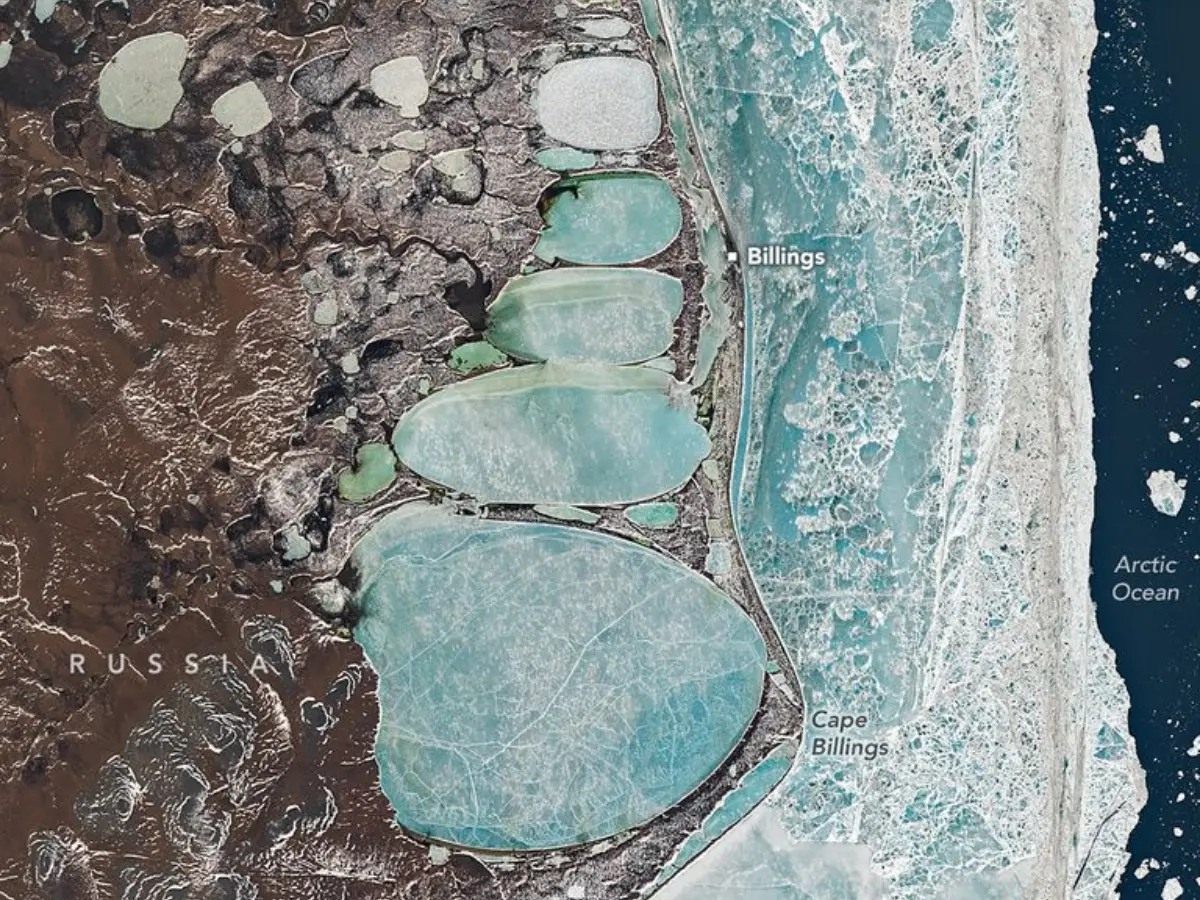
Billings snowman is actually a natural occurrence. Photograph: (NASA Earth Observatory/Michala Garrison)
In a remote region of Russia, NASA satellites have captured what appears to be a snowman. Billings experiences freezing temperatures throughout the year. This snowman is a result of natural phenomena linked to the cold conditions.
Satellite images released by NASA show a figure that resembles a snowman in one of the most remote corners of the Russian Arctic. The photo was taken on June 16, 2025, by the Operational Land Imager aboard the Landsat 8 satellite. However, the image is actually of a chain of frozen lagoons spread over an area of 22 kilometres near the village of Billings and Cape Billings on Russia’s Chukchi Peninsula. They occur in such a sequence and dimensions that it looks like a snowman. According to researchers, it is a result of natural geological processes, with ice, wind and water playing a role. The Landsat data shown in the photo is from the US Geological Survey.
This area of Billings in Russia remains frozen for the majority of the year. The minimum temperature, even during June, stays below the freezing point. “Although June is one of the warmest months in Billings, ice cover is routine even then. Mean daily minimum temperatures are just minus 0.6 degrees Celsius (30.9 degrees Fahrenheit) in June,” according to met data. The frigid conditions give rise to certain phenomena that contribute to the formation of these frozen lagoons. In this case, five main lagoon basins are visible, each frozen and stacked to create a familiar structure.
These are the result of what is known as "thermokarst" activity, where buried ice wedges melt and cause the overlying soil to collapse. Shallow depressions are created, which later fill up with meltwater. Wind and wave movement stretch the lake to create oval shapes. The boundaries between underground ice wedges are the thin ridges that appear in the image.
Billings is a remote area in Russia that is hard to reach in both winter and summer. However, the cold months make for better access since the lakes and rivers freeze, creating a surface that can be used to move around. In the summer months, the ground thaws and waterlogging prevents easy movement. The only way to reach it is by a helicopter in summer and a snow road in winter. Billings is located on the coast of the East Siberian Sea and has a population of around 200 people. It is one of the few inhabited places in this region of Russia.

