Internet thinks white light rising after meteor strike behind volcano is UFO. Scientist gives his verdict

&imwidth=600&imheight=450&format=webp&quality=medium "Internet thinks white light rising after meteor strike behind volcano is UFO. Scientist gives his verdict")
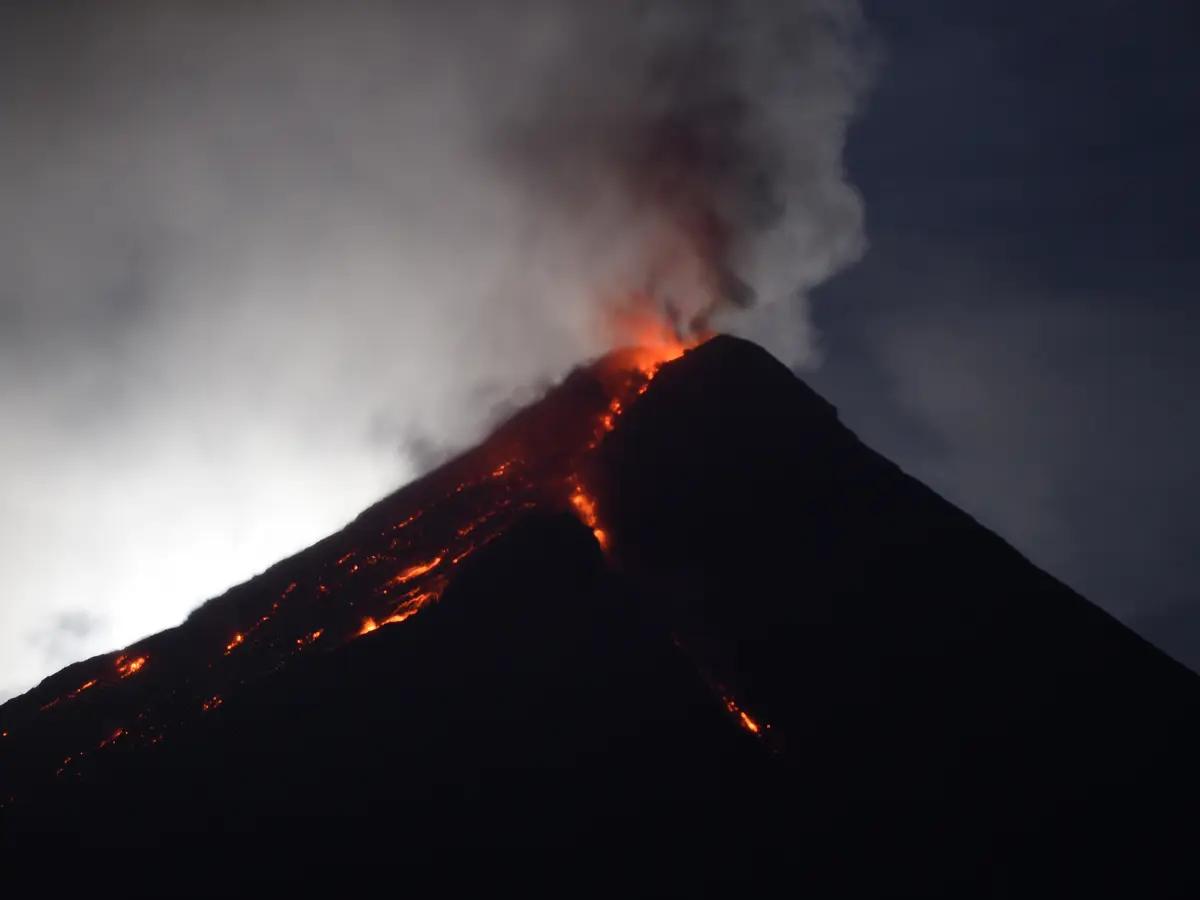
Meteor strike at Mount Mayon volcano in the Philippines. Photograph: (AFP)
A meteor exploded behind Mount Mayon volcano in the Philippines, just as it was erupting. At the same time, a white streak of light was seen rising in the sky. It appears to be a scene from a sci-fi thriller, with a UFO rising from a crash on Earth. However, that is not the truth.
On May 25, a meteor crashed near a volcano in the Philippines, and soon after impact, a white light source could be seen rising up in the night sky. This triggered curiosity about its nature, with some people speculating extraterrestrial involvement. However, a scientist has clarified that it wasn't what the mind wants to believe. According to Avi Loeb, it was "likely the glint from a satellite that reflects sunlight." As soon as the meteor crashes, a mysterious orb of light can be seen rising up from the landing site. He said in an interview with News Nation that this light is in no way connected to the meteorite and is coming from a satellite. Loeb said it was a coincidental phenomenon that a satellite reflected light at the same moment and place where a meteor struck.
A satellite coincidence over the Philippines volcano
The Harvard professor said that with more than 10,000 communication satellites moving around the Earth, it’s not very unlikely to see such a coincidence. The interviewer is surprised to learn this, and asks if he is sure "that this rising light is not originating from the meteorite?" to which Loeb offers evidence and replies, "The rising white light is moving along a straight line as expected for a satellite". The incident happened at Mount Mayon, one of the world's most active volcanoes. The moment a green fireball made impact was captured by several cameras, and occurred at 10:30 pm, according to the Philippine Information Agency.
Mount Mayon has been erupting for 140 days
The volcano was erupting at the time of the meteor strike, its 140th day, creating a visual spectacle that has amazed scientists across the world. The footage shared by afarTV shows the meteor strike, as lava oozes out of the volcano and a small, white light rises in the sky. "It is a gorgeous video of an unusual coincidence," Bill Cooke, the head of the Meteoroid Environments Office at NASA’s Marshall Space Flight Center, told The New York Times. Rebecca Williams, a volcanologist at the University of Hull in England, told the outlet, it was a "juxtaposition of two of the most powerful forces in the natural world."
The Philippine Institute of Volcanology and Seismology (PHIVOLCS) initially reported that the meteor struck the northern slopes of Mayon Volcano. However, it later stated that there was no crash landing and the space rock vaporised in the atmosphere. The agency wrote in a post on X, "Our review of seismic, infrasound and additional camera footage around the volcano indicates that the meteor disintegrated while in the atmosphere and did not strike the slopes of Mayon, contrary to our initial post."

