Indian and Chinese scientists discover new underground blind eel on Indo-Nepal border

&imwidth=600&imheight=450&format=webp&quality=medium "Indian and Chinese scientists discover new underground blind eel on Indo-Nepal border")
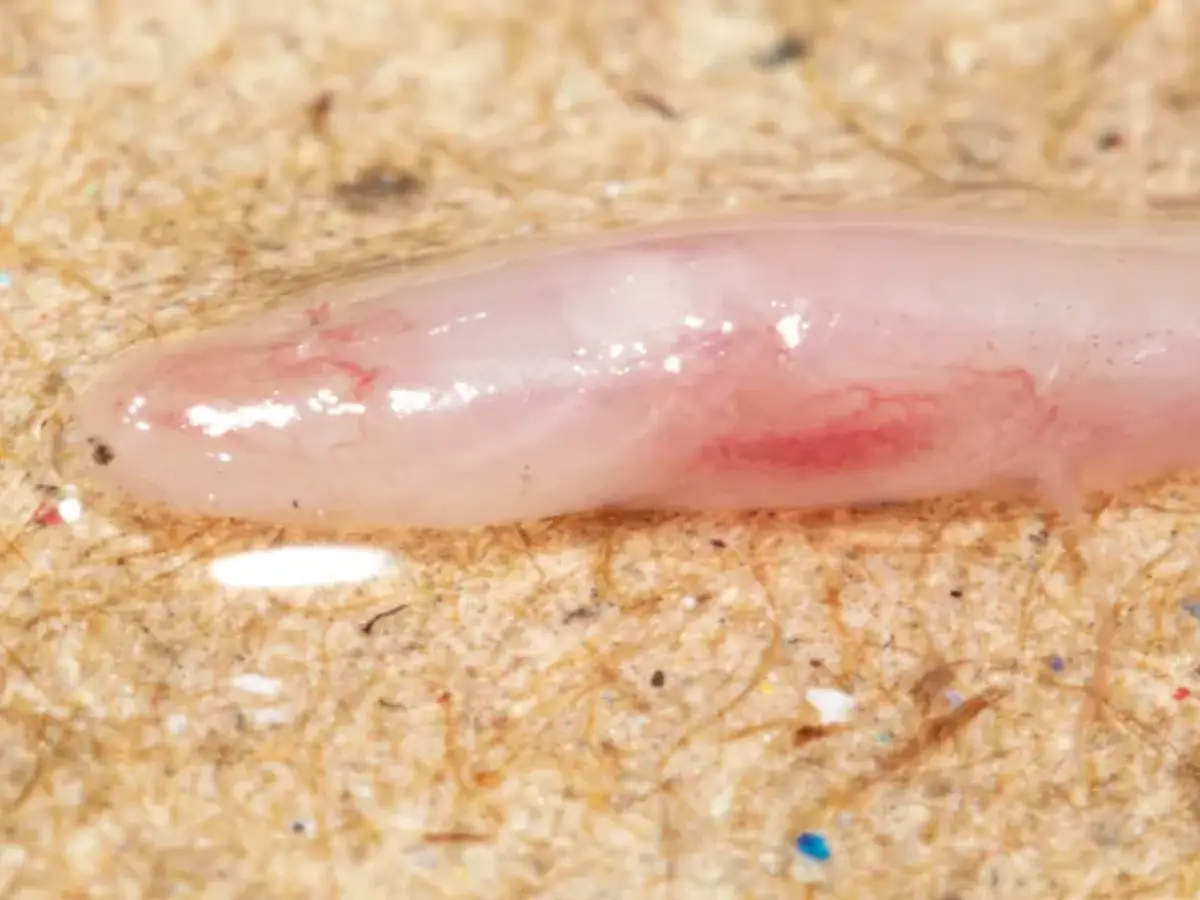
The tiny eel is translucent and appears to have no ribs. Photograph: (Thackeray Wildlife Foundation)
A new species of eel was found on the India-Nepal border after scientists followed up on a social media video two years ago. Finding it was hard and required pumping several gallons of water from a borewell. The fish can live in total darkness and is barely 1.5 inches long.
Scientists have found a translucent eel in the Gangetic Basin in northern India, the first subterranean fish found in the region. Measuring only 1.5 inches in length, the eel has adapted to living in pitch-dark conditions. Researchers first saw the eel emerging from a tiny hole on the India-Nepal border in a social media video. The colourless fish that had a unique body, intrigued scientists from India and China. Additionally, there was no record of a fish that lived in caves, sinkholes or aquifers in the region. After months of work, they finally found the fish, which has been named Gangaichthys indonepalicus.
Detailing the journey in a study published in the journal ZooKeys, they wrote that finding the fish proved to be a difficult task. Study co-author Akshay Khandekar from the Thackeray Wildlife Foundation said in a statement that they first had to identify borewells and wells where the fish could possibly be found. Convincing the owners to allow them to extract water was another arduous ask. When the work finally started, things unravelled.
How scientists found the eel
The first specimen was discovered after pumping roughly 530 gallons of water. However, it died soon after. The team pumped 132 more gallons of water in the same borewell and saw the second fish. Advanced micro-CT scanning and genetic analysis revealed that it was a new genus, with a colourless body, small eyes covered by skin and no ribs. Gangaichthys, the name given to it, means "fish of the Ganga," while indonepalicus reflects that the eel is found on the border between India and Nepal.
Agarwal said, "This is the first stygobitic fish from the Indo-Gangetic plains and from the Gangetic basin," while discussing the river's importance in India. The river Ganga provides fresh water and food and is a source of livelihood for millions of people. It is also one of the holiest rivers in the Hindu religion. Zoological Survey of India, the National Centre for Biological Sciences/TIFR (Bengaluru) and co-author You He of the Chinese Academy of Sciences were also part of the study.

