Europe's largest meat-eating crocodile-faced dinosaur found

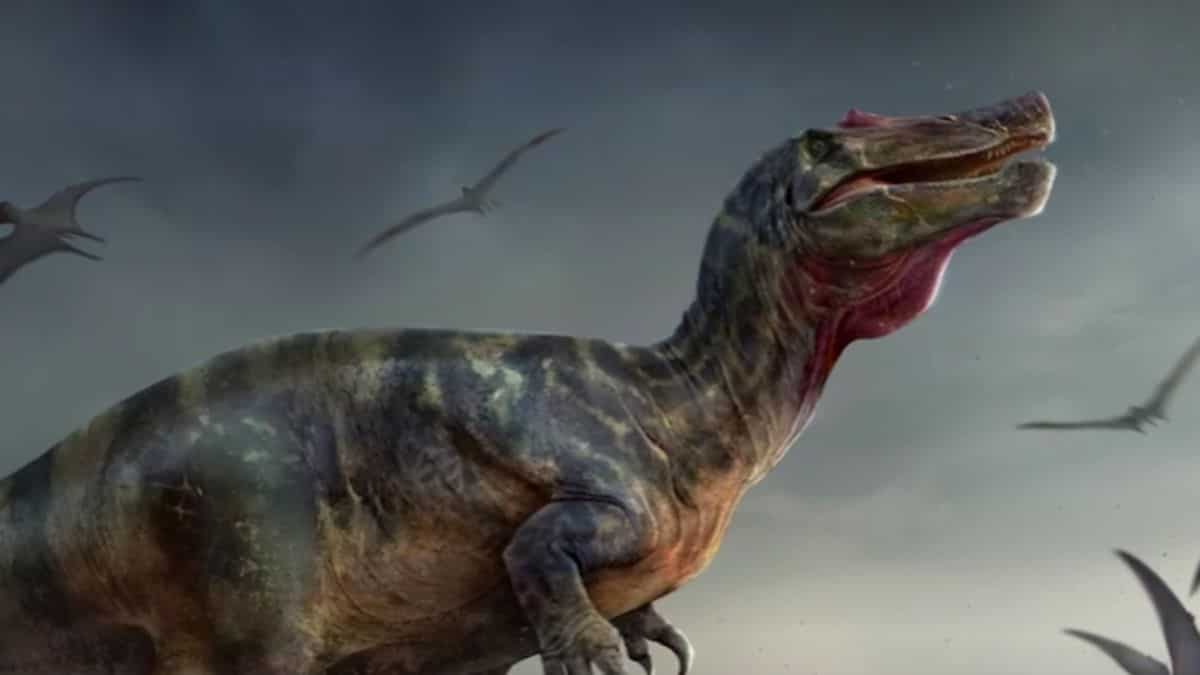
Dinosaur
Scientists said on Thursday (June 9) that a giant crocodile-faced meat-eating dinosaur has been discovered on the Isle of Wight by one of Britain's best fossil hunters. As per the experts, it was probably the largest predator ever to stalk Europe and prowled what is now England roughly 125 million years ago. Most of the bones of the two-legged spinosaurid were found by the late local collector Nick Chase.
Parts of the skeleton were found including bones of the back, hips and tail, some limb fragments but no skull or teeth. In a study published in the journal PeerJ Life & Environment, it has been revealed that the researchers at the University of Southampton used the few bones available to identify what they have called the "White Rock spinosaurid".
Chris Barker, a PhD student who led the study, said: "This was a huge animal, exceeding 10 metres (33 feet) in length and judging from some of the dimensions, probably represents the largest predatory dinosaur ever found in Europe."
So far, the researchers have not yet given the newly described dinosaur a scientific name because the remains were incomplete. However, they are calling the giant dinosaur the "White Rock spinosaurid".

A diagram shows fossil remains of a meat-eatingdinosaurdubbed the "White Rock spinosaurid," dating from about 125 million years ago during the Cretaceous Period, unearthed on England?s Isle of Wight.
The study revealed that a combination of features suggests that this is a member of Spinosauridae. Although, there's a lack of convincing autapomorphies that precludes the identification of a new taxon. It further added that this is the first spinosaurid reported from the Vectis Formation and the youngest British material referred to in the clade.
"Our conclusions are in keeping with previous studies that emphasise western Europe as a pivotal region within spinosaurid origination and diversification," the study noted.
Thomas Richard Holtz, a vertebrate palaeontologist from the University of Maryland said that the new find "does seem to be larger" than a huge predator whose fossilised remains were discovered in Portugal. Holtz is not involved in the study.
WATCH WION LIVE HERE
You can now write for wionews.com and be a part of the community. Share your stories and opinions with us here.