Eerie medieval gravestones found near 800-year-old shipwreck in English Channel

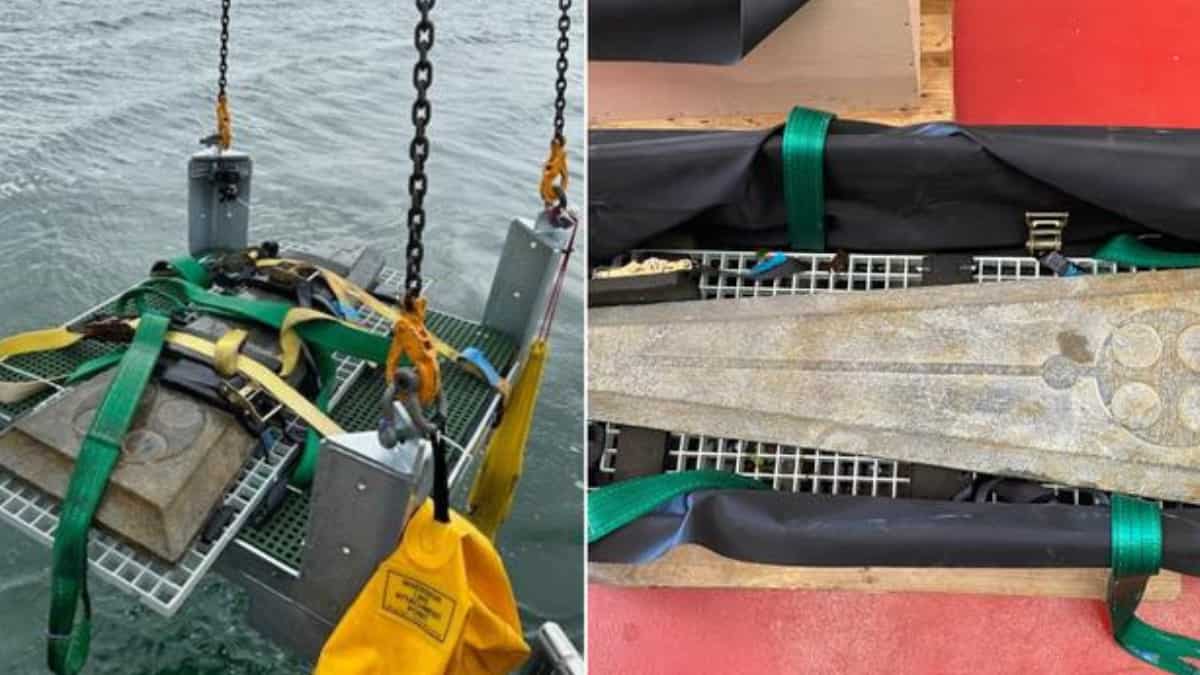
Image of the gravestones being lifted from English Channel.
In a stunning discovery, British archaeologists recently discovered eerie medieval gravestoneswhile carrying a search operation near an ancient shipwreck.
In a press release, Bournemouth University announced the deadly discovery. The gravestones were discovered in Studland Bay, which was off the coast of Dorset, and are said to be present at the bottom of the English Channel for 800 years.
"The slabs, carved from Purbeck marble, were amongst the cargo of England’s oldest historic shipwreck, which sank off the Dorset coast during thereign of Henry IIIin the thirteenth century," read the press release.
In 1216, the son ofKing John Henry III took the throne and ruled till he died in 1272. The grave slabs found seemed remarkably preserved across the centuries, even though one of the slabs was covered in barnacles.
Archaeologists spend two hours retrieving gravestones
It took more than two hours for the maritime archaeologists to bring the stones back to the surface on Tuesday (June 11).
"One immaculately preserved slab measures one and a half metres and weighs an estimated 70 kilogrammes," said the press release.
"The other, much larger slab is in two pieces, with a combined length of two metres and a weight of around 200 kilogrammes," it added. The weight of the slabs was nearly 154 pounds and 440 pounds, respectively.
According to the archaeologists, the gravestones appeared to have been made for the important members of the clergy, those who were venerated in medieval English society.
"Both have carvings of Christian crosses which were popular in the thirteenth century and the research team believe they were intended to be coffin lids or crypt monuments for high-status individuals in the clergy," read the statement.
Archaeologist Tom Cousins, who led the study, said that they have also found the type of stone, which was used in the slabs, in Westminster Abbey, Canterbury Cathedral and Salisbury Cathedral.
Watch:Indian-origin researcher discovers new tech device that fully charges EVs in 10 minutes
"The wreck went down in the height of the Purbeck stone industry, and the grave slabs we have here were a very popular monument for bishops and archbishops across all the cathedrals and monasteries in England at the time," he said.
"Although Purbeck marble was quarried near Corfe Castle [in Dorset], there has always been a debate about how much work was done here and how much was done in London," Cousins said.
"Now we know they were definitely carving them here, but they hadn’t been polished into the usual shiny finish at the time they sank so there is still more we can learn," he added.
Bournemouth University archaeologists have now started the work of desalinating the gravestones and conserving them before they are displayed in public next year.
(With inputs from agencies)