VAR heartbreak! Why Iran's dramatic 93rd-minute winner against Egypt was ruled out

&imwidth=600&imheight=450&format=webp&quality=medium "VAR heartbreak! Why Iran's dramatic 93rd-minute winner against Egypt was ruled out")
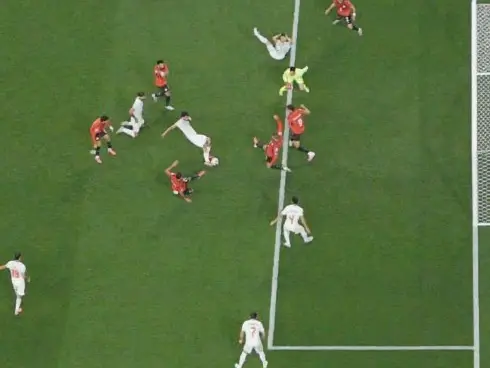
Screenshot taken from the video Photograph: (X)
Iran's stoppage-time winner against Egypt was ruled out by VAR for offside, sending Egypt into the FIFA World Cup Round of 32 after a 1-1 draw
Iran experienced a dramatic swing of emotions at Seattle Stadium on Saturday after a stoppage-time goal by Shoja Khalilzadeh was ruled out following a VAR review, resulting in a 1-1 draw against Egypt. The decision proved decisive as Egypt secured qualification for the Round of 32, while Iran's hopes of advancing remain uncertain heading into the final stage of the group phase. The stadium erupted in celebration in the 93rd minute when Khalilzadeh reacted quickest to a loose rebound inside the penalty area, firing the ball into the net after a frantic goalmouth scramble. The experienced defender celebrated passionately by taking off his shirt, earning a yellow card in the process. Moments later, however, Polish referee Szymon Marciniak was instructed by the Video Assistant Referee to review the sequence that led to the goal.
Why was Iran's goal disallowed?
The controversy centered around FIFA's offside law, which determines offside at the exact instant a teammate first touches or plays the ball, not when the eventual shot is taken. According to the official FIFA Law 11, “the timing of the offside is judged at the first point of contact of the play or touch by a teammate.” The move began with a deep free-kick floated into Egypt's penalty area. An Iranian player rose highest and managed to flick the ball further into the crowded six-yard box. At that precise moment, the offside line was established.
Although Egypt's defenders had stepped forward to deal with the initial delivery, two Iranian attackers had already moved beyond the second-to-last defender, leaving them in offside positions near the goal. Simply standing in an offside position is not automatically an offense. However, the infringement occurred when those players became directly involved in the next phase of play. FIFA's Law 11 states that a player in an offside position is penalised upon “becoming involved in active play by challenging an opponent for the ball or making an obvious action which clearly impacts on the ability of an opponent to play the ball.”
Watch the video of the goal disallowed
)
Screenshot taken from the video Photograph: (X)
The offside attackers immediately became active participants in the goalmouth scramble, influencing Egypt's defenders and preventing them from making a clean clearance. Under FIFA's Law 11, because an offside player gained an unfair advantage by becoming actively involved in the phase of play, the attacking move was deemed illegal from that point onward. As a result, referee Szymon Marciniak disallowed Khalilzadeh's finish after the VAR review.
The heartbreaking decision ensured the match ended 1-1, confirming Egypt's place in the Round of 32 while leaving Iran with everything still to play for in their quest to reach the knockout stage.

