Taliban to revise media laws, change could worsen conditions for press

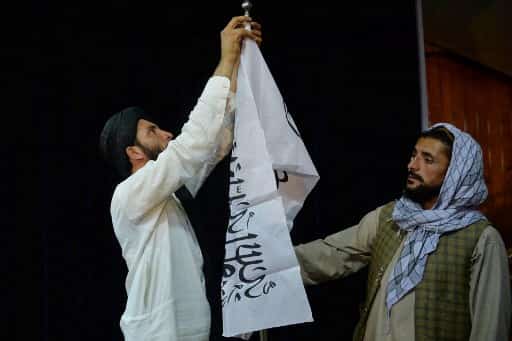
Men adjust the Taliban flag
Taliban officials indicated that they are going to change certain cultural and religious text in books as well as revise mass media laws in Afghanistan, a move that could worsen the dire conditions of journalists in the country. According to Afghanistan Journalists Centre (AFJC), there have been at least 245 cases of censorship, detention and violence against journalists since the Taliban took over.
On Tuesday, in a press conference, Hayatullah Mohajir Farahi, deputy minister of information and culture, indicated that till now they have reviewed 80 books and found at least 150 books were against “the principle of Islam” while some others were against “unity”. He added, “95% of the visual and audio media outlets in the country have been reformed.” He was reiterating the announcement made by the acting minister of information and culture who had indicated that they need to revise books that are against Islamic values, reported local media.
The Taliban spokesperson, Zabihullah Mujahid also took to Twitter and said, “We will make some changes in the cultural and religious sections and send it to the Islamic Emirate leader to confirm, and in the near future it will be available to the media.” This comes weeks after AFJC, an independent watchdog for defending and promoting press freedom in Afghanistan, released a concerning report which outlines the state of media freedom in the first year of Taliban rule.
The report shows a significant increase in atrocities committed against media workers, rise in cases of violation of media freedom and deterioration of press freedom marked by censorship, detentions and assaults against journalists, particularly, female journalists. Furthermore, out of the 245 cases, 130 are of short-term detention of journalists lasting from a couple of hours to months and consisted of physical violence, torture and insults.
Notably, hundreds of journalists, both male and female, had fled Kabul when the Taliban took over last year on August 15. The aforementioned report also noted that half of the 600 media outlets in Afghanistan are in financial crisis and at least 60% of workers have been unemployed since August last year. About 30% of the operating media outlets are on the verge of collapse due to lack of funding and professionals. Media outlets are also required to seek permission before publishing any content.
Experts indicated that these so-called reforms have amounted to extensive censorship of Afghan media which has led to its weakened state. Among the several restrictions, one dictates female anchors to wear headscarves or facemasks, while female journalists have largely been banned from state-run media outlets.
On the other hand, though the Taliban maintains that no journalist has died in Afghanistan, a report by the Committee to Protect Journalists (CPJ) shows at least 10 journalists were killed between 2020 and 2021.
The Taliban on Tuesday announced the establishment of a media violations commission, a department that will supposedly address complaints. While the commission reportedly has no female members or journalists, it does include several officials from the ministry of information and culture, media support groups and an Islamic scholar.
Since the Taliban took over, Afghanistan has witnessed several sporadic protests, but the media outlets have been told to stay away from these protests. “Recent protests were illegal and therefore filming and reporting on them is also illegal,” said the Taliban spokesperson. He added that protestors must seek permission from Taliban authorities before demonstrating on the streets.
This increase in restrictions has drawn widespread criticism from the United Nations and CPJ who have decried arrests of journalists and demanded that the Taliban stop harassing the local media workers and stifling freedom of speech with threats and detentions. Notably, despite restrictions and challenges, reports indicate that at least 210 TV and radio stations and over 100 publications are still active in Afghanistan.
You can now write for wionews.com and be a part of the community. Share your stories and opinions with us here.
WATCH WION LIVE HERE