Pakistan set to go to the polls: Key facts

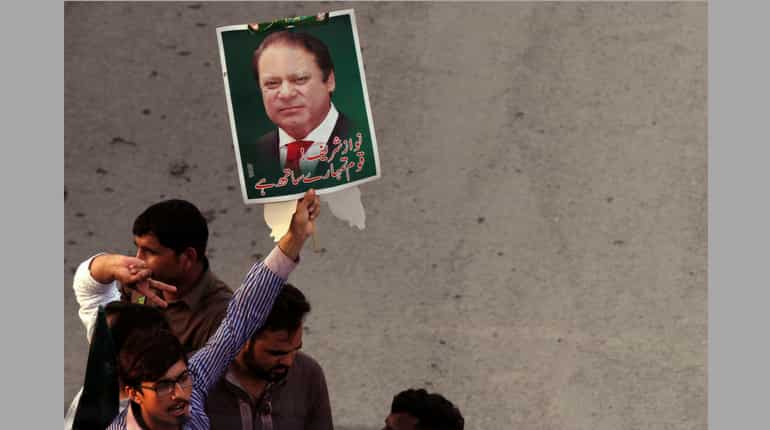
Nawaz Sharif
Polls show Imran Khan's PTI and the jailed Nawaz Sharif's PML-N in a tight race.
Pakistanis will go to the polls tomorrow to elect a new prime minister in the second democratic transition of power in the nation's 70-year chequered history. Here's taking a quick look at the key contenders in Pakistan's mega electoral battle and some crucial facts ahead of tomorrow's historic polls.
1. According to the Election Commission of Pakistan (ECP), 3,459 candidates are contesting for 272 general seats of the National Assembly, while 8,396 candidates are running for 577 general seats of the four provincial assemblies - Punjab, Sindh, Balochistan and Khyber-Pakhtunkhwa.
2. There are 105.96 million registered voters in the country.
3. The voting on more than 85,000 polling stations will start at 8.00 am and will continue till 6.00 pm. The counting of votes will be done on the spot soon after polling is concluded and results will be announced within 24 hours.
4. A fierce battle is expected between Sharif's PML-N and Khan's Pakistan Tehreek-i-Insaf (PTI) in Punjab, the most populous province often known for deciding the next government in the country.
5. For the first time in 2013, a civilian government in Pakistan completed its five-year term.
6. The ECP has taken elaborate measures to ensure that elections are held peacefully and in a fair and transparent manner.
7. More than 1.6 million polling staff will perform duties on the election day. About 400,000 police officers and 371,000 army troops have been deployed across the country.
8.Polls show Imran Khan's PTI and the jailed Nawaz Sharif's PML-N in a tight race. Bilawal Bhutto's PPP is expected to play kingmaker should neither party win a majority.
9.A new Islamist political party launched by Hafiz Saeed's followers has been banned.
10. Religious parties - some new, others established - are fielding more than 1,500 candidates for national and provincial assemblies, compared with a few hundred in 2013.
The big three: PPP, PTI, PML-N
Pakistan's three main parties all stress devotion to Islam, but the new religious parties portray them – especially the PML-N - as leading Pakistan down a Western-inspired path away from the country's Islamic values.
Cricket star-turned-politician Imran Khan is hoping to become Pakistan's prime minister after 20 years of being dismissed at the polls, as the country prepares to vote in a tense election pitting him against the party of jailed ex-premier Nawaz Sharif.
However, the PML-N could reap a sympathy vote after Nawaz Sharif returned to be arrested on July 13 along with his daughter Maryam, leaving his cancer-stricken wife in a London hospital.
Undeterred Hafiz Saeed
Pakistan's Election Commission this year rejected Saeed's Islamic charity's application to register a political party, the Milli Muslim League, but the group later registered candidates under the name of an existing party, Allahu Akbar Tehreek, which now campaigns with Saeed's image on its posters.
Emerging contenders
One new party, Tehreek-e-Labaik Pakistan, campaigns under the rallying cry "death to blasphemers" and is fielding 566 candidates, Reuters reported.
Another party, the Sunni extremist Ahl-e-Sunnat Wal Jamaat (ASWJ), is also fielding dozens of candidates under a different name, even though it is banned as the political wing of Lashkar-e-Jhangvi (LeJ), which has killed hundreds of minority Shi'ite Muslims. The party denies links with LeJ.
What to expect?
Recent nationwide polls indicate a tight race, with Khan's party ahead on 30 per cent in one survey, compared to 27 per cent for PML-N. Sharif's party tops another poll with 26 per cent compared to 25 per cent for Khan's Pakistan Tehreek-i-Insaf (PTI).
The election campaign concluded at midnight yesterday after about two months. All parties have claimed that they will grab most of the seats.
Imran Khan has pledged to break the decades-old two party "status quo" of PML-N and its historical rival the Pakistan People's Party (PPP) -- led by Bilawal Bhutto -- which is expected to finish third place.
Shahbaz Sharif, the president of the PML-N, said that his party would not only win at the centre but would also form the government in Punjab and Khyber-Pakhtunkhwa provinces.
Despite a massive electoral exercise, there is a big question if the election would bring much needed political and economic stability in the country.
(With inputs from agencies)