As Nepal PM completes a year in office, US-China political rivalry unfolds

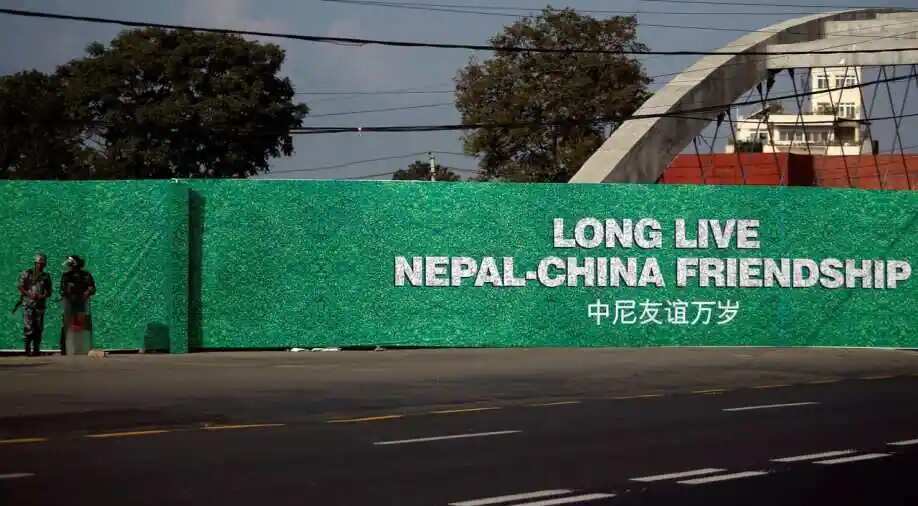
Nepal caught in a tussle between US and China
Nepal Prime Minister Sher Bahadur Deuba completes a year in office, and questions have been raised about Nepal’s non-aligned foreign policy.
Deuba was appointed the prime minister after the country’s supreme court ordered his appointment to replace CPN-UML leader KP Sharma Oli.
Now, during his time as the prime minister, concerns have come to light in China about whether Nepal is tilting towards the west.
This comes after the Nepal Parliament ratified the United States Millennium Challenge Corporation Nepal Compact despite China's strong reservations.
Despite significant political and economic investment from Beijing, Washington seems to have made new inroads in the country through a $500 million grant from the MCC.
Irked by the Nepali parliament’s passage of the MCC grant, the Chinese foreign ministry spokesperson alleged that Washington was undermining the sovereignty of other countries through “coercive diplomacy.”
Recently, another US State Partnership Program (SPP) in the field of security and military caused a flurry of debates in the country. China expressed grave concerns over whether Nepal would be a US ally in defence cooperation. The Chinese government even commended the decision after the Nepal government decided not to participate in the SPP.
A big power political rivalry is unfolding in the Himalayan nation, the Chinese vs the United States. China's government is accusing the US of luring Nepal into a military alliance.
In between the power-political rivalry, PM Deuba is scheduled to pay an official visit to the US later this month as this year marks the 75th year of diplomatic relations between the United States and Nepal.
Meanwhile, within five months second high-level delegation from China visited Kathmandu. Currently, Liu Jianchao, head of the International Liaison Department of CPC is in Nepal, reportedly to reunite the communist forces in the country.
In March, Chinese Foreign Minister Wang Yi visited Nepal which appeared to have been more of a fact-finding and damage-control exercise.
A few key agendas of Liu Jianchao's visit are to build party-to-party relations between the CPC and Nepal’s political parties, expedite the China-led Belt and Road Initiative (BRI), assess the ground reality for the upcoming elections and promote Chinese interests in Nepal, and also reminding Nepali leaders about China’s geopolitical sensitivities.
Nepal is heading towards provincial and federal elections that will take place later this year in November.
Liu Jianchao is visiting Kathmandu when there are talks about a possible electoral alliance among Nepal’s communist parties.
The largest communist party, the CPN-UML, is the main opposition, while another, CPN (Maoist Centre), is a partner in the ruling coalition led by the Nepali Congress.
Outlining the different facets of the visit, Binoj Basnyat, Maj. Gen. (Retd), and strategic analysts, South Asian Affairs told WION, "The visit is to reinstate the diplomatic engagements with the political forces in Nepal particularly with the democratic forces which are leading the government today. The second is to initiate unity or an alliance amongst the left parties for the upcoming election. The third is to reiterate China's interest and activities aimed against China's interest in Nepal,"
Jianchao held a meeting with Prime Minister Deuba and matters related to mutual interest were discussed as per the Foreign Ministry.
Meanwhile, Sundarnath Bhattarai former ambassador and acting president of the Chinese Study Centre believes, it is a regular visit.
"They meet all leaders of all the political parties. Jianchao started by meeting Sher Bahadur Deuba who is a Nepali Congress leader. They (China) don't distinguish between communist parties and other parties but they feel easier to deal with them just when KP Sharma Oli was the Prime Minister. It is quite natural for them to feel convenient working with communist parties", Bhattarai told WION.
"This visit can also be seen in the backdrop of the MCC ratification. The Pacific commander Charles Flynn visited Nepal and proposed Nepal to be part of SPP which is a strategic army policy against China which Nepal did not accept," he added.
Commenting on Under Secretary for Civilian Security, Democracy, and Human Rights and US Special Coordinator for Tibetan Issues Uzra Zeya's visit to a Tibetan refugee camp in Kathmandu, Bhattarai said, "It was an open secret that America's interest in Nepal is because of Tibet. She came to Nepal after visiting Dalai Lama in India whom we do give official recognition.
Bhattarai also said, "America wants to involve Nepal in their policy of containment against China and we don't to be involved."
Well, it is not the first time China is interfering in Nepal’s domestic politics and internal affairs. In 2020, a series of high-level visits took place in Nepal from Beijing to solve the rift between the then-ruling Nepal Communist Party (NCP), a coalition government, formed after a merger of the CPN-UML and Maoists Centre.
China’s Defence Minister, Wei Fenghe, visited Kathmandu on 28 November 2020. Thereafter, China’s ambassador to Nepal, Hou Yanqui, who played an important role in uniting the two factions of the NCP in May, also intensified her parleys with influential political leaders of the country, apart from the President of Nepal, Bidya Devi Bhandari.
Here, the question is what interest does the Chinese have in Nepal’s politics?
Basnyatsays the upcoming election is not only important for Nepal but also to divisional friends, particularly to neighboring countries India and China.
"The upcoming election will guide the political forces in power in Nepal on how they are going to deal both politically and diplomatically with friendly nations. So, the political forces particularly the left and the interest of China would come because naturally and ideologically the left thinks alike," he added.
China was not comfortable with the way the NCP split. Its efforts to unite the Oli-led CPN-UML and the Dahal-led CPN (Maoist Centre) to promote its interests in Nepal through BRI and other means could meet setbacks if there is no communist government.
The Chinese Communist Party had worked hard at unifying and successfully bringing the Nepal Communist Party to power in 2018. Then Nepali prime minister K.P. Sharma Oli was viewed as Beijing’s man.
In return, Beijing secured binding assurances that the Nepali government would back China on top of Chinese concerns like Taiwan and Tibet, as well as a clear commitment to Nepali participation in the BRI.
Basnyatbelieves the communist government is not in the interest of Nepal.
"The UML is a left party and more inclined to the socialist party. Whereas, other left parties are more communist in nature. So they being aligned together would more assist communism philosophy in the country rather than the democratic practices that would prevail. The UML and Maoist staying separate without an alliance will in the interest of democratic practices,"Basnyatsaid.
Other than the ratification of the MCC, major niggling issues between the two governments have also acted as irritants, including Chinese border violations in Nepal’s Humla district and China's failure to resume cross-border trade at two major passes with Nepal, the Tatopani-Zhangmu and Rasuwagadhi-Kerung pass. Trading between the two countries is suspended since the coronavirus pandemic due to which the relationship has frayed.
