'Akhand Bharat' mural row: Nepali leaders get irked, urge Prachanda to raise issue with Indian officials

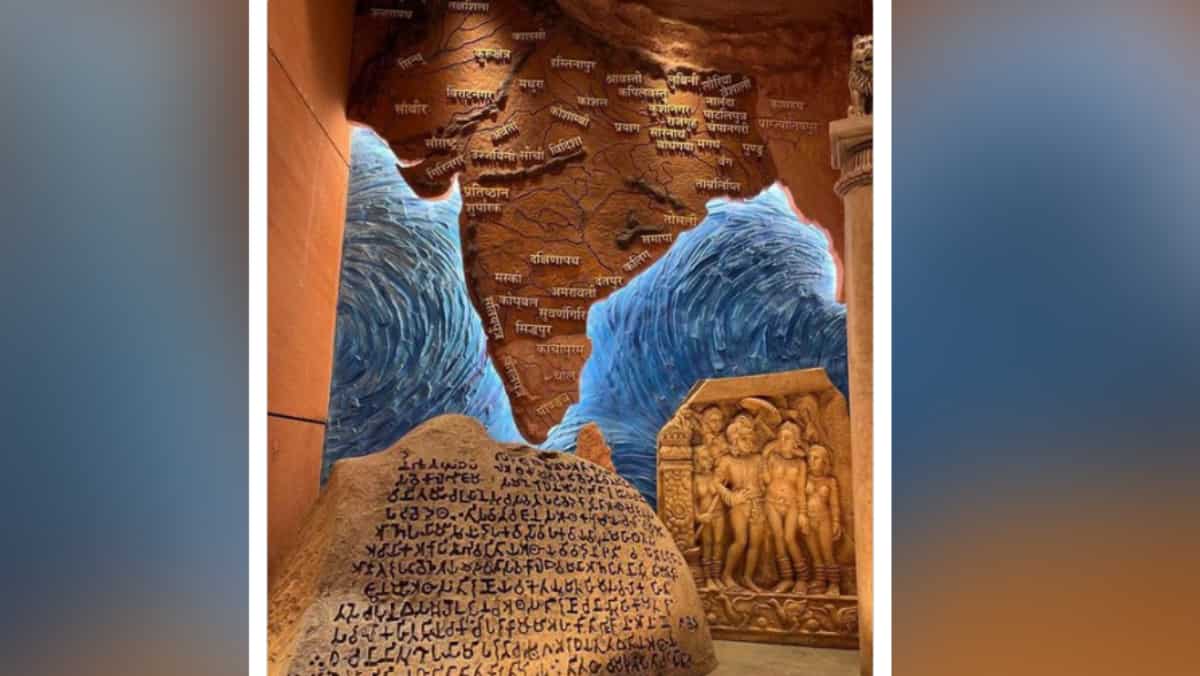
Mural at Indian Parliament building
The inauguration of the new Indian Parliament seems to be marred with a fresh controversy, this time a diplomatic one, over a mural inside the building that shows all the key kingdoms and ancient cities portraying ancient India.
One of the cities shown in the mural which drew severe criticism is Lumbini, the birthplace of Lord Buddha. The mural, appears to have come from the concept of 'Akhand Bharat', a term that refers to the undivided India whose geographical area included present-day Afghanistan, Pakistan, Bangladesh, Sri Lanka, Myanmar, and Thailand.
This concept is espoused by Hindutva nationalists envisaging that the neighboring countries Afghanistan, Bangladesh, Bhutan, India, Maldives, Myanmar, Nepal, Pakistan, and Sri Lanka would become part of India.
Nepalese leaders protest over controversial mural
With the holy site of Lumbini being one of the crucial cultural centres in Nepal, the leaders of the nation are now protesting for the removal of the mural from the new Parliament building.Nepal's former PM KP Sharma Oli on Tuesday urged PM Pushpa Kamal Dahal also known as “Prachanda” to discuss this with the Indian officials and urge them to get the mural removed from the new Parliament building.
Lumbini reflects the shared cultural relationship between India and Nepal. Indian Prime Minister Narendra Modi and his Nepalese counterpart Sher Bahadur Deuba in May last year participated in the foundation stone laying ceremony for the construction of a Centre of Buddhist Culture and Heritage at this holy site on the occasion of Buddha Jayanti.
Also Read | US: Mumbai 26/11 attack accused Tahawwur Rana challenges order of his extradition to India
Nepal's opposition CPN-UML party leader Oli reacted over the mural saying, “That is not fair,” reported The Kathmandu Post.
“If a country like India that sees itself as an ancient and strong country and as a model of democracy puts Nepali territories in its map and hangs the map in Parliament, it cannot be called fair,” he added in a statement at his party’s headquarters.
Kalapani dispute
India and Nepal have been at a diplomatic standstill on the issue of Kalapani. Both countries lay claim to the territory which is located in the easternmost corner of Pithoragarh district in the Indian state of Uttarakhand.
In November 2019, India published a revised political map that showed Kalapani as part of the Pithoragarh district. Agitated by this, the Nepali leaders registered their protest and brought that up with the Indian officials.
Watch | Hollywood star Bruce Willis' daughter Tallulah talks about her father's daily battle with dementia
Another diplomatic jolt was felt in India-Nepal relations when on 8 May 2020, India inaugurated a strategically crucial link road connecting the Darchula-Lipulekh pass link road that passes through the Kalapani region. At the time, Kathmandu summoned the then-Indian envoy to Nepal, Vinay Mohan Kwatra, to register the protest.
Pakistan reacts over mural controversy
One of the other cities that the mural shows is the ancient city of Taxila or Takshashila, which is presently in Pakistan but was a part of India. The country's foreign ministry spokesperson Mumtaz Zahra Baloch dismissed the map and expressed astonishment over the mural at the ministry'spress conference.
"The gratuitous assertion of 'Akhand Bharat' is a manifestation of a revisionist and expansionist mindset," a statement by the ministry said.
India-Nepal bilateral ties
The protest by the Nepali leaders comes at a time when Prachanda is visiting India are taking place at a time when Kathmandu and New Delhi are looking forward to bolstering diplomatic ties by resolving the remaining border issues.
Nepali PM who is in India for a four-day visit held a bilateral meeting with PM Modi where the latter said the nations will continue to work to take the bilateral relations to the height of the Himalaya and will resolve all the issues, be it the boundary issue or any other issue.
"I am happy to share that the partnership between India and Nepal has been a super hit,” PM Modi said.
WATCH WION LIVE HERE
You can now write for wionews.com and be a part of the community. Share your stories and opinions with us here.