Women may be more resilient to physiological stresses of space travel than men, says study

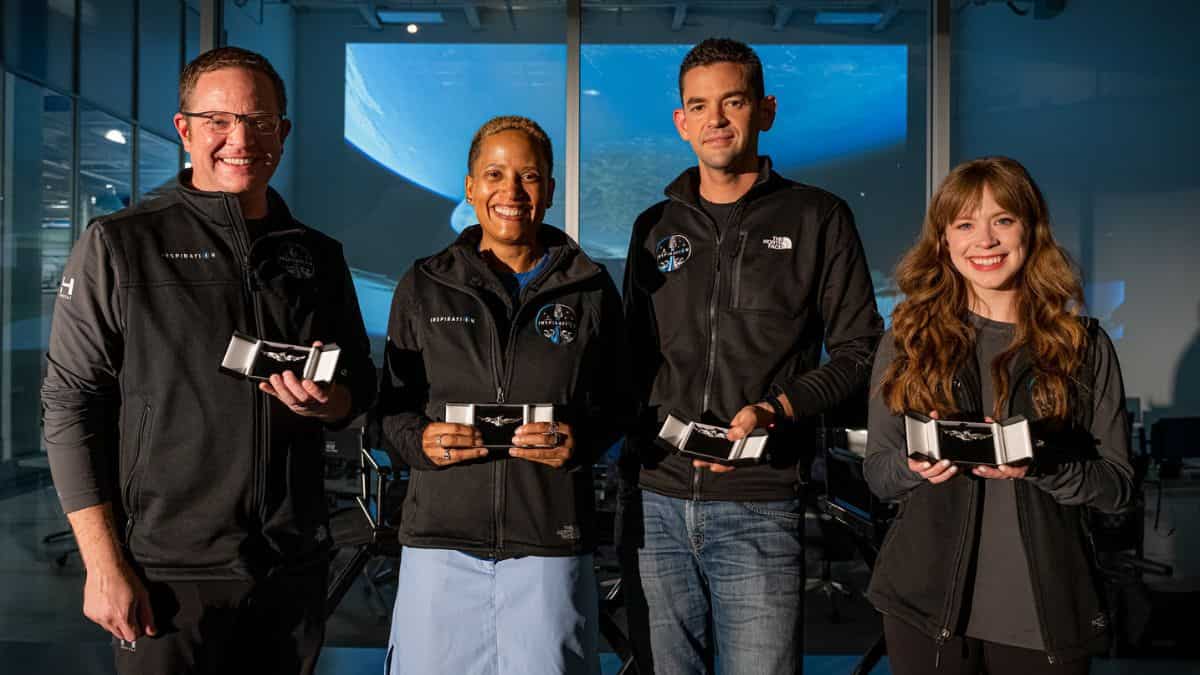
Crew members of the Inspiration4 mission. Credit: the Inspiration4 crew
Travelling to outer space is no easy task but a tough female astronaut can conquer it all.
New research by scientists intended to study the ways in which a human body reacts to the challenges in outer space has suggested that women are more resilient to the physiological stresses of space travel than men.
The study helmed by Christopher Mason, a physiology professor at Weill Cornell Medicine in New York, also says that women space travellers quickly recover upon landing back toEarth as compared to men.
“Males appear to be more affected by spaceflight for almost all cell types and metrics,” the research paper mentioned.
Researchers examined data that they collected from over 60 astronauts (both male and female) who travelled to outer space to find out how their immune systems reacted to the spaceflight.
They also collected similar data from the fourindividuals who were a part of SpaceX's Inspiration4 mission and flew around Earth for three days in 2021 and compared the two.
The results demonstrated that the men experienced more disruptions in their gene activity as compared to women and took more time to come back to normal upon returning to Earth.
“The aggregate data thus far indicates that the gene regulatory and immune response to space flight is more sensitive in males,” the scientists wrote. “More studies will be needed to confirm these trends, but such results can have implications for recovery times and possibly crew selection, for example, more females, for high-altitude, lunar, and deep space missions.”
It is not yet known why women could be more resilient to spaceflight than men, however, Mason said that one of the contributing factors to this might be a female body's power to cope up with the demands of pregnancy.
“Being able to tolerate large changes in physiology and fluid dynamics may be great for being able to manage pregnancy but also manage the stress of spaceflight at a physiological level,” he said.
(With inputs from agencies)