Voyager 1 at one light-day: Spacecraft to reach unthinkable milestone after 49 years

&imwidth=600&imheight=450&format=webp&quality=medium "Voyager 1 at one light-day: Spacecraft to reach unthinkable milestone after 49 years")
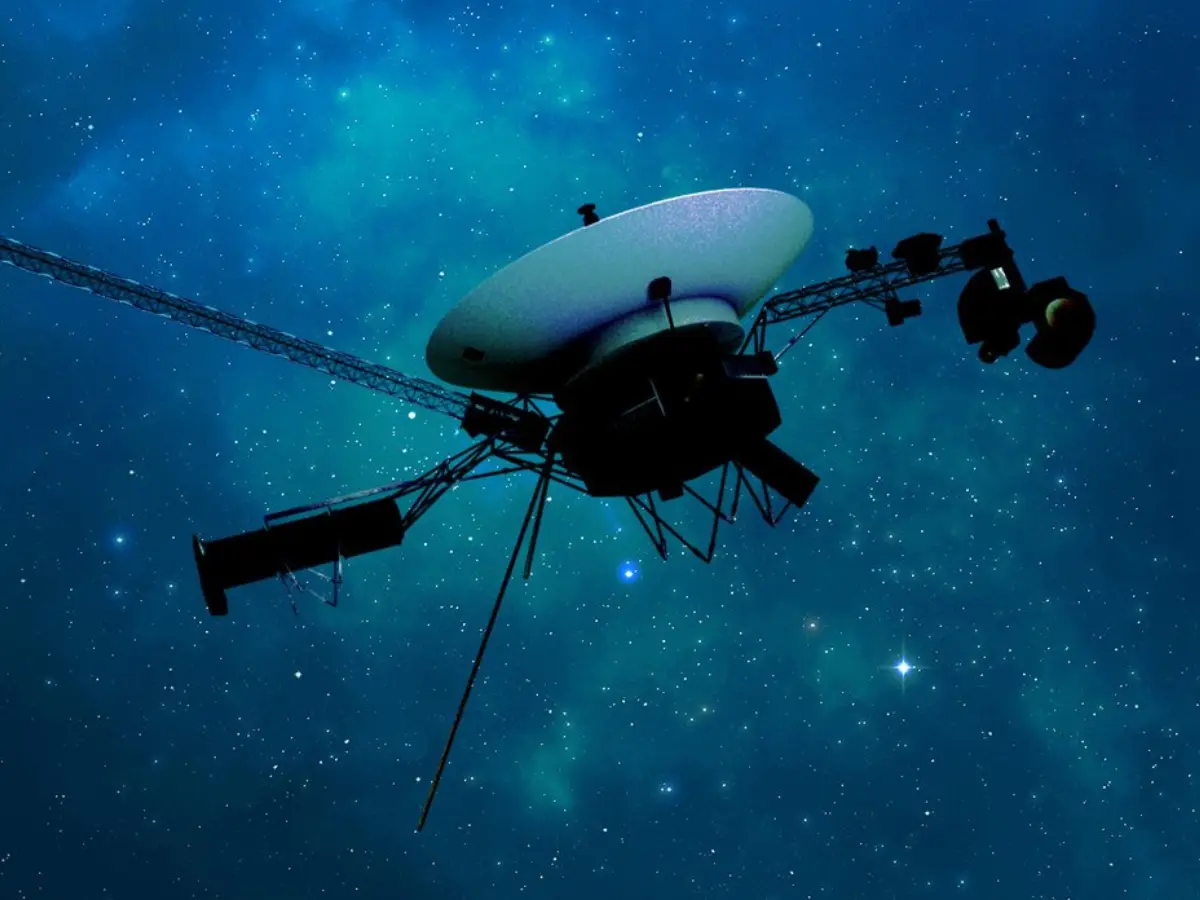
Voyager 1 was launched in 1977 and will reach a historic point in space in 2026. Photograph: (NASA)
Voyager 1 was launched in 1977, and after 49 years of travelling, it will reach a milestone in space that was once thought unachievable. The spacecraft is still going strong, and in 2026, it will make yet another record, one of light-day proportions.
Voyager 1, the spacecraft that took off from Earth in 1977 and is today careening through the vast expanse of interstellar space, is gearing up to reach a historic point in the universe. In November 2026, Voyager 1 will become the first man-made spacecraft to travel to a mark that is one light-day from Earth - a point light takes an entire day to reach from our planet. NASA's spacecraft is still going strong even after 48 years. It has accomplished several milestones in this time, and the one set to occur in 2026 will be the highlight of its space journey. Right now, Voyager 1 is around 24 billion kilometres from Earth and travelling at a speed of 61,195 kilometres per hour. That's slow in space, but still effective for Voyager. It is the most distant human-made object from Earth. One of its many aims is to encounter alien life. In preparation for that day, the Voyager is carrying a Golden Record with a message from humans. Also Read: Voyager spacecraft crossed 'wall of fire' to reach interstellar space. What is it?
Voyager 1 and the wall of fire
In 2026, Voyager 1 will be 25.9 billion kilometres from Earth. If light is beamed from Earth towards Voyager at this point, it will take exactly 24 hours to reach it. It would be a defining moment in human space exploration and its journey so far in exploring the expanse of the universe. The momentous occasion is still over a year away, but scientists are already eagerly preparing for it. Voyager 1 and Voyager 2 have achieved several important points in space and also shed light on the planets in the solar system as they visited them on their way to outer space. When the Voyager probes reached the heliopause, the edge of the heliosphere, they encountered temperatures of 54,000-90,000 degrees Fahrenheit. This point is also called the “wall of fire” because of the extreme temperatures. Despite the high heat, they survived and, as per NASA, Voyager 1 reached the interstellar boundary in 2012. After it crossed the heliosphere, the protective bubble of solar wind, it started sending data about outer space. Also Read: NASA fixes a 21-year-old fault aboard Voyager 1 that no one thought could ever be solved
Till when will Voyager 1 work?
Voyager 1 also made crucial discoveries at Jupiter and Saturn, where it found new moons and rings of the two planets. It photographed Jupiter in January 1979 and, in March, made its closest flyby of the planet at a distance of about 349,000 kilometres. Next was Saturn and Voyager 1, the ringed planet, in November 1980, with the closest approach on November 12, 1980. NASA is doing all it can to keep it going for as many years as possible. The spacecraft is expected to remain strong until the 2030s at least, after which its systems will die down. Recently, the space agency managed to revive thrusters aboard the Voyager 1 spacecraft that stopped working in 2004. There is a range of scientific instruments on board Voyager 1 that help it send back data from interstellar space. To increase its life, many of its instruments have been turned off to conserve power. Voyager 1 has proven that it is a marvellous feat designed by humans, having endured radiation and the harsh environment of space.

