US women getting tubes tied 'doubled' after constitutional right to abortion revoked

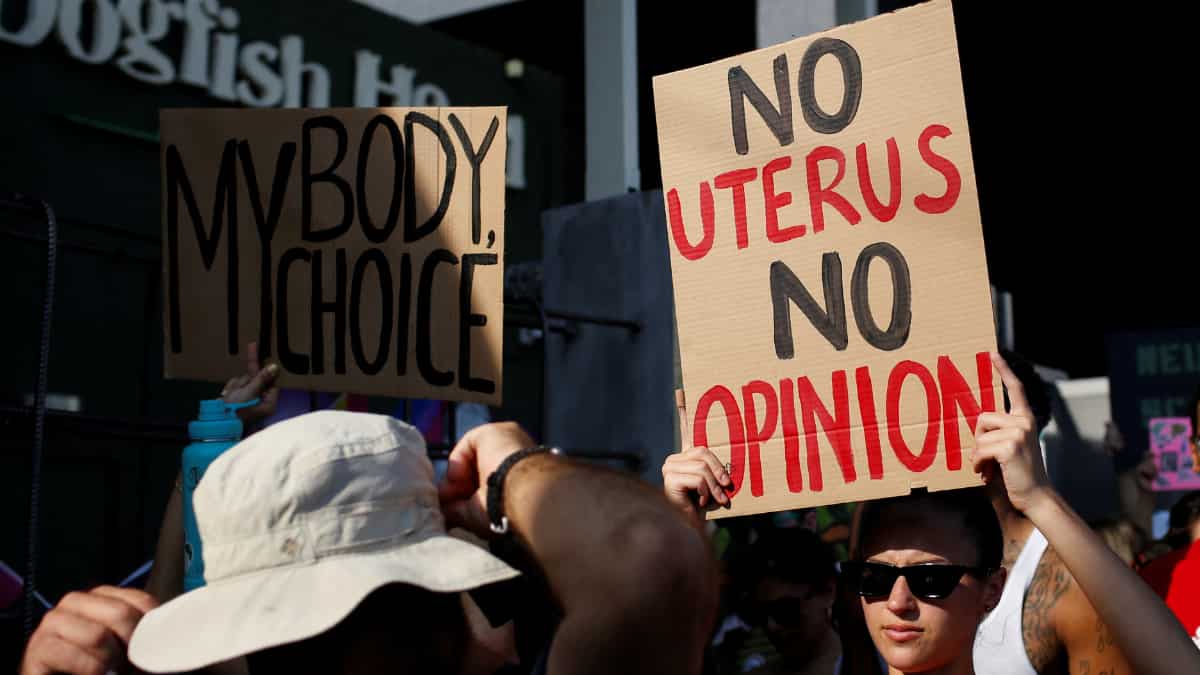
An abortion rights protester holds a sign as she demonstrates after the US Supreme Court's ruling on abortion.
On Wednesday (April 10), Arizona's top court revived a Civil War-era law from 1864, which puts a near-total ban on abortion. The law makes it a felony to provide an abortion or help a person obtain one.
According to a new paper in the journal JAMA Health Forum, adults are seeking permanent contraception after the US Supreme Court overturned Roe V. Wade in 2022 and took away the 'constitutional' right to abortion. Since then, more and more US states have completely banned abortions with others imposing limited access on abortions.
The study analysed data from 113 million people across the United States and found that there's been an increase in permanent contraception in both men and women between the ages of 18–30.
Women's permanent contraception rate double then men
Women undergoing tubal ligations, known as 'getting your tubes tied' were twice as high as men undergoing vasectomies,
Since Roe v. Wade was overturned in 2022, there has been an immediaterise of 58 sterilization procedures for women, or around 5.31 procedures per 100,000 persons each month. This is roughly double the previous rate of 2.84 proceduresper month for women. Men had an overall increase of 27 procedures, but no significant increase in monthly procedures.
“The major difference in patterns of these two procedures likely reflects the fact that young women are overwhelmingly responsible for preventing pregnancy and disproportionately experience the health, social, and economic consequences of abortion bans,” lead author Jacqueline Ellison, said in a press release.
“Women and people who can get pregnant also disproportionately experience the health, social, and economic effects of unwanted pregnancy. Because of this and the fact that parenting responsibilities fall predominately on women, cisgender men may not feel the same sense of urgency to undergo permanent contraception,” Ellison added.
What do these findings imply?
The abrupt increase in permanent contraceptive methods shows fear or anxiety among young people with restricted abortion access. “What is concerning to me is that young people may be feeling pressure to use a contraceptive method that they otherwise would not prefer, which has implications for reproductive autonomy,” Ellison said.
What was the Roe v. Wade case about?
The 1973 Roe v. Wade judgment provided a foundation for legal abortion in the United States. Jane Roe, an unmarried pregnant woman, challenged Texas' abortion ban.
The court ruledin her favor, saying, "The United States Constitution provides a fundamental "right to privacy" that protects a person's right to choose whether to have an abortion. The abortion right is not absolute. It must be balanced against the government's interests in protecting health and prenatal life."
The Court overturned theruling in the Dobbs v. Jackson Women's Health Organization case in 2022, eliminating the 'constitutional' right to abortion.
