Twilight clouds, dust clouds and more line the atmosphere of Mars

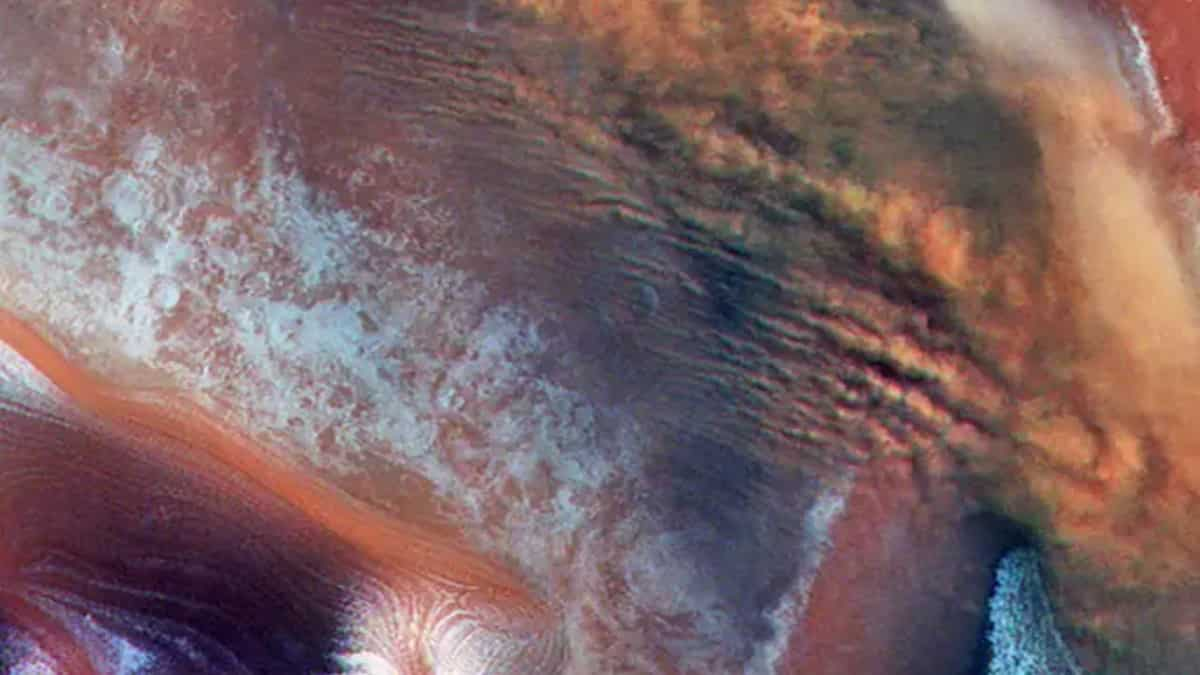
Mars clouds
Mars, Earth's nearest neighbour, has caught the imagination of scientists who have been keenly studying the red planet for signs of life and to know whether humans can one day live there. One such research has revealed the amazing cloud patterns that run on Mars.
Images of clouds on Mars have been captured by the High Resolution Stereo Camera (HRSC) instrument in orbit on board the European Space Agency (ESA) Mars Express spacecraft since 2005.The collection spans more than 20 years.
The collection of cloud pictures, or "cloud atlas", shows the amazing atmospheric phenomena witnessed there. While some of them are similar to ones seen on Earth, others are unique.
The atlas has been made by Daniela Tirsch at the German Aerospace Center in Berlin and her colleagues who collected images of these clouds.
The dazzling array of clouds comes into existence when its thin atmosphere, made up of primarily carbon dioxide, condenses and mixes with dust and water vapour.
"Clouds on Mars are just as diverse and fascinating as those we see in our skies on Earth, with some features unique to the red planet," Tirsch said.
The ones that resemble those on Earth are the gravity wave clouds. The thin clouds are formed when features on the land below force parts of the atmosphere upwards which then interact with other columns of atmospheric gas.
The other types of clouds are cloud streets which spread out over larger regions. They look the same as gravity wave clouds but are caused by chaotic currents in Mars’s atmosphere. Speaking about the clouds, Tirsch said at the Europlanet Science Congress in Berlin, "They are enigmatic but beautiful."
"One of my favourite phenomena are the beautiful 'cloud streets'—linear rows of fleecy clouds that develop around the huge volcanic Tharsis rise and the northern lowlands in northern spring and summer. While they resemble cumulus clouds on Earth, they are formed under different atmospheric conditions," said Dr Tirsch.
The clouds not found on Earth are the dust clouds formed due to the planet's atmospheric conditions. These clouds are bright red, carry huge amounts of Martian dust and can extend for hundreds of kilometres.
"We also see impressive dust clouds that can spread hundreds of kilometres—a phenomenon we luckily don't experience on Earth."

(Photo:ESA/DLR/FU Berlin/A. Cowart)
Unique features of Mars give birth to orographic clouds. These are seen near volcanoes when large amounts of gas is forced upwards. Some of these clouds can also mix with dust or dust-filled storms and create clouds that look like eruptions.
The twilight clouds especially stunned the researchers. “We were astonished at the wealth of morphologies that twilight clouds could have,” said Tirsch.
They form near the horizon as the sun rises on Mars and take on different appearances.

