Sword and mirror unite: Ancient grave sheds light on female warriors during Iron Age in Britain

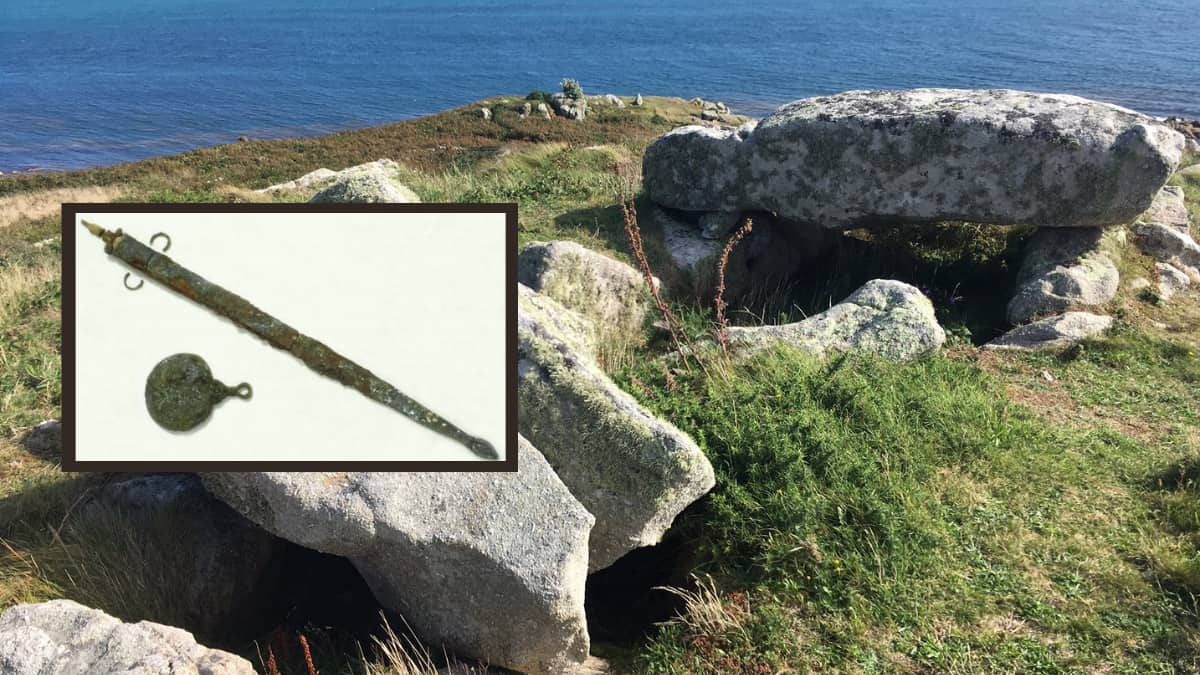
Bryher grave
A long-standing enigma surrounding a 2,000-year-old grave on the Isles of Scilly has finally been solved, and in doing so, has raised intriguing questions about the role of women in Iron Age warfare in Britain.
For decades, archaeologists have pondered whether the stone-lined burial chamber discovered in 1999 on Bryher contained the remains of a man or a woman. Now, scientists may have some answers.
Man or woman? A warrior
Unearthed in the chamber were a sword in a copper alloy scabbard and a shield, objects that are typically associated with men.
However, leaving scientists scratching their heads, were other objects usually associated with women — a brooch and a bronze mirror, adorned with what appeared to be a sun disc motif.
These mix of objects, the coexistence of a mirror and a sword, made the grave stand out as unique in Iron Age Western Europe. Both the objects from the Bryher grave are now on display at the Isles of the Scilly Museum.
Now,a scientific study led by Historic Englandhas deduced that the remains indeed belong to a woman.
This groundbreaking discovery could provide valuable insights into the roles of female warriors during the Iron Age.
How did scientists achieve this feat?
Initially, conventional methods such as DNA analysis were used, however, due to the disintegration of the bones, they failed. Only a dark soil stain and small fragments of bone and teeth, totalling about 150g, were recovered from the skeleton.
The Guardian reports that advances in scientific techniques, particularly a sophisticated method developed at the University of California, Davis, allowed researchers to test tooth enamel. Their findings are published in the Journal of Archaeological Science: Reports.
Dr Glendon Parker, from UC Davis, explained, "Tooth enamel is the hardest and most durable substance in the human body. It contains a protein with links to either the X or Y chromosome, which means it can be used to determine sex. This is useful because this protein survives well compared to DNA."
"Our analysis involved extracting traces of proteins from tiny pieces of the surviving tooth enamel. This allowed us to calculate a 96 per cent probability that the individual was female," added Parker.
A sword and a mirror
As per The Guardian report, in ancient times, warfare primarily consisted of surprise attacks and raids on enemy settlements. The mirror and weapons found in this grave are all closely associated with such warfare.
Mirrors, along with aritualistic significance,may have also played a role in signalling, communication, and coordinating attacks during the Iron Age.
Dr Sarah Stark, a human skeletal biologist at Historic England, highlighted that the findings provide evidence of a woman holding a leading role in warfare on Iron Age Scilly.
"Although we can never know completely about the symbolism of objects found in graves, the combination of a sword and a mirror suggests this woman had high status within her community and may have played a commanding role in local warfare, organising or leading raids on rival groups," said Stark.
This revelation challenges previous assumptions about gender roles in Iron Age society, and could hint that "female involvement in raiding and other types of violence was more common in Iron Age society than we’ve previously thought, and it could have laid the foundations from which leaders like Boudicca would later emerge," she said.
(With inputs from agencies)
WATCH WION LIVE HERE
You can now write for wionews.com and be a part of the community. Share your stories and opinions with us here.

