Submerged wall could be largest Stone Age megastructure in Europe

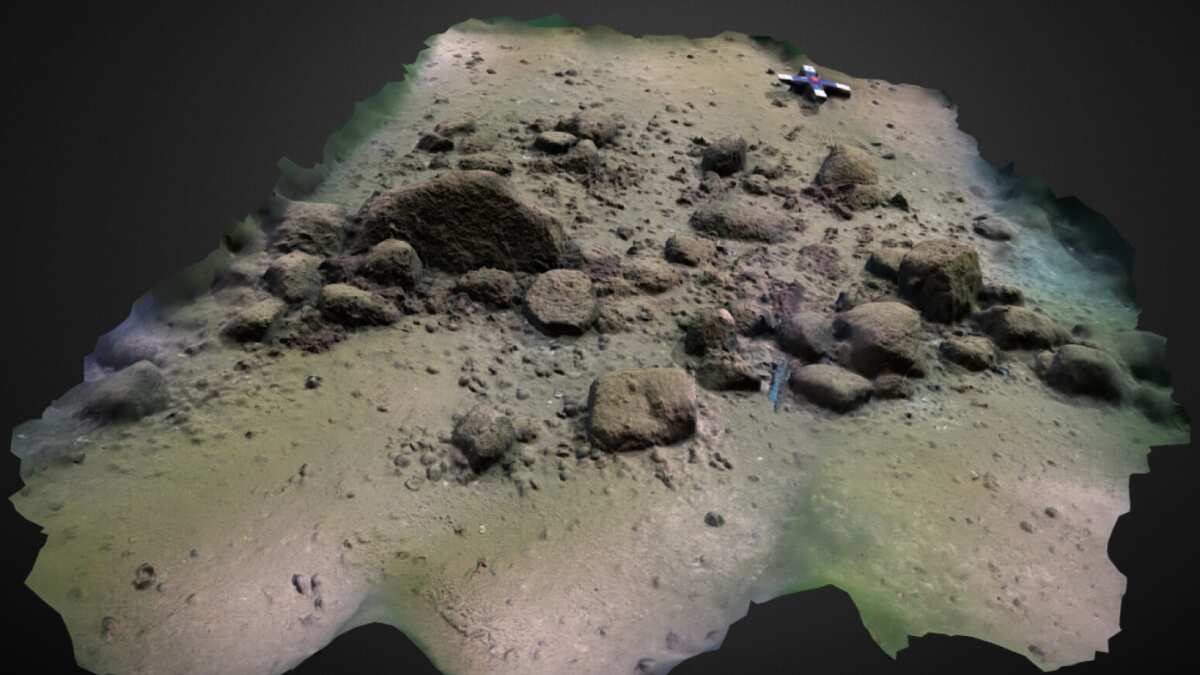
Blinkerwall
A Stone Age wall was found at the bottom of the Baltic Sea. The wall could be the largest Stone Age megastructure in Europe which is believed to be built by humans.
Researchers have said that a kilometre-long wall, dubbed the Blinkerwall, has been found 21 metres below the surface of the Baltic Sea off Germany's Baltic coast. The wall contains around 1,700 stones.
The wall possibly was built around 11,000 years ago to channel reindeer and other prey into places where they could more easily be killed.
The discovery was made by chance when the researchers were mapping seafloor depths with sonar in 2021. The team returned to the site with underwater cameras when initial data revealed odd protrusions down below.
Students were on a training exercise with geophysicist Jacob Geersen at the Leibniz Institute for Baltic Sea Research Warnemünde in Germany and during the initial study, they used a multibeam sonar.
As quoted by Science News, Geersen said, "When we found the rocks, I realised it's possibly not a natural process that put these rocks together."
He further said that the team again lowered a camera focusing on the structure in 2022, and then they found a row of stones. Geersen said, "It was only when we contacted the archaeologists that we understood it could be something significant."
Geersen said that "when you chase the animals, they follow these structures, they don't attempt to jump over them and "the idea would be to create an artificial bottleneck with a second wall or with the lake shore".
Another team member Marcel Bradtmöller, who is also an archaeologist at the University of Rostock, Germany, said that there's no reason or evidence for a modern structure to have been built underwater at this site. Bradtmöller noted that the team also can't think of any natural process that could create such a structure.
The researchers have written in Proceedings of the National Academy of Sciences that a second wall which ran alongside the Blinkerwall may be buried in the seafloor sediments.
"It was likely constructed by hunter–gatherer groups more than 10000 y ago and ultimately drowned during the Littorina transgression at 8500 y B.P. Since then, it remained hidden at the seafloor, leading to a pristine preservation that will inspire research on the lifestyle and territorial development in the larger area," the researchers said.
(With inputs from agencies)