Star circling two other stars that orbit each other shatters a 70-year-old record

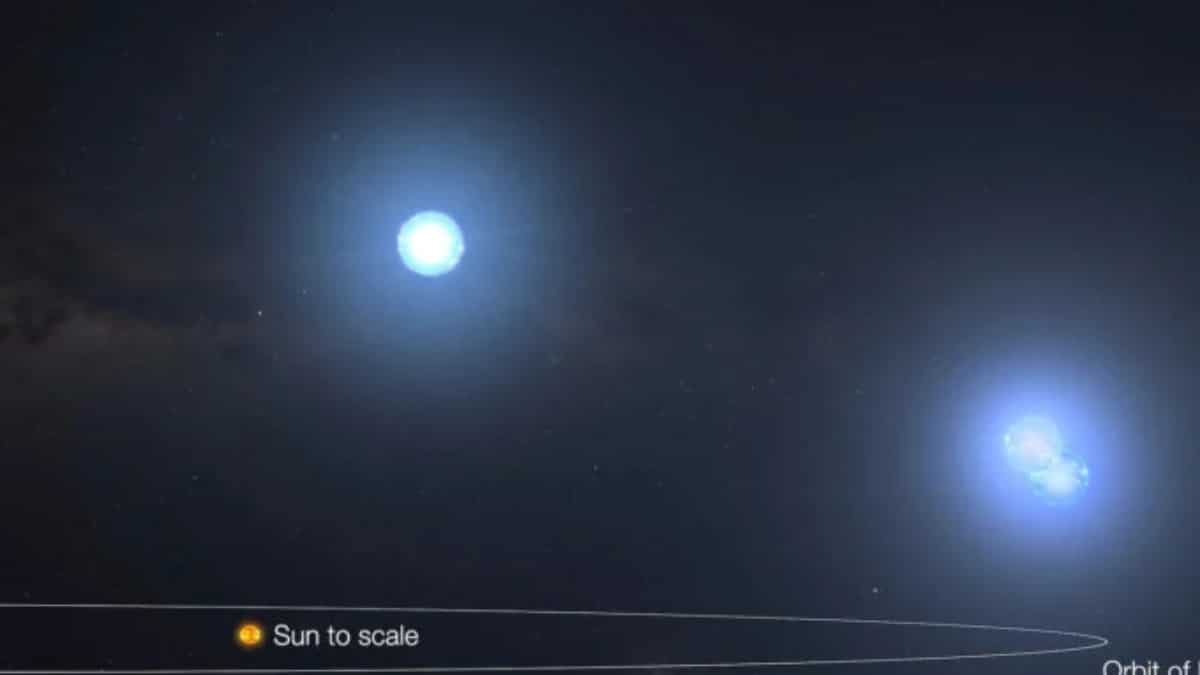
Three star system
A unique triple star system has been discovered using NASA's Transiting Exoplanet Survey Satellite (TESS) and Artificial Intelligence. A group of NASA astronomers and citizen scientists were stunned to see a distant trio of celestial objects locked with each other.
Designated TIC 290061484, details about the groundbreaking discovery have been published in The Astrophysical Journal. The system comprises two inner stars, both of which orbit each other every 1.8 days. The third star moves around this pair of stars and takes a little longer to complete one orbit, which happens in nearly 25 days.
The outer star has broken a nearly 70-year-old record for the shortest outer orbital period in such systems. The previous record was held by a third star that orbited an inner pair in 33 days which was found in 1956.
The discovery happened after TESS observed cosmic "strobe lights". Launched in April 2018, TESS has been purposed to find exoplanets and gaze into different star systems with its four high-powered cameras.
The TIC system is almost flat, making it easy for the satellite to detect changes in light as they pass in front of each other. The stars cross right in front of, or eclipse, each other while orbiting. At this moment, the nearer star blocks some of the farther star's light.
The trip bound to each other was found through flickers in starlight. The flickers were recorded and passed through a machine learning program, after which the pattern of dimming and brightening was found, indicating a three-star system.
Citizen scientists, IA Terentev of Russia and HM Schwengeler of Switzerland were then called in to examine the images taken by TESS and look for the large number of eclipses indicative of a 2+1 triple system.
They are part of the Visual Survey Group, where volunteers sort through images to help professional astronomers.
“It’s exciting to identify a system like this because they’re rarely found, but they may be more common than current tallies suggest,” Saul Rappaport, an emeritus professor at MIT, who led the Visual Survey Group and worked on the study, said in a statement.
"We're mainly looking for signatures of compact multi-star systems, unusual pulsating stars in binary systems, and weird objects," he added.
The orbits of the three stars is so tight that it can fit inside that of Mercury’s orbit around our Sun. This has meant that no planet was able to be born in the system. The study further says that the three stars will merge in about 20 million years, resulting in a supernova explosion.

