Explained | Spacecraft Mission Operations, the science that's steering Chandrayaan-3 to the Moon

Chandrayaan-3
"How is Chandrayaan-3 getting to the moon?" Most people posed with this question would reply that the Chandrayaan-3 spacecraft was launched into space by the Indian LVM3 rocket and thereafter the craft is propelling its way to the moon.
Of course, the launch of a rocket is the most spectacular moment of any spacefaring mission - it makes great visuals for television and social media, and the engine roar of the rocket is a certain goosebumps moment. However, a rocket launch mission (from lift-off to satellite injection) barely lasts 20 minutes (in the case of Chandrayaan-3 it was 16 minutes). So, how does the spacecraft safely and efficiently get to the moon in the six weeks that it travels in space? That's where a lesser-known science, 'Spacecraft Mission Operations' comes into play. The teams working on Spacecraft Mission Operations are the ones who remotely monitor, control and keep the spacecraft operational.
Mission planning
Think of it as planning a business trip by road. A whole variety of aspects need to be factored in - when to reach, when to leave, the route to take, backup plans etc. Planning a space mission is quite similar but with exponentially higher levels of complexity and no tolerance for errors. If the primary plans fail, there are multiple backup plans kept in place.
When Chandrayaan-3 was launched on July 14th, the vehicle lifted off at 2:35pm (IST) and on the same afternoon, ISRO announced that the Lunar landing is scheduled for 5:47pm (IST) on August 23. This indicates that the entire 40-day journey to the moon and the manoeuvres to be performed in between are planned well in advance, and they are precisely charted on a minute-to-minute basis.
While planning such missions, a whole variety of factors are taken into consideration. There is an entire branch of space science known as 'Orbital Mechanics' that is used to determine what is known as a 'Launch window', a period of time within which a certain launch must happen. Launch windows depend on a plethora of factors - place of launch, type of orbit intended, final destination, whether it is headed for another planet, number of satellites being carried, the time of the year, the position of the relevant celestial bodies and also near-nil risk of space debris.
Mission Operations
In a layman's view, a rocket launch mission is considered successful if the satellite is injected into its orbit. However, that is just the beginning of the constant process of mission monitoring, where various aspects of the spacecraft's health and performance have to be kept track of. For a spacecraft to work properly and safely, it has to be able to generate its own power, its antennae have to be positioned towards the earth, its systems and sensors must be functional, it must be kept clear of space debris, it must be kept safe from solar storms etc. From the time a satellite is placed in orbit, till the time its operational life ends (or it is disposed by de-orbiting), a spacecraft is constantly monitored.
Tracking, Telemetry and Command
It is one thing to launch rockets and spacecraft away from the Earth, but the purpose of the mission is fulfilled only if there is a constant communication link between the ground stations and the spacefaring rocket and spacecraft. Simply put, tracking and telemetry serve as the eyes and ears of any space agency. Using giant antennae positioned at various locations, it is possible to locate the craft, communicate with it, receive the data being shared by the craft and even issue commands to the craft.
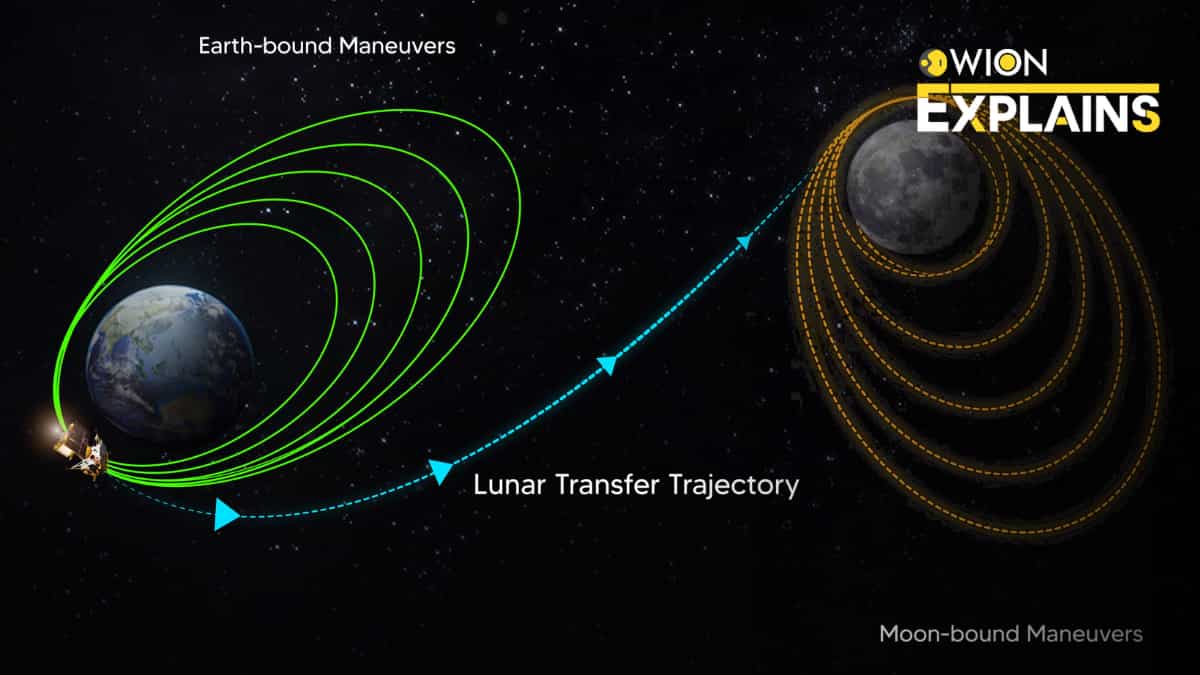
During its time in orbit around the earth, Chandrayaan-3 was commanded to perform five Orbit Raising manoeuvres, each of which slingshot it further away from the earth. Most recently (on August 1st), Chandrayaan-3 was pushed outside of Earth's orbit and put on a path that will lead it to rendezvous with the moon on August 5th. All of these manoeuvres performed by the craft are based on commands that are issued from the ground stations that ISRO operates.
ISRO Telemetry, Tracking and Command Network (ISTRAC), Bengaluru handles the major responsibility to provide tracking support for all the satellite and launch vehicle missions of ISRO. The major objectives of the centre are to carrying out mission operations of all operational remote sensing and scientific satellites, providing Telemetry, Tracking and Command (TTC) services from launch vehicle lift-off, till injection of the satellite into orbit and to estimate its preliminary orbit in space etc. In this endeavour, ISTRAC is supported by ISRO's Indian Deep Space Network, Karnataka.
Tracking Deep Space missions: An international collaborative effort
However large and capable, all radars and communication antennae have a specific range within which they can track and communicate. When tracking a rocket launch, tracking a global constellation of satellites or tracking deep space missions (interplanetary or Lunar missions), an extremely wide coverage of antennae from various locations are required. Such antennae and related infrastructure have to be installed at multiple locations and can cost huge sums of money.
ISRO's ISTRAC has established a network of ground stations at Bengaluru, Lucknow, Mauritius, Sriharikota, Port Blair, and Thiruvananthapuram, within India. Brunei, Biak (Indonesia) are the friendly-foreign nations where ISTRAC operates its overseas facilities. However, when a spacecraft like Chandrayaan-3 circles the earth and travels farther (the moon is 3.84lakh kms away), it is imperative to have a global network of stations that can offer tracking support.
As part of ISRO's International cooperation with major space agencies, multiple tracking stations belonging to NASA, the European space agency and Swedish Space Corporation are tracking Chandrayaan-3 from around the world. These include South Point Satellite Station in Hawaii, Goldstone in California, Kourou in South America (French Guiana), Madrid in Spain, Goonhilly in the UK and Canberra in Australia. The constant tracking from Indian and foreign stations ensures that India's Chandrayaan-3 spacecraft is visible to one or more stations at a time and can be monitored and safely steered towards the moon.
On August 23rd, at 5:43pm (IST), when the Lunar soft-landing of Chandrayaan-3 is planned, all eyes would be on ISTRAC in Bengaluru, as the station coordinates with its foreign collaborators to monitor the craft's all-important touchdown on Lunar soil.
WATCH WION LIVE HERE
You can now write for wionews.com and be a part of the community. Share your stories and opinions with us here.
