Solar shooting stars: Scientists left stunned by 'rain of fireballs' on Sun

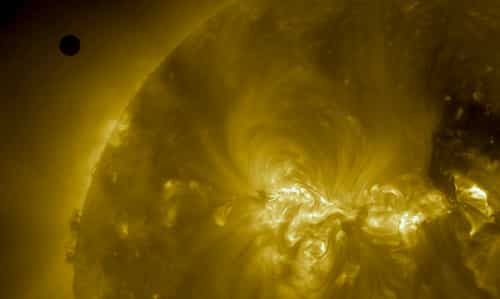
Shooting stars on Sun heat up Sun's corona and make some spots brighter
Astronomers have made a stunning discovery of meteor-like streaks falling on the surface of the Sun. Experts claim these solar shooting stars are different from the shooting stars we see on Earth. Here what we call 'shooting stars' are actually fragments of space dust or rocks that burn up in our atmosphere.
The solar shooting stars, on the other hand, are massive clumps of plasma that plummet to the Sun's surface at incredible speeds. You can simply call it a massive rain of fireballs, that play a key role in heating up the corona, the outermost part of the Sun's atmosphere.
How were these shooting solar stars observed?
The researchers observed these solar shooting stars using the Solar Orbiter spacecraft of the European Space Agency. This is the first time such impacts have been spotted. The observations reveal that these impacts create short but intense bursts of brightness and result in the upward movement of stellar material and shock waves that heat up the gas in the Sun's corona.
Watch:A Super-Earth will toss us into the Sun
Scientists believe that this discovery could help solve the mystery of why the corona, the outermost part of the Sun's atmosphere, is hotter than the layers beneath it. Because generally, solar models predict that the Sun should become hotter as we move closer to its core, but the corona defies this theory. Now, we seem to have solved this puzzle.
How are coronal rains formed on Sun?
The Solar Orbiter captured these phenomena while observing coronal rain, which is plasma firework displays consisting of gas with temperatures exceeding two million degrees Fahrenheit. Instead of water, coronal rains form when localised temperature drops, causingsolar plasma to condense into dense lumps. These lumps then fall to the cooler surface of the Sun, known as the photosphere, as fieryrain at speeds of up to 220,000 miles per hour.
The Solar Orbiter made these observations from a close distance of just 30 million miles from the sun, closer than the orbit of Mercury. The spacecraft, equipped with high-resolution cameras and sensitive remote-sensing instruments, detected the heating and compression of gas under these coronal rains.
Why spotting shooting stars on Sun is difficult?
Unlike shooting stars on Earth, which develop bright tails due to friction in our atmosphere, these solar shooting stars lack bright tails. This is because powerful magnetic fields in the sun's corona strip gas from the falling clumps, preventing the formation of tails and making the observation of solar meteors challenging until now.
WATCH WION LIVE HERE