

&imwidth=800&imheight=600&format=webp&quality=medium "Smiley face spider discovered in Indian Himalayas. It was only ever found in Hawaii")
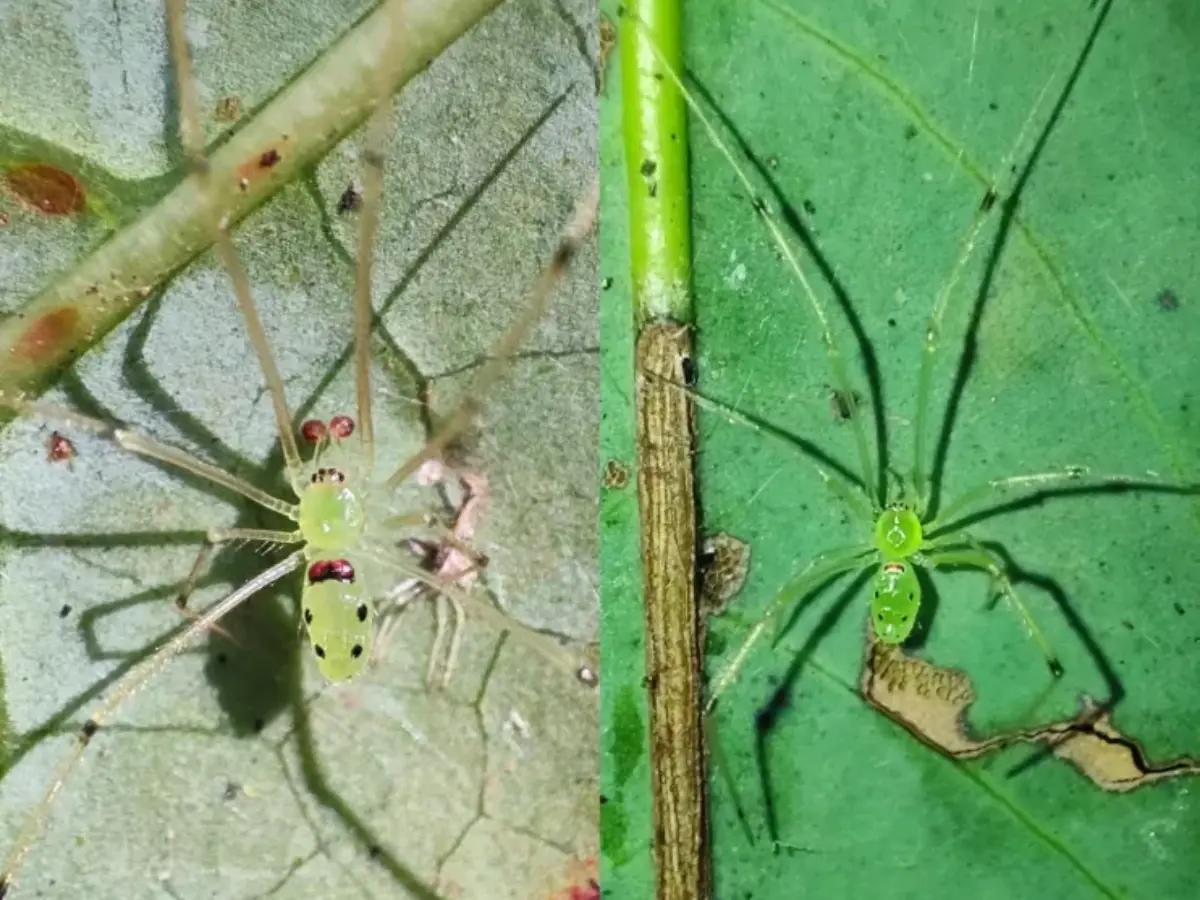
A spider with a smiley face on its back has been discovered in the Himalayas. The arachnid was believed to be native to Hawaii, so finding it in a region of India has left scientists pretty much amazed. The Theridion grallator has this cheerful display on top of its abdomen. The spider is tiny and has a vibrant green hue. It was first seen in Hawaii in 1900, and for the longest time, it was only seen there. But now we know that this is not the only smiley spider species in the world. According to the study published in the journal Evolutionary Systematics, there is one more of its kind in the Himalayas. The new spider has been named the Himalayan happy-face spider (Theridion himalayana). The discovery was made by researchers from India’s Forest Research Institute and the Regional Museum of Natural History. They were on an expedition in Uttarakhand to map, catalogue ant biodiversity. This is when this tiny arachnid caught their attention.
Devi Priyadarshini, biologist at the Regional Museum of Natural History, said in a statement, "My co-author [Ashirwad Tripathy] kept sending me spiders from high altitude regions for identification. One day, he sent me a photo of an arachnid clinging to a Daphniphyllum leaf." Priyadarshini said she was instantly shocked to see the creature. “I had seen the Hawaiian spider during my master’s program…I knew instantly we had a jackpot because of its striking resemblance,” Priyadarshini said. Tripathy continued to make a record every time he came across a similar-looking spider. All 32 of them appeared to be the same species and had a smiley dot-and-stripe colouration pattern, known as morphs.
Smiley face spider: A genetic mystery
A DNA analysis revealed an 8.5 per cent genetic variation from the Hawaiian happy-face spider. This meant that this species developed independently of the one in Hawaii, even though they were identical. “The name [Theridion] Himalayana was decided as the species name because we both wanted to pay our respects to the mighty Himalaya mountain ranges," Tripathy said. The green colour helped the spiders to hide themselves in the landscape, while the reason for the smiley pattern remains unclear. Both species also seem to like ginger plants, despite not being native to Hawaii. Priyadarshini said the similar smiley pattern is “definitely indicative of a deeper genetic mystery”.

