Secrets of Earth’s lost past hidden in ancient volcanoes on Mars? Scientists suggest so...

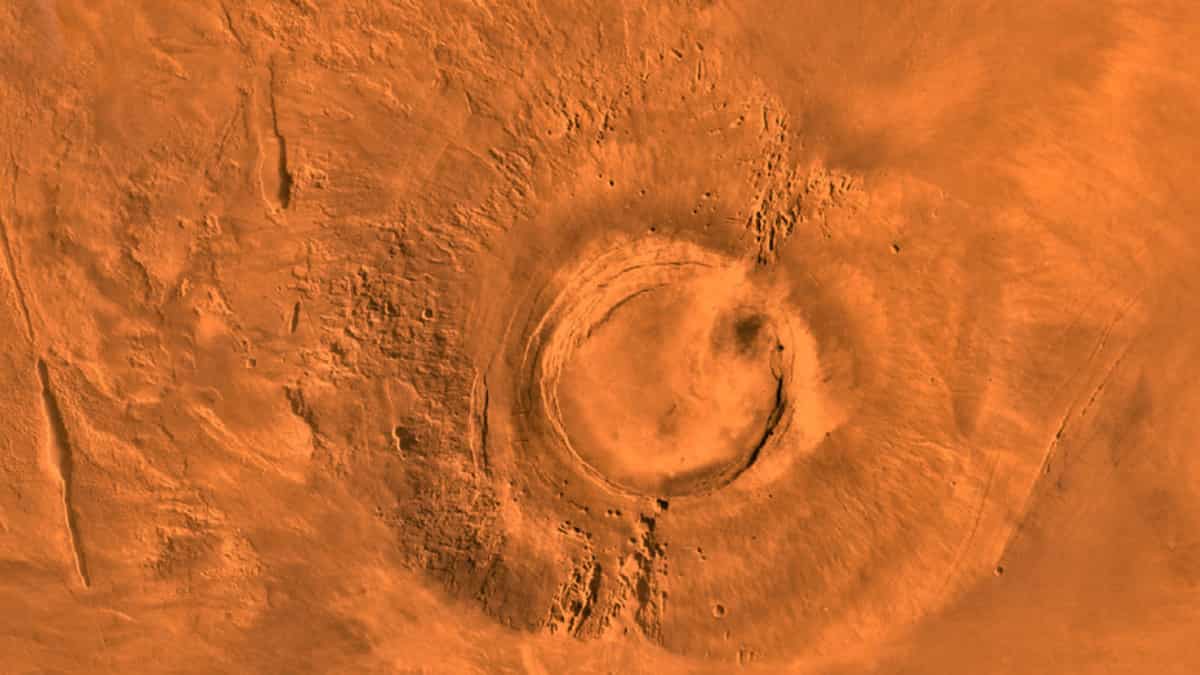
Representational image of volcano on martian surface.
In a new survey of the surface of Mars carried out by scientists, it was found that the volcanoes which littered the red planet are likely to resemble the rumblings which were on Earth before the formation of tectonic plates around 3 billion years ago.
Scientists believe that the surprisingly violent history of Mars is likely to reveal some clues regarding the past of the Earth.
The scars of volcanic activity, which were found in the Eridania region of the planet's southern hemisphere, were catalogued by planetary scientist Joseph Michalski of the University of Hong Kong and his colleagues with the use of remote sensing data from different orbiters.
Also Read:Alien life existed near ancient mile-deep lake, active volcanoes on Mars? Scientists suggest so
At present, the Earth has a crust of interlocking continental plates which float above its viscous mantle and Mars is usually considered as a one-plate planet which once had active volcanoes. These volcanoes were massive in size and explosive in nature and Olympus was the largest among them – its volume being 100 times greater than Earth's biggest Mauna Loa in Hawaii.
Why were volcanoes on Mars so large in size?
The volcanoes on planet Mars were so large because the planet had less number of tectonic plates which help in venting the pressures of a churning mantle. Mars' geological history has not been recycled like that of our planet and can contain inklings of how Earth's crust may have been formed.
"The planet Mars represents a particularly valuable puzzle piece in this regard," wrote Michalski and his colleagues in their published paper.
"Though the crust is heavily impact cratered, the ancient geologic record remains largely intact and therefore provides an invaluable window into early Solar System geological conditions and clues to early crustal evolution,” the researchers explained.
According to the researchers, they may be able to find hundreds more volcanoes in the Eridania region, many of which may have probably erupted beneath an ancient sea. This is likely to provide a good parallel to what happened on Earth during the Archean period when the planet was mostly constituted of water and the earliest forms of life came into existence.
Watch:Elon Musk reveals 'Game Plan' to relocate millions people on Mars
"It's just astonishing to think about the scale of activity in this region," said study author and planetary geologist at the Planetary Science Institute Aster Cowart, while speaking to Space.com.
"Seeing a Martian landscape shaped by these processes and preserved in stasis provides us with a great opportunity to investigate planetary landscape evolution in more detail,” he added.
(With inputs from agencies)