Scientists uncover oldest evidence of 'slingshot' tongue

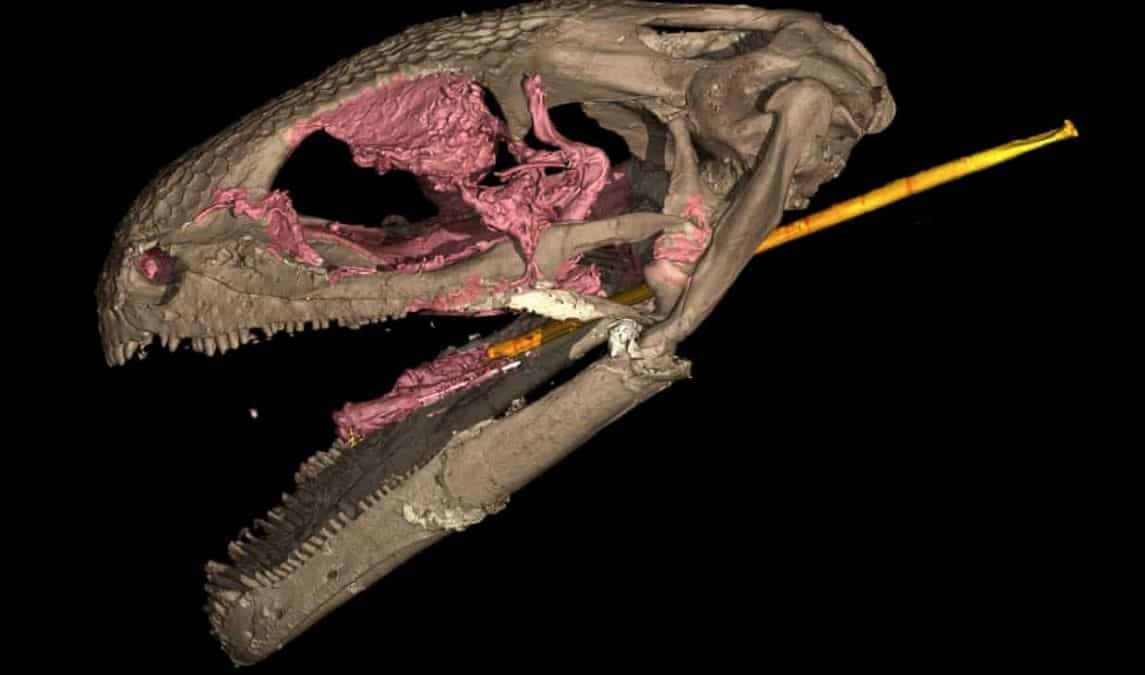
CT scan of albanerpetontids
Scientists have uncovered theoldest evidence of a 'slingshot' tongue in99 million-year-old amphibians.
Albanerpetontids, known for their ''ballistic tongues'', are predatorsare an extinct clade of Middle Jurassic-Pliocene and primarily Laurasian amphibians.
Researchers at the Florida Museum of Natural History believe that their findings,published in the journal Science, redefine how tiny animals are fed.
Albanerpetontids are characterised by numerous osteological features, including fused frontals; an interdigitating intermandibular joint; nonpedicellate marginal teeth tipped with tricuspid, chisel-shaped crowns; and modified "cervical" vertebrae that superficially resemble the atlas-axis complex in mammals.
“This discovery adds a super-cool piece to the puzzle of this obscure group of weird little animals. Knowing they had this ballistic tongue gives us a whole new understanding of this entire lineage,” saidEdward Stanley, a co-author of the study and the director of the Florida Museum of Natural History’s digital discovery and dissemination laboratory.
Amphibians have three distinct lineages:frogs, salamanders, and limbless caecilians.
Researchers believe albanerpetontids, which date back to 165 million years may be the fourthlineage of amphibians.
According toSusan Evans, another co-author of the study and a professor of vertebrate morphology and palaeontology at University College London,“If the earliest albanerpetontids also had ballistic tongues, the feature has been around for longer than the earliest chameleons, which likely date back to 120m years ago.”
Fossils of albanerpetontids have been known since the mid-19th centuryand for over a century were interpreted as belonging to salamanders.
Albanerpetontids are of interest in their own right because they were a moderately successful clade that contained at least three genera and a dozen species, with a known temporal range of about 160 million years and a geographic distribution that encompassed Europe, North America, Asia, and Africa.