Scientists discover world's largest bacterium in Caribbean swamp

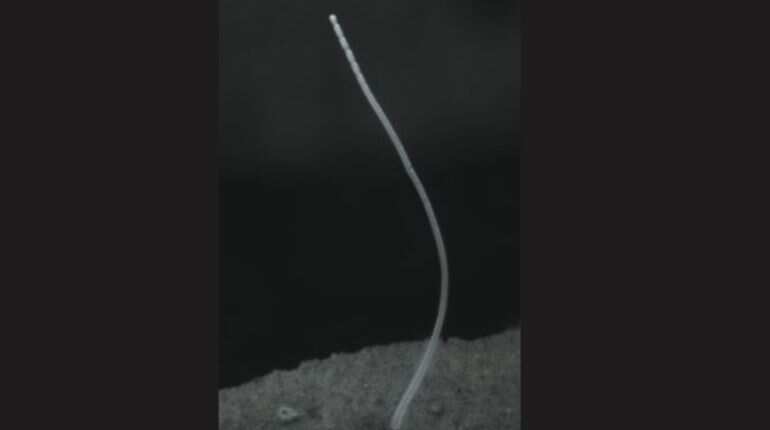
Thiomargarita magnifica (Photo Courtesy: Jean-Marie Volland)
Scientists have unearthed the world's largest bacterium in a Caribbean mangrove.
The bacteria is big enough to be viewed by the naked eye. The research which appeared in Science journal said Thiomargarita magnifica "although thin and tubular stretched more than a centimetre in length".It can reportedly grow up to 2 centimetres.
The bacterium has an average cell length greater than 9000 micrometres, researchers found.
The study informed that cells of most bacterial species are around 2 micrometres in length with some of the largest specimens reaching 750 micrometres.
Watch:Methane-consuming bacteria can generate power
Scientists are still unclear how the bacterium ended up being so large although researchers believe it adapted to avoid being eaten by smaller organisms.
The Thiomargarita magnifica was first discovered on mangrove leaves in Guadeloupe.
Jean-Marie Volland, a scientist with joint appointments at the USDepartment of Energy (DOE) said: "It’s 5,000 times bigger than most bacteria. To put it into context, it would be like a human encountering another human as tall as Mount Everest.”
On its rather exotic name, Silvina Gonzalez-Rizzo, an associate professor of molecular biology, said: “Magnifica because magnus in Latin means big and I think it’s gorgeous like the French word magnifique.”
(With inputs from Agencies)
WATCH WION LIVE HERE
You can now write for wionews.com and be a part of the community. Share your stories and opinions with us here.