Scientists discover building blocks of life and minerals in asteroid Bennu’s particles. This means...

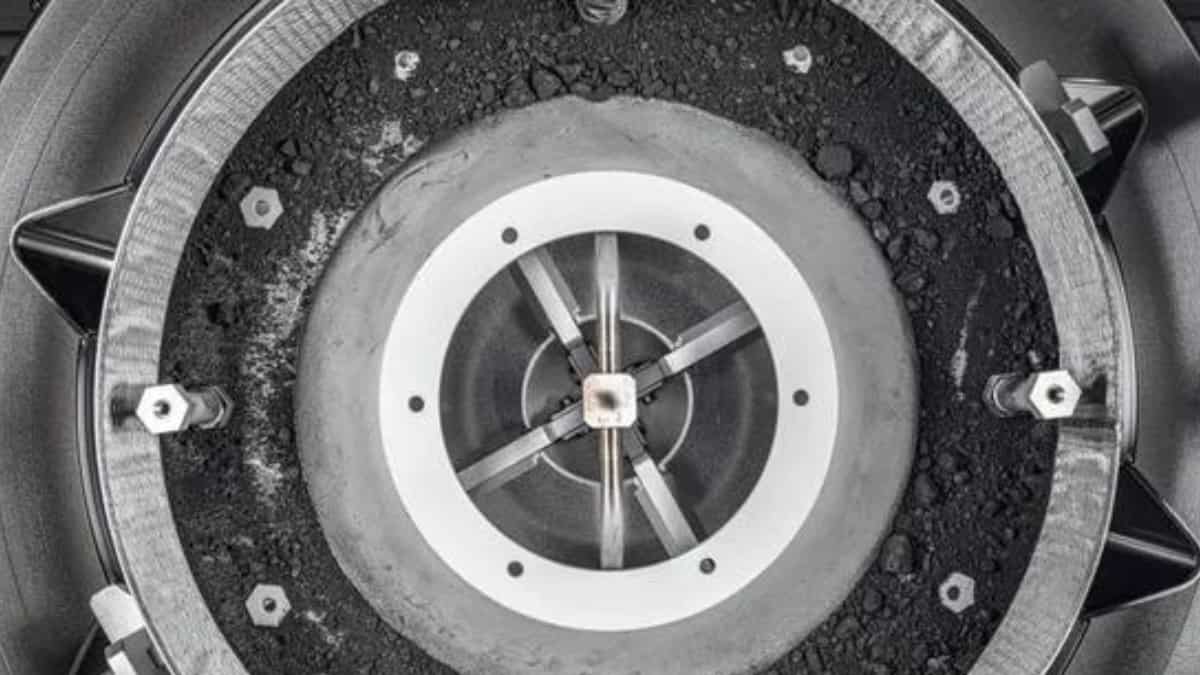
The close-up image of NASA's OSIRIS-REx sample trays which contain dust and rubble.
The scientists, four years after collecting the sample from asteroid Bennu with the help of NASA's OSIRIS-Rex spacecraft, finally found the space rock's intriguing composition.
Scientists have found that the near-Earth asteroid has a surprising reservoir of a mineral, which is known as magnesium phosphate.
As per the scientists, the bright-white particles, which were sprinkled in a sea of the asteroid's dark rocks are a rare discovery in astromaterials.
"It's no surprise that we initially thought this might be a contaminant," saidJessica Barnes, who is an assistant professor at the Lunar and Planetary Laboratory (LPL) and has been leading the sample's phosphate analysis, as reported by Live Science.
Barnes, while speaking at the Lunar and Planetary Science Conference (LPSC) in Texas, said that no good chemical analogues of the mineral are present on Earth, either because it vanishes soon or since they have rarely survived on the Earth after the fall.
Here's what analysis tells aboutparent body of asteroid Bennu
The presence of minerals in Bennu's sample can be used for inferring different episodes of geologic activity on the parent body of asteroid Bennu.
The scientists, in the sample, also found the widespread presence of glycine, which is the simplest amino acid and an important ingredient ofproteins, along with other water-bearing minerals which include magnetite, sulfites, olivine and carbonates, which are tangible evidence to prove that the parent body of Bennu witnessed multiple water-related episodes before its fragments intermingled into Bennu.
While studying the extraterrestrial bounty, other scientists also discovered abundant water-altered compounds known as phyllosilicates, along with a rich collection of other hydrated and organic minerals.
Watch:Gravitas: Asteroid flew past Earth in near miss
NASA's OSIRIS-REx mission scooped the sample from asteroid Bennu in 2020 and it came back to Earth in a protected capsule on September 24, 2023.
After a day, the sample was sent to NASA's Johnson Space Center (JSC) in Houston for analysis, where a "tiger team" of scientists started the material's preliminary investigation, which had leaked outside the sample collector of the spacecraft.
It was also reported by the mission team that the stones catalogued had different types of textures and hydrated minerals and proof for space weathering, which is expected from an airless, eons-old rock.
Natural History Museum in London's planetary scientist Sara Russell, after studying a small fragment of the sample, said, "It's a beautiful sample. Also, I would say it's not quite like any meteorite in our collection."
(With inputs from agencies)