Scientists carry out breakthrough investigation, reveal what's inside the moon

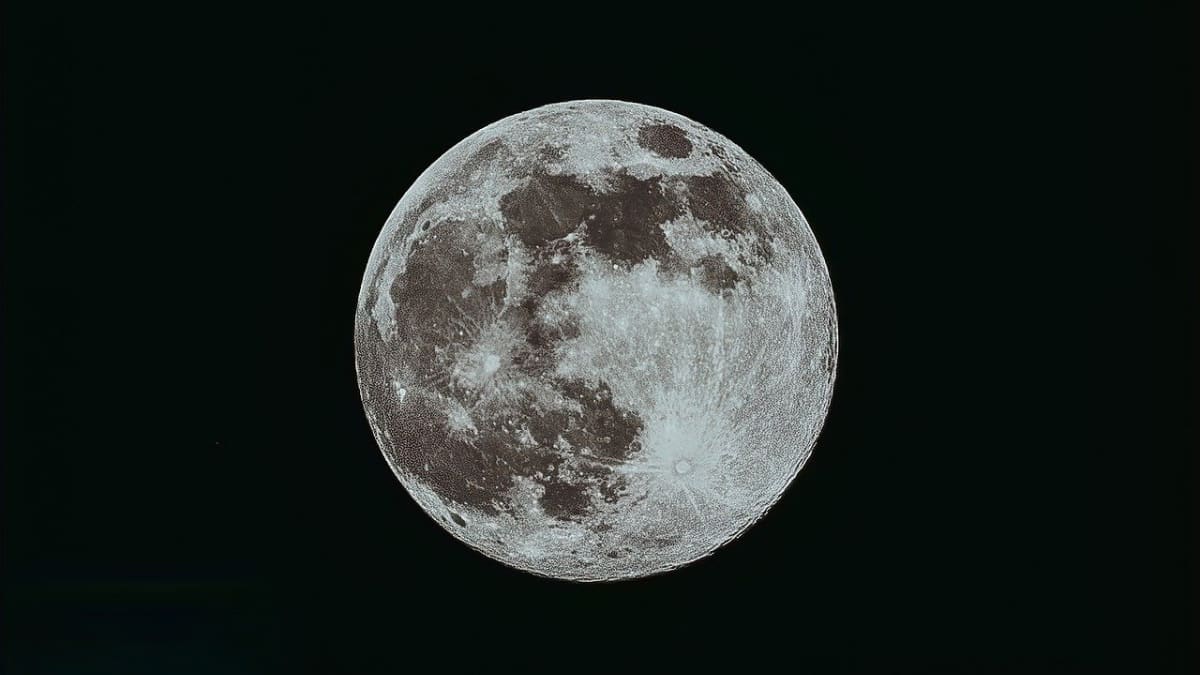
In a breakthrough investigation carried out in May, the scientists discovered that the inner core of the moon is a solid ball and has a density similar to that of iron. With this discovery, the researchers hope to finally settle the long debate about whether the inner heart of the moon is molten or solid which will lead to a more accurate understanding of the history of the moon and also of the solar system.
"Our results," said a team headed by astronomer Arthur Briaud of the French National Centre for Scientific Research in France, "question the evolution of the moon's magnetic field thanks to its demonstration of the existence of the inner core and support a global mantle overturn scenario that brings substantial insights on the timeline of the lunar bombardment in the first billion years of the Solar System."
Investigating the interior composition of the celestial objects in the solar system is accomplished most effectively through seismic data. The generation of acoustic waves by earthquakes and the way they reflect the material inside the moon or any planet help scientists create a detailed map of the interior of the object.
Denser material falls towards the centre of moon: Study
The lunar seismic data was collected by the Apollo mission, however, its resolution is too low to determine the state of the inner core. It was known that there is a fluid core but what it encompasses remained a part of the debate. The solid inner core's models and the entirely fluid core work equally well with the data of Apollo.
To understand what is inside the core, data was collected by Briaud and his colleagues from space missions and lunar laser ranging experiments were carried out to compile a profile of different lunar characteristics. These were the degree of its deformation through its gravitational interaction with Earth, the difference in its distance from Earth, and its density.
WATCH |Chandrayaan-3: First-ever recording of Moon-quakes | WION Fineprint
The scientists then conducted modelling with different core types to figure out which most closely matched the observational data. Several interesting findings were made by the researchers. The researchers figured out that denser material falls towards the centre inside the moon and less dense material rises upwards.
The activity has been proposed as a way of explaining the existence of certain elements in the moon's volcanic regions. The research of the team added another point to the "for" tally of evidence.
You cannow write forwionews.comand be a part of the community. Share your stories and opinions with ushere.
WATCH WION LIVE HERE