Scientists believe an Earth-like planet might be hiding in our solar system

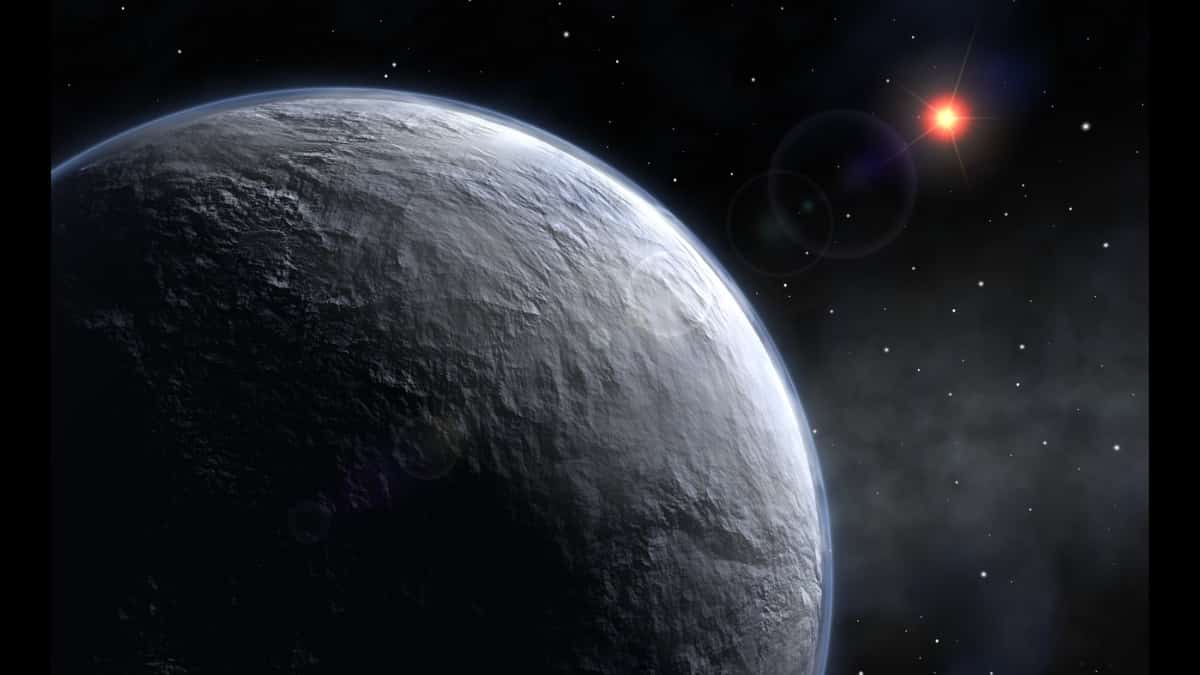
Icy exoplanet
Amid the ongoing debate about the existence of a so-called ‘Planet Nine’ which scientists believe has been lurking around in the murky depths of our solar system for years now, two scientists from Japan have a new theory that suggests the existence of a more modestly sized, Earth-like planet closer than the disputed Planet Nine.
Argument around existence of ‘Planet Nine’
Scientists have been debating about the presence of the so-called Planet Nine, the supposedly massive terrestrial planet for some time now, after Pluto was unceremoniously stripped of its planetary status and declared a dwarf planet.
So far, the most distant single object ever to be found in our solar system is some 132 astronomical units from the Sun, to put this into perspective, Pluto is at an average distance of about 40 astronomical units from the Sun.
About the new theory
Planetary scientists Patryk Sofia Lykawka of Kindai University in Japan and Takashi Ito of the National Astronomical Observatory of Japan, in a recent paper, published in The Astronomical Journal, have put forth an alternative explanation.
They suggest that there might be a more modestly sized, Earth-like planet revolving around the Sun, closer to the debated Planet Nine, on a tilted orbit.
Trans-Neptunian objects (TNOs) found beyond the orbit of Neptune, which scientists have recently taken note of due to their peculiar clustering behaviour have led them to suggest the presence of a hidden world and the idea of a 9th planet lurking beyond our range of visibility.
“We predict the existence of an Earth-like planet and several trans-Neptunian objects on peculiar orbits in the outer solar system, which can serve as observationally testable signatures of the putative planet’s perturbations,” the duo wrote.
This comes as scientists have found a number of TNOs including icy rocks and dwarf planets beyond Neptune which are some 30 astronomical units from the Sun, which extend as far as we can see. This is the Kuiper belt and the objects it contains are called TNOs.
Lykawka and Ito said that they have found the properties of a hypothetical planet that could explain “three fundamental properties of the distant Kuiper Belt: a prominent population of TNOs with orbits beyond Neptune’s gravitational influence, a significant population of high-inclination objects, and the existence of some extreme objects with peculiar orbits.”
The two scientists suggested that the mass of this possible Earth-like planet would be between 1.5 and three times that of Earth. The most distant point from the Sun in this planet’s orbit would be between 250 and 500 astronomical units and an inclination of 30 degrees respective to the plane of the solar system.
WATCH WION LIVE HERE
You can now write for wionews.com and be a part of the community. Share your stories and opinions with us here.