Russian Soyuz spacecraft lifts off with three astronauts to ISS

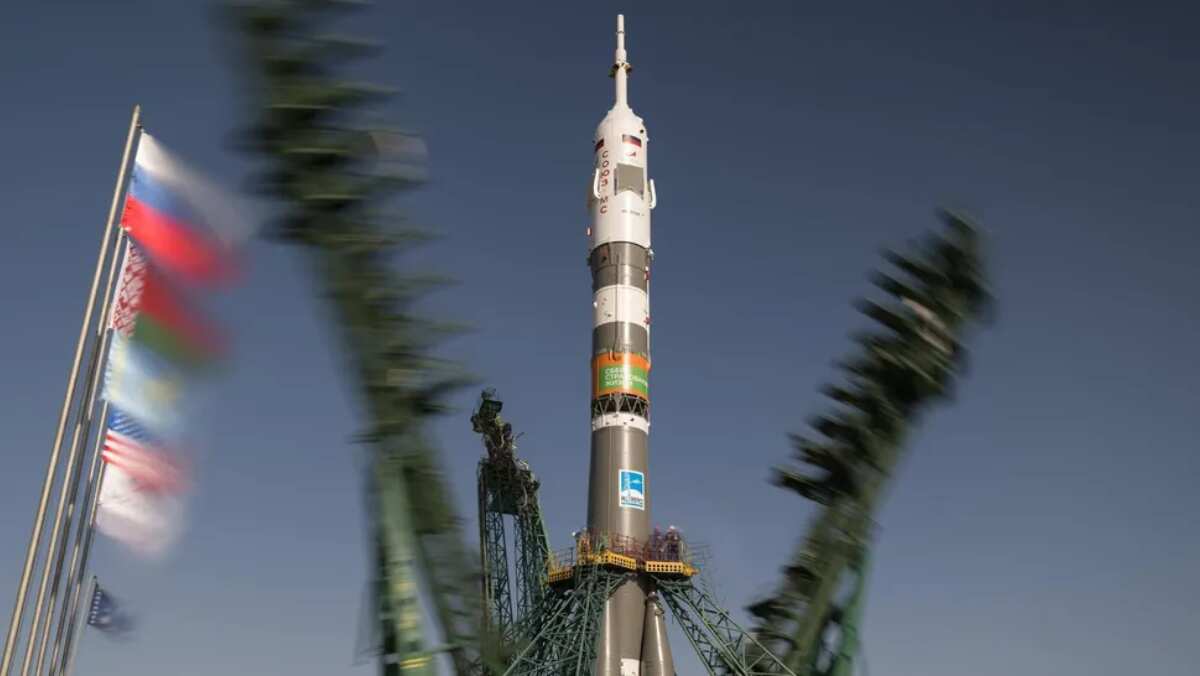
Russian Soyuz spacecraft
A highly anticipated lift-off of a Russian Soyuz spacecraft was successful as it launchedthree astronauts — one male and two females — to the International Space Station (ISS) on Saturday (Mar 22). This comes after the lift-off was dramatically halted just seconds before its scheduled departure on Thursday (Mar 21).
The spacecraft carried NASA astronaut Tracy Dyson, Marina Vasilevskaya of Belarus, and Russian Oleg Novitsky. The launch took place from the Baikonur launch facility in Kazakhstan.
Following eight minutes, the space capsule detached from the rocket and entered its orbit. This initiated a two-day, 34-orbit journey towards the ISS. The docking procedure with the ISS is now scheduled to take place at 1510 GMT on Monday (Mar 25).
Earlier, on March 21, the mission control amidst the anticipation, announced "Launch!" in Russian. However, soon after, an unexpected message of "automatic cancellation of the launch" echoed through the live stream. The crew, comprising a Russian, an American, and a Belarusian were safely evacuated.
The sudden termination was attributed to a rare occurrence - a fluctuation in the current of a chemical power source, as disclosed by Roscosmos, the Russian space agency.
Space chief Yuri Borisov, had stated, "Colleagues, space is like this and the situation is quite understandable." Now, the mission is scheduled for a launch attempt on Saturday (Mar 23).
The mission is aimed to contribute to vital research for future space exploration endeavours.
The Soyuz spacecraft carries a crew of three astronauts. It has been used extensively for missions to the International Space Station (ISS), ferrying astronauts and cosmonauts to and from the orbiting laboratory.
The inaugural Soyuz flight took place on November 28, 1966.
However, tragedy struck during the first crewed Soyuz mission, Soyuz 1, which launched on April 23, 1967.
Watch |Terror attack in Moscow: ISIS claims Moscow attack
Unfortunately, the mission ended in disaster due to a parachute failure and cosmonaut Vladimir Komarovwas killed.
Launched atop a Soyuz rocket from the Baikonur Cosmodrome in Kazakhstan, the Soyuz spacecraft was the sole method for transporting crews to and from the International Space Station (ISS) between the retirement of the Space Shuttle in 2011 and the demonstration flight of SpaceX Crew Dragon in 2020.
Throughout this period, the Soyuz was extensively used for ISS crew transportation. Although China conducted crewed Shenzhou flights during this timeframe, none of them included docking manoeuvres with the ISS.
(With inputs from agencies)