Pluto may not be a real planet, but it has got a hidden ocean

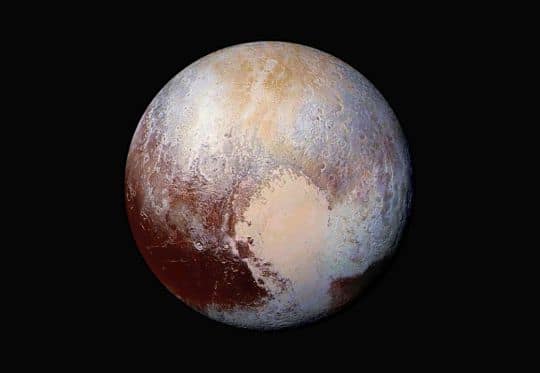
Pluto
Pluto's secrets are being unraveled! Astronomers have found convincing evidence of a massive ocean of liquid water hidden beneath the dwarf planet's icy surface.
This exciting discovery, published in Icarus, offers new insights into the makeup of this distant world.
What lies beneath the ice in the ocean?
This new research was led by Alex Nguyen, a graduate student in Earth, environmental and planetary sciences at Washington University in St. Louis.
Nguyen and his team used mathematical models and images from NASA’s New Horizons spacecraft to investigate Pluto’s subsurface ocean.
The research co-authored by Patrick McGovern of the Lunar and Planetary Institute in Houston,sheds light on a long-standing debate about the possibility of liquid water on Pluto.
Pluto is not just a frozen rock
Clyde Tombaugh discovered Pluto in 1930. Initially recognised as the ninth planet in our solar system, the International Astronomical Union (IAU) reclassified it as a dwarf planet in 2006.
Pluto orbits the Sun at an average distance of 5.9 billion kilometers, taking approximately 248 Earth years to complete one orbit. It is smaller than Earth's moon, with a diameter of about 2,372 kilometers.
Composition and moons
Pluto mainly consists of rock and ice. Its surface features a variety of landscapes, including mountains, valleys, plains, and an ocean that we’ll learn more about soon. The dwarf planet has a thin atmosphere composed primarily of nitrogen, methane, and carbon monoxide.
Pluto has five moons: Charon, Nix, Hydra, Kerberos, and Styx. Charon, the largest of these moons, is nearly half the size of Pluto itself.
Scientists believed that Pluto’s extremely cold surface temperature of -220°C, which causes even gases like nitrogen and methane to freeze solid, would make the existence of liquid water impossible.
“Pluto because of its smaller size, could have lost almost all of its heat shortly after it was formed, so basic calculations would suggest that it’s frozen solid to its core.”
Despite Pluto's frigid surface, recent discoveries like cryovolcanoes erupting with ice and water vapor are fueling the theory of a hidden ocean. Prominent scientists, including William B. McKinnon of WUSTL, now widely agree that Pluto likely conceals a vast liquid water ocean beneath its icy shell.
Pluto’s subsurface secrets
Nguyen and McGovern’s study dig deeper into the properties of Pluto’s hidden ocean. They created mathematical models to explain the cracks and bulges in the ice covering the Sputnik Platina Basin.
This colossal basin, sculpted by a huge meteor impact billions of years ago, hints at the ocean below. The team's models suggest this ocean is shielded by a 40-to-80-kilometer-thick (25-to-50-mile-thick) shell of water ice. By analysing surface fractures, they were even able to estimate the ocean's potential density or salinity.
“We estimated a sort of Goldilocks zone where the density and shell thickness is just right,” Nguyen explains.
The findings recommend that Pluto’s ocean is, at most, about 8% denser than Earth’s seawater, comparable to Utah’s Great Salt Lake. If humans could somehow reach Pluto’s ocean, they would effortlessly float.
However the space agencies have no such immediate plans to revisit Pluto, but these findings lay the groundwork for future exploration and research.
The discovery of a liquid water ocean beneath Pluto’s icy surface challenges our understanding of this distant world and opens up new avenues for planetary exploration.
A hidden ocean of liquid water beneath Pluto's icy challenges our current understanding of this distant world, demanding a reevaluation of its internal makeup and processes.
(With inputs from agencies)