‘One must shout to have conversation’: NASA finds sound travels slower on Mars than Earth

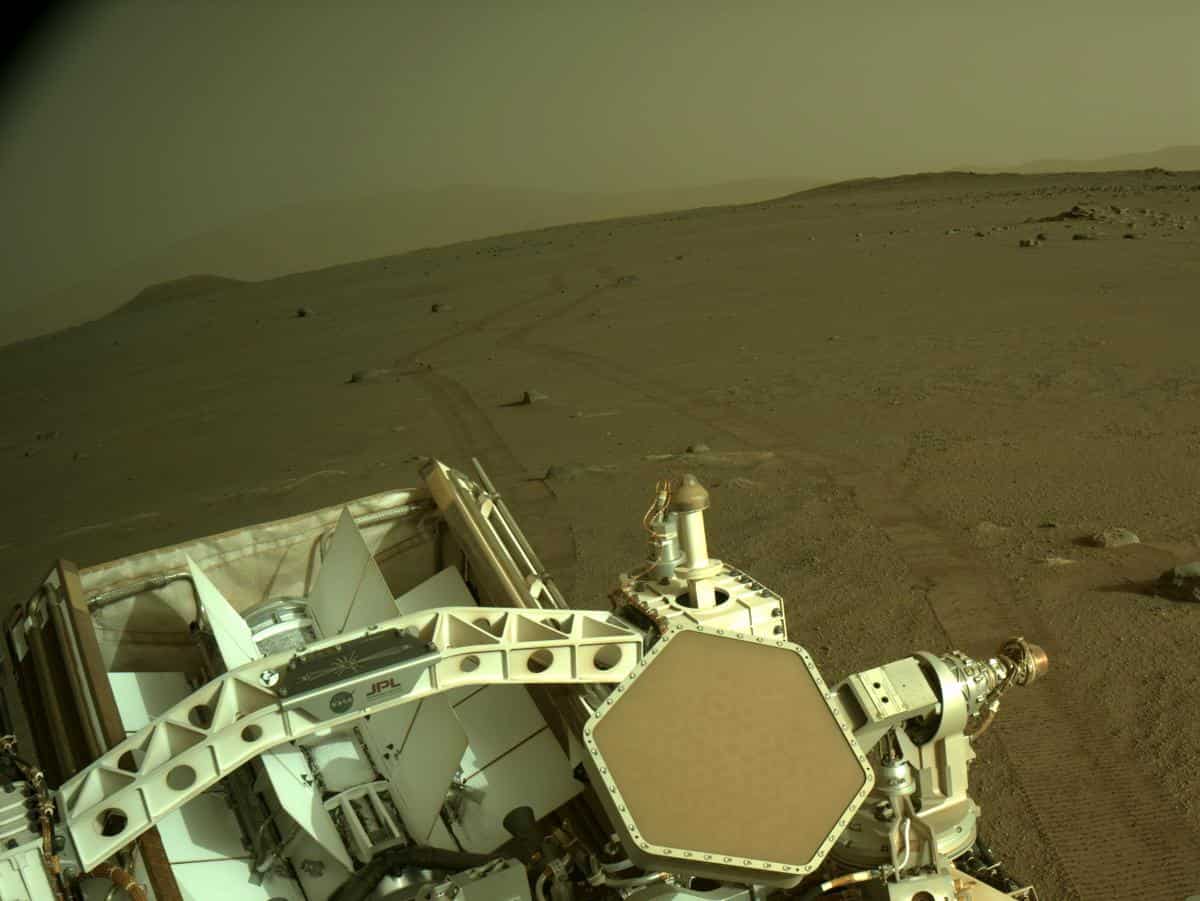
(image credit: NASA) Perseverance rover on Mars
NASA has found that the speed of sound on Mars is a lot slower than on Earth and a “deep silence prevails” over the red planet.
The scientists came to the conclusion after calculating the speed of sound on Mars dating back to February 19, 2021, the day after NASA's Perseverance rover landed on the planet.
They found out that sound travels 100 meters per second slower on Mars compared to Earth.
Moreover, the researchers discovered that there are two speeds of sound on Mars — one for high-pitched sounds and one for low-pitched sounds.
On Earth, sounds usually travel at 767 mph (343 meters per second). But on Mars, low-pitched sounds travel at about 537 mph (240 meters per second), while higher-pitched sounds move at 559 mph (250 meters per second), NASA said.
“This would make it difficult for two people standing only five meters apart to have a conversation," according to a press release on the findings.
This peculiar sound environment is due to the incredibly low atmospheric surface pressure on Mars, which is 170 times lower than Earth's pressure, the study published in Nature on Friday said.
For example, if a high-pitched sound travels 213 feet on Earth, it will travel just 26 feet on Mars.
While sounds on Mars can be heard by human ears, they are incredibly soft.
"At some point, we thought the microphone was broken, it was so quiet," said Sylvestre Maurice, an astrophysicist at the University of Toulouse in France and lead author of the study, according to NASA.
Besides the wind, “natural sound sources are rare,” the press release said.
But NASA scientists believe that Mars may become more noisy in the autumn months, when there is higher atmospheric pressure.
"We are entering a high-pressure season," co-author of the study Baptiste Chide said in the press release. "Maybe the acoustic environment on Mars will be less quiet than it was when we landed."