Once known as world's largest iceberg, A68 has now completely melted

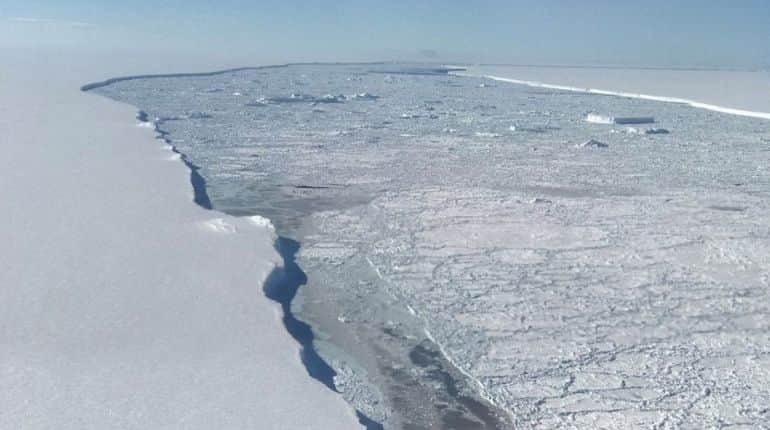
In this image released by NASA on their NASA ICE Twitter page, the edge of Larsen C Ice Shelf (L) is seen with the western edge of iceberg A68 in the distance over the Antarctic on November 1, 2017
The world’s largest iceberg - A68 has finally succumbed to melting. A68 became famous as one of the most well-documented icebergs in history. Now, it has melted into the Atlantic Ocean.
A68 broke off from the Larsen C Ice Shelf in 2017 and measuredupto 6,000 square kilometres. For a few years, the iceberg stayed put at its place, but soon began to float away from Antarctica as summer set in 2018.
Since then, the iceberg hadundergone quite the journey - moving from South Atlantic to the South Georgia Island where it was met with warmer temperatures. This effectively broke the iceberg into multiple smaller parts.
Since then, those pieces have become too small to be tracked, as stated by the US National Ice Center.
Satellite imagery facilitated the scientists in studying the iceberg whose first crack was caught by researchers. They also kept a note of water temperatures around the iceberg as it steadily moved.
Long ago, the A68 was enormous, almost the size of Prince Edward Island and the US state of Delaware.
While intact, it was largely seen as the world’s largest iceberg. It was momentarily upped by the B15 iceberg which boasted an area of 11,000 square kilometres after breaking off from the Ross Ice Shelf 2000.
Since then, B15 has also scattered into smaller pieces of ice.