Newly identified ‘heavily armoured’ crocodile ancestor walked the Earth before dinosaurs

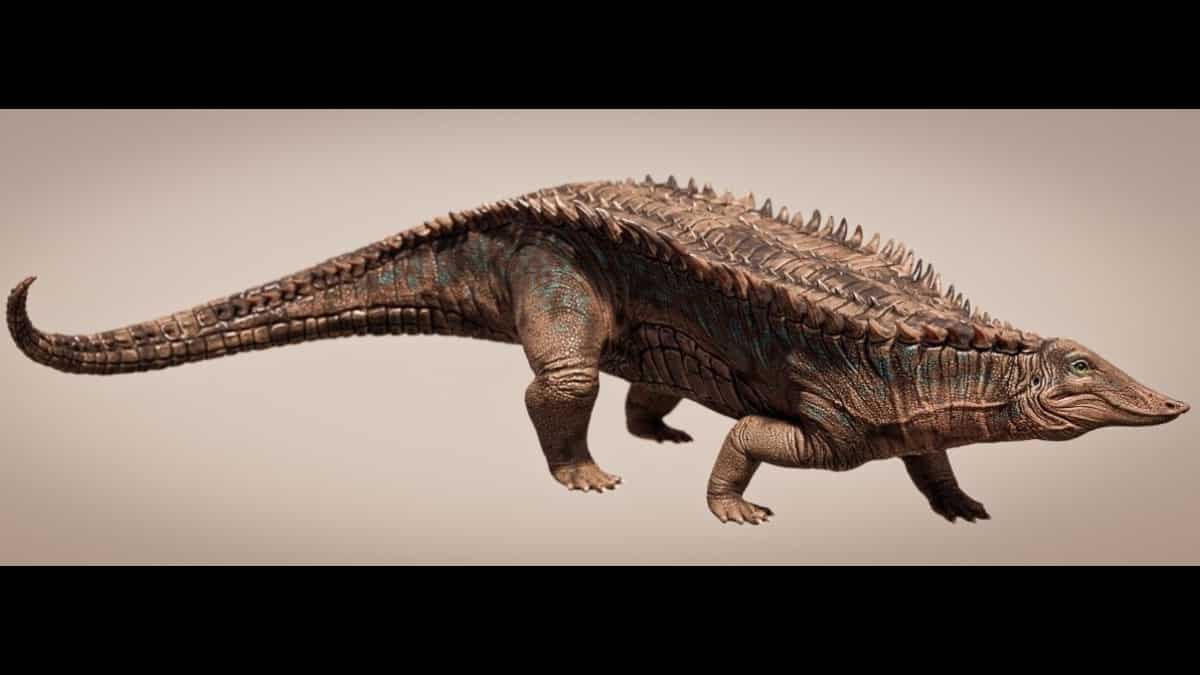
Newly identified ‘heavily armoured’ crocodile ancestor
A new study led by researchers at the University of Texas, Austin recently identified aetosaurs, a heavily armoured cousin of modern crocodiles who walked the Earth before dinosaurs did before going extinct around 200 million years ago.
About the newly identified aetosaurs
Aetosaurs, according to the study published in The Anatomical Record, came in various shapes and sizes. Today, their fossils are found on every continent except Antarctica and Australia.
The newly identified aetosaur species – likely omnivorous ancestors of the carnivore modern crocodiles – is named Garzapelta muelleri by the researchers.
The name “Garza” comes from Garza County in northwest Texas, where the fossil was found, and “pelta” is Latin for shield, while the species name “muelleri” honours the palaeontologist who originally discovered it, Bill Mueller.
The study published, earlier this year, centres around the suit of armour – called a carapace. Scientists typically use bony plates – also known as osteoderms – that make up aetosaur armour to identify the different species but typically don’t find many fossil skeletons to work with.
However, in this case, the scientists found 70 per cent of the fossil which covered each major region of the body.
“We have elements from the back of the neck and shoulder region all the way to the tip of the tail,” said William Reyes a doctoral student at the UT’s Jackson School of Geoscience who led the research, in a statement.
The Garzapelta lived around 215 million years ago and had a lot more armour. “Take a crocodile from modern day, and turn it into an armadillo,” Reyes said.
What did the researchers find?
The osteoderms would be embedded directly into the skin and fitted together like a mosaic. However, their bony exterior was not the only protection they had against predators as Garzapelta’s sides were flanked by curved spikes.
The researchers noted that spikes on Garzapelta were not unique and similar ones were found on another aetosaur species but surprisingly the two were only distantly related.
According to Reyes, there are a number of distinct features that marked Garzapelta as a new species from how the plates fit together to unique bumps and ridges on the bones.
However, it was only after the researchers determined that the spikes evolved independently that they were able to ascertain that Garzapelta would best fit among other aetosaur species.
Notably, the fossil had been sitting on a shelf for around 30 years or so before Reyes encountered it during a visit to the Texas Tech University fossil collections.
(With inputs from agencies)