Rocket from Mars to Earth? NASA's 'amusement park' approach to return red planet samples

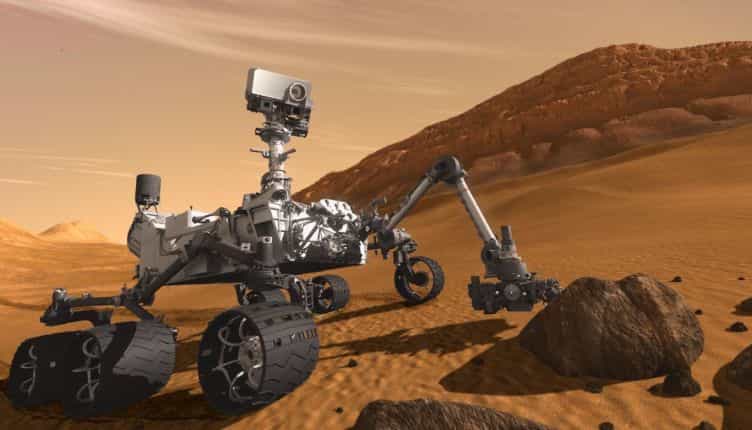
Curiosity rover
We all know that NASA Curiosity rover is carefully trudging the surface of the Red Planet making observations and collecting samples. What good is a sample if it can't be analysed to see if it reveals some fascinating new thing about our neighbouring planet? But for this analysis, the sample must be brought to Earth. And NASA is going for an 'amusement park' approach to get the precious cargo back to Earth.
Enter NASA's 'Mars Sample Return Mission' which it will carry out with the European Space Agency (ESA).
The mission will be launched to bring Martian samples back to Earth. But it will not be as easy as firing a rocket from here and just picking up sample to bring it back home. It will be a multi-step process.
The Mars Sample Return Mission will be historic as it will involvelifting off of a rocket from another planet for the first time in history of our space-faring endeavours!
So here's how things will unfold.
A spacecraft named 'Sample Retrieval Lander' (SRL) will lift off from Earth and travel all the way to Mars. It will make a careful landing on the planet's surface. The SRL will carry with it another rocket named Mars Ascent Vehicle (MAV).
Watch | Scientists surprised by source of largest quake detected on Mars
After landing on Mars, the Martian samples collected by Curiosity rover will be loaded onto MAV, which will then get ready for a launch.
So what's the 'amusement park' bit?
Since we have never carried out a lift-off from the surface of another planet, we do not know 100 per cent what will happen during a lift-off from Mars. But scientists certainly have an idea about the obstacles in this path.
Unlike Earth, Mars does not have a launchpad which provides flat surface for a rocket to lift off. And when a rocket lifts off, it exerts crazy amount of force on the ground beneath it. Launchpads on Earth are designed to withstand this unimaginable force.
But loose Martian soil is unlikely to withstand the giant force and may cave in during the lift-off of a rocket from its surface. The fuel blast may also hurl up rocks which may damage the rocket before it gets a chance to lift off.
It is because of this the Mars Ascent Vehicle (MAV), after it is loaded with Martian samples, will be 'tossed' up in Martian air by the Sample Retrieval Lander (SRL). When the MAV is in the air and before it crashes back to the ground due to Mars' gravity, it will fire its thrusters and set off for the Martian sky! The manoeuvre is sure to be tricky.
In amusement parks, we have come across attractions that toss us up in the sky and make us question our life choices, even when the safety wires bring you down, albeit almost at the speed of a free-fall.
Also Read | Will 'Devil Comet' hurtling towards Earth bring devastation? Here's what scientists suggest
The manoeuvre of the MAV is similar, it's just that it will not come back down towards the surface, but will fire engines and lift-off.
When it reaches the Martian orbit, it will hand over the sample to the Earth Return Orbiter (ERO) which would already be orbiting Mars. The ERO will then hed towards Earth, with the precious samples collected on the surface of the Red Planet.
You can now write for wionews.com and be a part of the community. Share your stories and opinions with us here.
WATCH WION LIVE HERE