NASA spots eerie holes in clouds above Florida. Are they a paranormal phenomenon or...

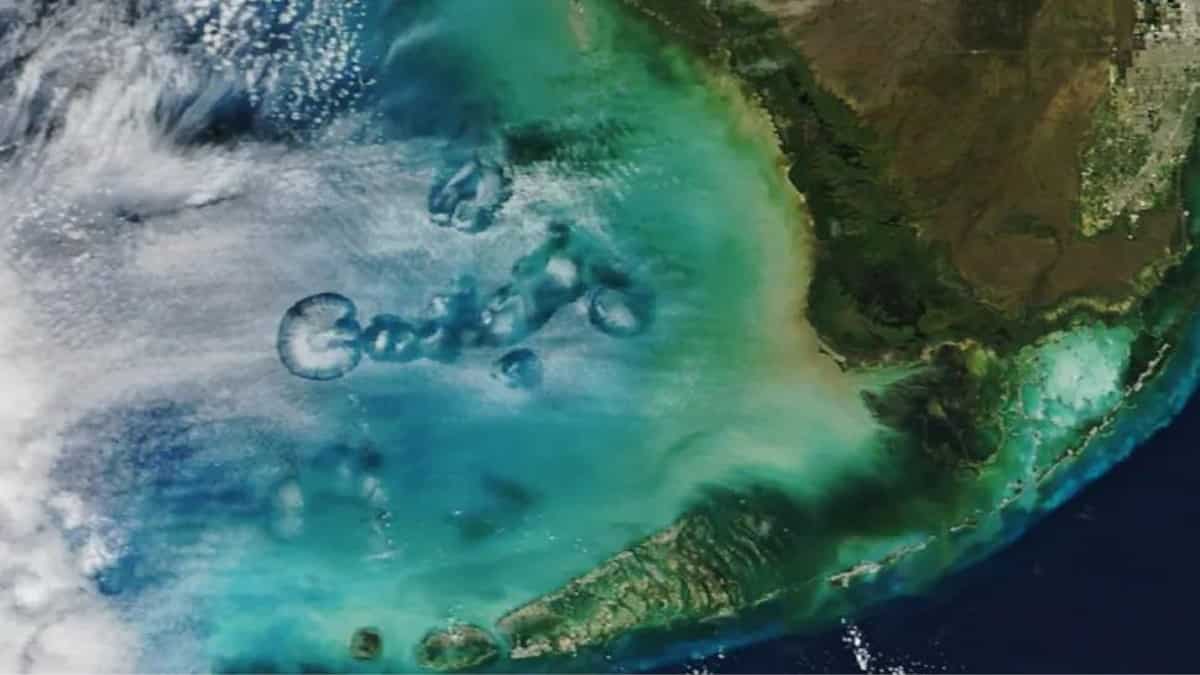
The strange, circular holes were captured by NASA's Terra satellite above the Gulf of Mexico.
NASA's Terra satellite recently captured a strange image of the sky above the Gulf of Mexico and just off the coast of Florida, which revealed some odd, eerie holes in the clouds.
This is not the first time that such holes have been spotted. In fact, for more than 60 years, these holes have been puzzling the scientists, some even linking it to paranormal phenomena. However, now scientists have decoded the mystery behind these clouds.
In the photo, which was captured by the Moderate Resolution Imaging Spectroradiometer (MODIS) using NASA's Terra satellite last month, a cluster of ellipse-shaped figures or circles appeared which looked like they had been neatly cut out from the clouds. As per NASA, they even depicted "feathery wisps" in the middle of the hole.
What are these holes and what causes them?
These holes are called cavum clouds, hole-punch clouds or fallstreak holes. Such holes are caused by aeroplanes which travel through banks of altocumulus clouds, as per NASA, which cited a study published by University Corporation for Atmospheric Research (UCAR) scientists in 2010 and 2011.
NASA claimed these mid-level clouds are filled with liquid water droplets which are "supercooled." Because of this, the droplets remain in a liquid state even when temperatures fall to the typical freezing point of water.
"Supercooling happens when water droplets are exceptionally pure and lack small particles, such as dust, fungal spores, pollen, or bacteria, around which ice crystals typically form," said NASA.
Watch:Universe's brightest and hungriest black hole
"Supercooling may sound exotic, but it occurs routinely in Earth’s atmosphere. Altocumulus clouds, which cover about 8 per cent of Earth’s surface at any given time, are mostly composed of liquid water droplets supercooled to a temperature of about (5 degrees Fahrenheit)," it added.
UCAR scientists finally found that when planes pass through clouds, they sometimes create either cavum or canal clouds. Cavum clouds are formed when planes pass at a fairly sharp angle, while canal clouds appear when planes pass at a longer, shallow angle.
(With inputs from agencies)